Steve

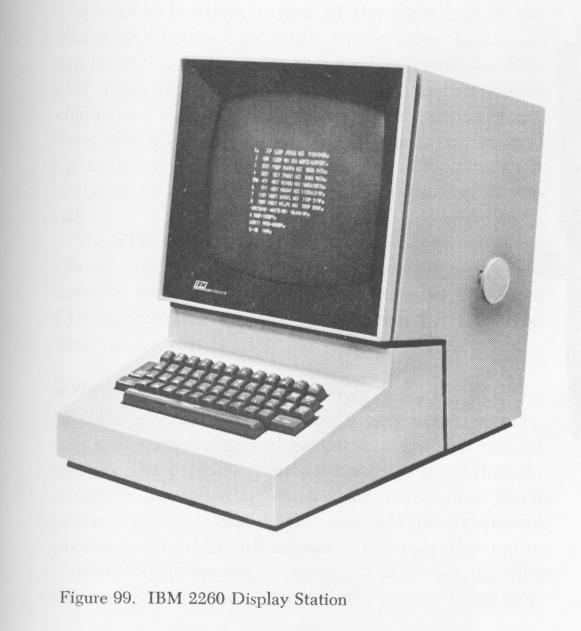
What colour were the characters? If they were green I expect it was a 3277
Model 1. If they were orange it was a 2260.
If it helps there's a picture on these two pages:

http://www.columbia.edu/acis/history/2260.html
http://www.beagle-ears.com/lars/engineer/comphist/c20-1684/fig099.jpg

This reminds me that there were 2 models of 2260 (and 2265). Scratching my
memory rather deeply[1] I believe that the smaller model had 12 rows and 40
columns while the larger model had the 12 rows and 80 columns.

I once visited a highly efficient mail order company installation which may
well have used the smaller model 2260 for - what is now called - the
"mission-critical" task of entering typically housewives' orders. They
operated a "lights-out", operator-less machine room and had a locally
modified DOS (now VSE) operating system.

Incidentally, in contrast to the displays which were of a size you might
expect for the limited number of characters, the control unit, the 2848,
which drove the characters presented on the display surface continuously,
was enormous.

Chris Mason

[1] It was the 2260 which provided the excuse for my first visit to the US,
Washington[2] initially. Strictly it was the combination of 2260 and CICS
and it was CICS that vindicated the management decision to haul me along at
the last minute - in place of the salesman - since I even made myself ill
getting CICS to work - source code fiddling was necessary, not just your
common-or-garden customization and also not the first or the last time. This
was just prior to the George McGoooovern disaster in 1972. I was also able
to add a holiday in Florida and New York - but this story's long enough
already.

[2] Well, a bit more! You know how you states-side folk distinguish the city
of Washington from the state by adding the suffix DC. The guy in charge of
that project hailed from an English county with the name Durham[3] - as do
I, in fact - and, since there is also a city Durham, the county is always
called County Durham. It was his little joke that we were going to
Washington DC rather than Washington CD, from which you can work out that
there is also a town called Washington in County Durham - whence hailed the
eminent nation-builder after whom the US city and state are named.

[3] I'm on a roll! There is, as all baseball fans know, a city by the name
of Durham in North Carolina, quite well known by all interested in IBM
networking - so I still have a tenuous connection to the topic. <g> I have
my own theory over how the city got its name. A few years ago I read a book
about the famous Sir Walter who gave his name to the state capital. The
headquarters for his activities in the "New World" was a palace on the
Strand which had been the London seat of the Bishop of Durham who was, and
still is, the 3rd prelate of the Anglican church - after the two
Archbishops. Surely this holds water as a reason to name a new town in the
Carolina colonies Durham once the name Raleigh had already been used. Well,
I though so until the town's web site told me that it was named after a Dr
Bartlett Durham around 1850, how prosaic!

----- Original Message -----
From: "Thompson, Steve (SCI TW)" <[EMAIL PROTECTED]>
Newsgroups: bit.listserv.ibm-main
To: <[email protected]>
Sent: Tuesday, 22 August, 2006 10:50 PM
Subject: Re: >27x132?


> We had some IBM terminal of some kind back in the '70s when I was in
> college (second attempt). It was 12 lines and 40 char across and we used
> ACTS to access it (Ambassador College Terminal System). I can't tell you
> how much I enjoyed BTAM and TCAM.
>
> So I was wondering if those were the MOD1 types or something else. They
> definitely used the 3270 protocols for attribute bytes and the like
> (just like I had to do with good ol' CICS 1.1.1).
>
> Later,
> Steve.T

----------------------------------------------------------------------
For IBM-MAIN subscribe / signoff / archive access instructions,
send email to [EMAIL PROTECTED] with the message: GET IBM-MAIN INFO
Search the archives at http://bama.ua.edu/archives/ibm-main.html