[
https://issues.apache.org/jira/browse/DRILL-5975?page=com.atlassian.jira.plugin.system.issuetabpanels:comment-tabpanel&focusedCommentId=16261990#comment-16261990
 ]
weijie.tong commented on DRILL-5975:
------------------------------------

I recalled we ever stress tested Drill with the following configure: one
cluster with120 nodes ,16 cores,32g memory  ,80 concurrent queries , each query
is a pushed down Druid TimeseriesQuery that means aggregated result data will
be loaded into Drill.So we only need 32g memory which is enough.  I have not
seen disk or network bottleneck. The best cpu utilization is 40% ,any more
queries will be blocked and slower.

> Resource utilization
> --------------------
>
>                 Key: DRILL-5975
>                 URL: https://issues.apache.org/jira/browse/DRILL-5975
>             Project: Apache Drill
>          Issue Type: New Feature
>    Affects Versions: 2.0.0
>            Reporter: weijie.tong
>            Assignee: weijie.tong
>
> h1. Motivation
> Now the resource utilization radio of Drill's cluster is not too good. Most
> of the cluster resource is wasted. We can not afford too much concurrent
> queries. Once the system accepted more queries with a not high cpu load, the
> query which originally is very quick will become slower and slower.
> The reason is Drill does not supply a scheduler . It just assume all the
> nodes have enough calculation resource. Once a query comes, it will schedule
> the related fragments to random nodes not caring about the node's load. Some
> nodes will suffer more cpu context switch to satisfy the coming query. The
> profound causes to this is that the runtime minor fragments construct a
> runtime tree whose nodes spread different drillbits. The runtime tree is a
> memory pipeline that is all the nodes will stay alone the whole lifecycle of
> a query by sending out data to upper nodes successively, even though some
> node could run quickly and quit immediately.What's more the runtime tree is
> constructed before actual running. The schedule target to Drill will become
> the whole runtime tree nodes.
> h1. Design
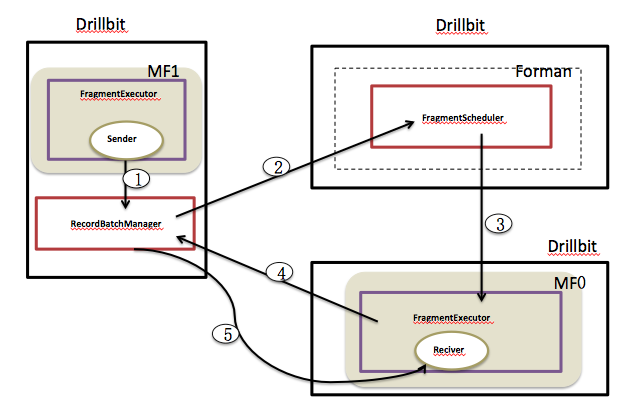
> It will be hard to schedule the runtime tree nodes as a whole. So I try to
> solve this by breaking the runtime cascade nodes. The graph below describes
> the initial design.
> !https://raw.githubusercontent.com/wiki/weijietong/drill/images/design.png!
>  [graph
> link|https://raw.githubusercontent.com/wiki/weijietong/drill/images/design.png]
> Every Drillbit instance will have a RecordBatchManager which will accept all
> the RecordBatchs written by the senders of local different MinorFragments.
> The RecordBatchManager will hold the RecordBatchs in memory firstly then disk
> storage . Once the first RecordBatch of a MinorFragment sender of one query
> occurs , it will notice the FragmentScheduler. The FragmentScheduler is
> instanced by the Foreman.It holds the whole PlanFragment execution graph.It
> will allocate a new corresponding FragmentExecutor to run the generated
> RecordBatch. The allocated FragmentExecutor will then notify the
> corresponding FragmentManager to indicate that I am ready to receive the
> data. Then the FragmentManger will send out the RecordBatch one by one to the
> corresponding FragmentExecutor's receiver like what the current Sender does
> by throttling the data stream.
> What we can gain from this design is :
> a. The computation leaf node does not to wait for the consumer's speed to end
> its life to release the resource.
> b. The sending data logic will be isolated from the computation nodes and
> shared by different FragmentManagers.
> c. We can schedule the MajorFragments according to Drillbit's actual resource
> capacity at runtime.
> d. Drill's pipeline data processing characteristic is also retained.
> h1. Plan
> This will be a large PR ,so I plan to divide it into some small ones.
> a. to implement the RecordManager.
> b. to implement a simple random FragmentScheduler and the whole event flow.
> c. to implement a primitive FragmentScheduler which may reference the Sparrow
> project.


--
This message was sent by Atlassian JIRA
(v6.4.14#64029)