Yes, that’s true, but a bit confusing. In the scenario where many
    plugins are using the lib in a Jenkins core that doesn’t have it;
    the plugin that loads first would dictate what version of the lib
    to use for the other plugins, even though it is bundled in each
    plugin (unless they use pluginFirstClassLoader), and that could
    cause confision/issues like the once we have with guava today for
    example.

    But when the user upgrades to a core that has the lib then core
    will be the one dictating what version of the lib to use.

    *Robert Sandell*

    Software Tools Engineer - SW Environment and Product Configuration

    Sony Mobile Communications

    *From:*[email protected]
    <mailto:[email protected]>
    [mailto:[email protected]] *On Behalf Of *Tom Fennelly
    *Sent:* den 1 juli 2014 12:41
    *To:* [email protected]
    <mailto:[email protected]>
    *Subject:* Re: New Jelly tags - via Jenkins Core + Plugin "shim",
    or via simple Java jar dependency ??

    But wouldn't that be the case anyway if we defined the base tag
    in the normal way inside Jenkins core i.e. plugins using the tag
    would need to wait for a core update to get fixes on that tag?

    On 01/07/2014 09:19, Sandell, Robert wrote:

        If there is a bug in your little library that is fixed and
        released, all plugins using it will probably have to update
        the dependency and release a new version of the plugin, until
        it appears in core.

        If the library was a plugin all plugins would get the bugfix
        when the new icon plugin version gets installed.

        *Robert Sandell*

        Software Tools Engineer - SW Environment and Product
        Configuration

        Sony Mobile Communications

        *From:*[email protected]
        <mailto:[email protected]>
        [mailto:[email protected]] *On Behalf Of *Tom
        Fennelly
        *Sent:* den 1 juli 2014 00:33
        *To:* [email protected]
        <mailto:[email protected]>
        *Subject:* New Jelly tags - via Jenkins Core + Plugin "shim",
        or via simple Java jar dependency ??

        Hi.

        We're in the process of creating a new <icon> in the hope of
        allowing more control over icons in the UI [1]. As part of
        that, we want to allow plugins that adopt this new tag to
        remain backward compatible with older versions of Jenkins.

        Up to now, the convention seems to have been that all core
        jelly taglibs (forms etc) live in Jenkins core and plugins
        get them from there:


<https://lh5.googleusercontent.com/-bnwMqmtmK4I/U7HdvP9_azI/AAAAAAAABIg/9ZtjRLr_kQU/s1600/Screenshot+2014-06-30+22.54.39.png>

        Of course, this means that a given plugin has a dependency on
        a particular version of Jenkins on which it is installed.
         For that reason, we talked [1] about creating "shim" plugin.
         This would be a plugin that defines an intermediate icon tag
        (maybe call it <icon-shim>) that has Jenkins version
        switching code inside it i.e.

            if (jenkinsVersion >= 1.571) {

                // use new <l:icon> tag ...

            } else {

                // use display icon in traditional way (as <img>)

            }


<https://lh3.googleusercontent.com/-po0x1R8HUj0/U7HioP8dtXI/AAAAAAAABIw/wBNp2arHqD8/s1600/Screenshot+2014-06-30+23.09.04.png>

        This all seemed a bit clumsy/ugly/messy to me, requiring
        multiple icon related tags... plugin release management for
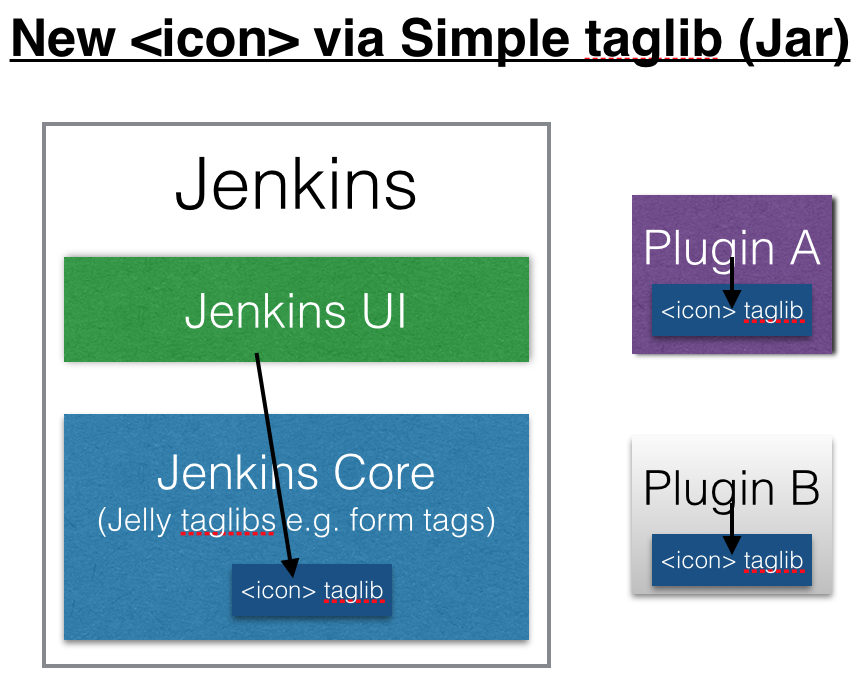
        the shim plugin etc etc.  So I decided to try creating a
        simple <icon> taglib jar (i.e. not putting the <icon> taglib
        in Jenkins Core).  Then, Jenkins Core and whatever plugins
        wish to upgrade (to using the new <icon> tag) simple add this
        new taglib as a dependency, independently of each other.  So
        long as the <icon> taglib does not use anything in a newer
        release of Jenkins, then the plugin should work all the way
        back down the Jenkins releases:


<https://lh6.googleusercontent.com/-OMgCDihqezQ/U7HjQ9oJoUI/AAAAAAAABI4/pVCDvV2M2TI/s1600/Screenshot+2014-06-30+23.09.17.png>

        I have some code here [2].  It works fine from a Jenkins Core
        perspective.  I'm going to change the Credentials plugin now
        and test that it works on new and old versions of Jenkins.
         I'm fairly confident it will.  The icon taglib is currently
        in an "icon" module of the root the project.  I know that's
        probably not a good long-term location - if the idea sticks,
        we can easily move it to a new home.

        So.... what's "wrong" with doing it this way Vs using a
        "shim" plugin ? :)

        [1]
        https://groups.google.com/forum/?hl=en#!topic/jenkinsci-dev/GOiQdvctBB0

<https://groups.google.com/forum/?hl=en#%21topic/jenkinsci-dev/GOiQdvctBB0>

        [2] https://github.com/tfennelly/jenkins/compare/icon-tag
--
You received this message because you are subscribed to the
        Google Groups "Jenkins Developers" group.
        To unsubscribe from this group and stop receiving emails from
        it, send an email to
        [email protected]
        <mailto:[email protected]>.
        For more options, visit https://groups.google.com/d/optout.
--
You received this message because you are subscribed to a
        topic in the Google Groups "Jenkins Developers" group.
        To unsubscribe from this topic, visit
        https://groups.google.com/d/topic/jenkinsci-dev/YiR-u6wz6lI/unsubscribe.
        To unsubscribe from this group and all its topics, send an
        email to [email protected]
        <mailto:[email protected]>.
        For more options, visit https://groups.google.com/d/optout.
--
You received this message because you are subscribed to the
    Google Groups "Jenkins Developers" group.
    To unsubscribe from this group and stop receiving emails from it,
    send an email to [email protected]
    <mailto:[email protected]>.
    For more options, visit https://groups.google.com/d/optout.
--
You received this message because you are subscribed to a topic
    in the Google Groups "Jenkins Developers" group.
    To unsubscribe from this topic, visit
    https://groups.google.com/d/topic/jenkinsci-dev/YiR-u6wz6lI/unsubscribe.
    To unsubscribe from this group and all its topics, send an email
    to [email protected]
    <mailto:[email protected]>.
    For more options, visit https://groups.google.com/d/optout.