Not at all... I just pointed out that if you go the way I originally
suggested you get a nice clean tag in core and all the mess in a shim
plugin that will go away eventually...
On 1 July 2014 16:18, Tom Fennelly <[email protected]> wrote:

>  OK.... after talking to Stephen again we're heading back in the old
> "shim" direction (he has beaten me into submission lol).
>
>
> On 01/07/2014 13:53, Stephen Connolly wrote:
>
> yep... only now you are back to doing a shim plugin.... See... I told you
> there was no escape!
>
>  OTOH you now do not need to get the changes into core to release your
> module
>
>
> On 1 July 2014 13:20, Tom Fennelly <[email protected]> wrote:
>
>>  Thanks Robert.  Good point!!
>>
>> So maybe what we could do then is a cross between what I was referring
>> to, and "shim" plugin i.e. a "jenkins-icons" plugin that just depends on
>> the "jenkins-icons" module (in the same way as Jenkins core would depend on
>> it) and nothing more i.e. doesn't define any new tags etc.  Then, have the
>> other plugins add the "jenkins-icons" plugin as a dependency plugin.  That
>> would resolve that issue, right?
>>
>>
>> On 01/07/2014 13:11, Sandell, Robert wrote:
>>
>>  Yes, that’s true, but a bit confusing. In the scenario where many
>> plugins are using the lib in a Jenkins core that doesn’t have it; the
>> plugin that loads first would dictate what version of the lib to use for
>> the other plugins, even though it is bundled in each plugin (unless they
>> use pluginFirstClassLoader), and that could cause confision/issues like the
>> once we have with guava today for example.
>>
>> But when the user upgrades to a core that has the lib then core will be
>> the one dictating what version of the lib to use.
>>
>>
>>
>>
>>
>>
>>
>>
>>
>> *Robert Sandell*
>>
>> Software Tools Engineer - SW Environment and Product Configuration
>>
>> Sony Mobile Communications
>>
>>
>>
>> *From:* [email protected] [
>> mailto:[email protected] <[email protected]>] *On
>> Behalf Of *Tom Fennelly
>> *Sent:* den 1 juli 2014 12:41
>> *To:* [email protected]
>> *Subject:* Re: New Jelly tags - via Jenkins Core + Plugin "shim", or via
>> simple Java jar dependency ??
>>
>>
>>
>> But wouldn't that be the case anyway if we defined the base tag in the
>> normal way inside Jenkins core i.e. plugins using the tag would need to
>> wait for a core update to get fixes on that tag?
>>
>> On 01/07/2014 09:19, Sandell, Robert wrote:
>>
>> If there is a bug in your little library that is fixed and released, all
>> plugins using it will probably have to update the dependency and release a
>> new version of the plugin, until it appears in core.
>>
>> If the library was a plugin all plugins would get the bugfix when the new
>> icon plugin version gets installed.
>>
>>
>>
>>
>>
>>
>>
>>
>>
>> *Robert Sandell*
>>
>> Software Tools Engineer - SW Environment and Product Configuration
>>
>> Sony Mobile Communications
>>
>>
>>
>> *From:* [email protected] [
>> mailto:[email protected] <[email protected]>] *On
>> Behalf Of *Tom Fennelly
>> *Sent:* den 1 juli 2014 00:33
>> *To:* [email protected]
>> *Subject:* New Jelly tags - via Jenkins Core + Plugin "shim", or via
>> simple Java jar dependency ??
>>
>>
>>
>> Hi.
>>
>> We're in the process of creating a new <icon> in the hope of allowing
>> more control over icons in the UI [1]. As part of that, we want to allow
>> plugins that adopt this new tag to remain backward compatible with older
>> versions of Jenkins.
>>
>>
>>
>> Up to now, the convention seems to have been that all core jelly taglibs
>> (forms etc) live in Jenkins core and plugins get them from there:
>>
>>
>>
>>
>> <https://lh5.googleusercontent.com/-bnwMqmtmK4I/U7HdvP9_azI/AAAAAAAABIg/9ZtjRLr_kQU/s1600/Screenshot+2014-06-30+22.54.39.png>
>>
>> Of course, this means that a given plugin has a dependency on a
>> particular version of Jenkins on which it is installed.  For that reason,
>> we talked [1] about creating "shim" plugin.  This would be a plugin that
>> defines an intermediate icon tag (maybe call it <icon-shim>) that has
>> Jenkins version switching code inside it i.e.
>>
>>
>>
>>  if (jenkinsVersion >= 1.571) {
>>
>>   // use new <l:icon> tag ...
>>
>>   } else {
>>
>>   // use display icon in traditional way (as <img>)
>>
>>   }
>>
>>
>>
>>
>>
>>
>> <https://lh3.googleusercontent.com/-po0x1R8HUj0/U7HioP8dtXI/AAAAAAAABIw/wBNp2arHqD8/s1600/Screenshot+2014-06-30+23.09.04.png>
>>
>> This all seemed a bit clumsy/ugly/messy to me, requiring multiple icon
>> related tags... plugin release management for the shim plugin etc etc.  So
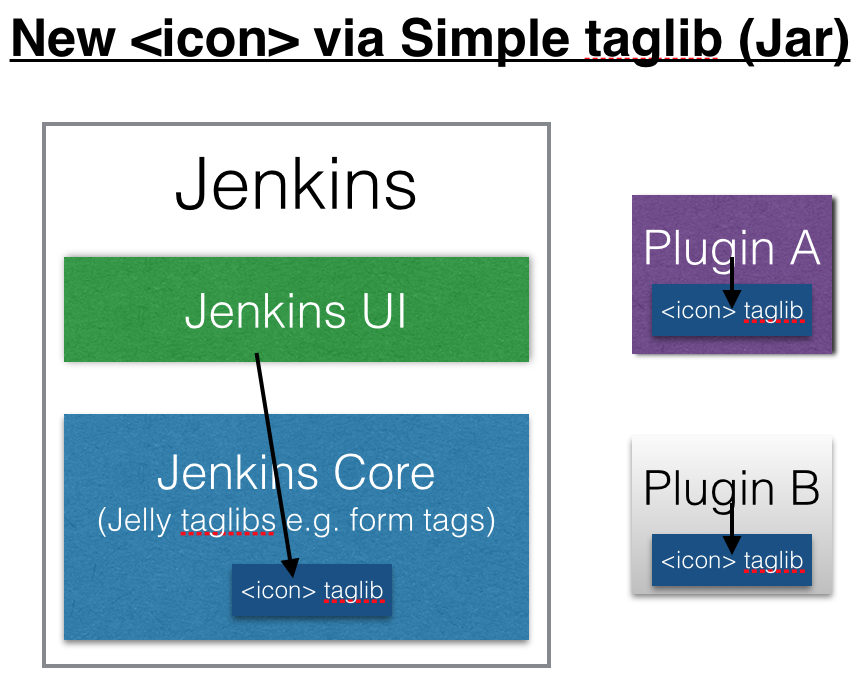
>> I decided to try creating a simple <icon> taglib jar (i.e. not putting the
>> <icon> taglib in Jenkins Core).  Then, Jenkins Core and whatever plugins
>> wish to upgrade (to using the new <icon> tag) simple add this new taglib as
>> a dependency, independently of each other.  So long as the <icon> taglib
>> does not use anything in a newer release of Jenkins, then the plugin should
>> work all the way back down the Jenkins releases:
>>
>>
>> <https://lh6.googleusercontent.com/-OMgCDihqezQ/U7HjQ9oJoUI/AAAAAAAABI4/pVCDvV2M2TI/s1600/Screenshot+2014-06-30+23.09.17.png>
>>
>> I have some code here [2].  It works fine from a Jenkins Core
>> perspective.  I'm going to change the Credentials plugin now and test that
>> it works on new and old versions of Jenkins.  I'm fairly confident it will.
>>  The icon taglib is currently in an "icon" module of the root the project.
>>  I know that's probably not a good long-term location - if the idea sticks,
>> we can easily move it to a new home.
>>
>> So.... what's "wrong" with doing it this way Vs using a "shim" plugin ? :)
>>
>>
>>
>> [1]
>> https://groups.google.com/forum/?hl=en#!topic/jenkinsci-dev/GOiQdvctBB0
>>
>> [2] https://github.com/tfennelly/jenkins/compare/icon-tag
>>
>> --
>> You received this message because you are subscribed to the Google Groups
>> "Jenkins Developers" group.
>> To unsubscribe from this group and stop receiving emails from it, send an
>> email to [email protected].
>> For more options, visit https://groups.google.com/d/optout.
>>
>> --
>> You received this message because you are subscribed to a topic in the
>> Google Groups "Jenkins Developers" group.
>> To unsubscribe from this topic, visit
>> https://groups.google.com/d/topic/jenkinsci-dev/YiR-u6wz6lI/unsubscribe.
>> To unsubscribe from this group and all its topics, send an email to
>> [email protected].
>> For more options, visit https://groups.google.com/d/optout.
>>
>>
>>
>> --
>> You received this message because you are subscribed to the Google Groups
>> "Jenkins Developers" group.
>> To unsubscribe from this group and stop receiving emails from it, send an
>> email to [email protected].
>> For more options, visit https://groups.google.com/d/optout.
>>  --
>> You received this message because you are subscribed to a topic in the
>> Google Groups "Jenkins Developers" group.
>> To unsubscribe from this topic, visit
>> https://groups.google.com/d/topic/jenkinsci-dev/YiR-u6wz6lI/unsubscribe.
>> To unsubscribe from this group and all its topics, send an email to
>> [email protected].
>> For more options, visit https://groups.google.com/d/optout.
>>
>>
>>    --
>> You received this message because you are subscribed to the Google Groups
>> "Jenkins Developers" group.
>> To unsubscribe from this group and stop receiving emails from it, send an
>> email to [email protected].
>> For more options, visit https://groups.google.com/d/optout.
>>
>
>  --
> You received this message because you are subscribed to a topic in the
> Google Groups "Jenkins Developers" group.
> To unsubscribe from this topic, visit
> https://groups.google.com/d/topic/jenkinsci-dev/YiR-u6wz6lI/unsubscribe.
> To unsubscribe from this group and all its topics, send an email to
> [email protected].
> For more options, visit https://groups.google.com/d/optout.
>
>
>  --
> You received this message because you are subscribed to the Google Groups
> "Jenkins Developers" group.
> To unsubscribe from this group and stop receiving emails from it, send an
> email to [email protected].
> For more options, visit https://groups.google.com/d/optout.
>

--
You received this message because you are subscribed to the Google Groups
"Jenkins Developers" group.
To unsubscribe from this group and stop receiving emails from it, send an email
to [email protected].
For more options, visit https://groups.google.com/d/optout.