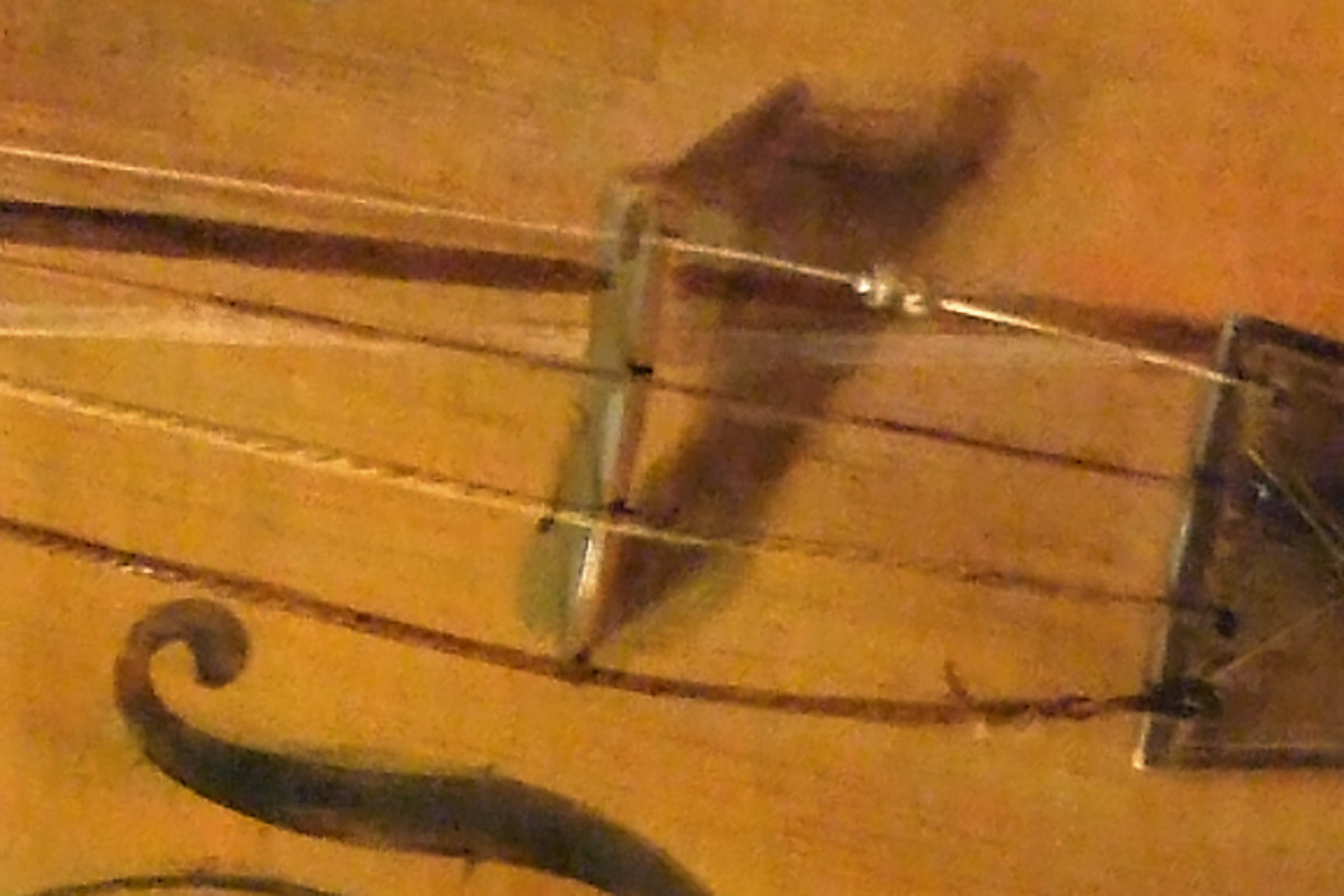
At 01:07 AM 4/2/2010, you wrote:
>Thanks - and any details about that beautiful cello painting you
>pointed us to?
The painting is in the National Museum in Stockholm. During a
performance at Drottningholm, I visited the museum and saw that the
painting was not in the museum book that was available for sale, or
as a postcard, so I asked the security guard if I could take a photo
with my point and shoot. As it was dark, I held the shutter open for
a half second to take the photo.
I have a real camera, of course, and I always forget to bring it.
Books never show the strings anyway, so I got as close as I could to
photograph the strings. I took a photo of the info card, but it is
too blurry to read.
The National museum has an online catologue but I can't find it
there. Best I can do is perhaps ask some of my friends in Sweden, or
perhaps you know some of the string players in the Baroque orchestra there.

My impression of the painting is that there were four gut strings,
all different in texture and different in color, no metal. The 4th
string is not much thicker than the third string, as is often the
case for lute strings that reach a kind of size limit in the bass.
The other thing is the two conjunct spheres on the top string below
the bridge. This could be a knot, such as when a broken string is
reused, but I must say I really did consider that it was a fine
tuning mechanism when I was in the museum. Looking at an enlargement
of the photo, it does not appear to be a typical knot, because the
texture and thickness is different than the string. So it could be
that it is either a fine tuning mechanism, or a device to control a
wolf tone, or a clasp to serve as a knot to retie a string.
Becuase the object looks like two pearls, I can't rule out that it is
an ornament.

If it is a fine tuner, it would have to work, I think, that the ends
of the strings were enclosed in two round holders joined by a simple
screw mechanism.

Then again, maybe it is a knot! Just a double knot.....How annoying.
Should have brought the Zeiss lens.

The other thing that is interesting about this painting is you can
see the width of the bow is 1/3 the distance between the strings, as
a rough guess, and the top of the bridge is about two thicknesses of
the third string.

Lastly, if you look at the very end of the low C string, you can see
that it is slightly curved. This could only be possibly if the string
had an inner core, possibly of wire, or of the string were twisted in
such a way that it caused some bunching in the twists, such as you
see in a telephone handset cord. I don't think the curve is artistic
license, but of course there is no way to know.


I went to the museum to see the Judith Leyster violin painting, but
it was on loan to Kassel. So I then went to Kassel, and it was on
loan somewhere else.

Here is a detail that has a shadow enhancing filter applied
http://voicesofmusic.org/cello_detail.jpg
dt


--

To get on or off this list see list information at
http://www.cs.dartmouth.edu/~wbc/lute-admin/index.html