SpaceX IPO: The Lockup PlaybookWhy the Stock Falls 35-50% After the Lockup
Expires
<https://substack.com/@vaughncordle>
Vaughn Cordle, CFA <https://substack.com/@vaughncordle>
Jun 11, 2026
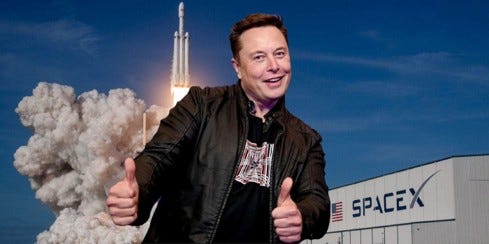
<https://substackcdn.com/image/fetch/$s_!qDjX!,f_auto,q_auto:good,fl_progressive:steep/https%3A%2F%2Fsubstack-post-media.s3.amazonaws.com%2Fpublic%2Fimages%2F7faa75ba-eb7b-473b-88cc-f906149c2bde_489x244.jpeg>SpaceX
CEO Elon Musk. His stake is worth $866 billion at the IPO price.
*SpaceX is a magnificent company selling stock at a fantasy multiple. At
93x revenue, the IPO price requires perfection across every segment
simultaneously. The S-1 reveals a staggered lockup designed to distribute
insider supply into market strength, $700 million in related-party
transactions between Musk-controlled companies, and a deal structure where
every bank in the syndicate profits from the forecasts that justify the
valuation it is paid to distribute. Most retail investors will enter at
$175 or higher. My estimate: the stock settles 35-50% below the IPO price
by mid-2027. Skip the opening. Wait for gravity.*
The Architecture of the Deal

Parts One <https://vaughncordle.substack.com/p/token-bloat-valuation-trap>
 and Two <https://vaughncordle.substack.com/p/the-ai-valuation-trap> documented
the AI valuation trap — token bloat, circular revenue, infrastructure
constraints, depreciation stretch, and retail concentration risk. This
report applies that framework to the most dangerous IPO in the pipeline.
The stock price will be exceptionally volatile during the 180-day lockup
period — staggered insider selling, options amplification, and a managed
float make this a dangerous entry for long-term investors buying at the
opening price.

The S-1 is public. The lockup structure confirms how this deal is
engineered and who it is engineered for.

SpaceX goes public June 12 at $135 per share. The company is issuing
555,555,555 shares to raise $75 billion — the largest IPO by capital raised
in market history. At the offering price, SpaceX carries an implied market
capitalization of approximately $1.77 trillion. The raise is split across
21 underwriting banks. Goldman Sachs is the lead underwriter, alongside
Morgan Stanley, Bank of America, Citigroup, and JPMorgan Chase.
A Market Already at Extremes

The U.S. market capitalization-to-GDP ratio stands near an all-time high of
roughly 232%. Adding SpaceX, Anthropic, and OpenAI at current valuations
would push that ratio to an estimated 260-270%. The top ten U.S. technology
companies carry a combined market value larger than the six biggest
economies in Europe and equal to approximately 86% of U.S. GDP.

SpaceX enters this market at 93x annualized revenue. The S&P 500 trades at
roughly 3.3x sales. That number is misleading. Ten Big Tech companies — 40%
of the index — inflate the average. The other 490 companies trade far
lower. The market is not expensive. Big Tech is expensive. The index just
hides it. SpaceX at 93x is joining the most overvalued sector inside the
most concentrated index at the most inflated level in market history.

Thirty percent of the float — $22.5 billion — is allocated to retail
investors. Three times the standard retail allocation for a mega-cap IPO.

That sounds generous. It is the rocket fuel that launches the share price.
What the S-1 Actually Shows

SpaceX is not coming public as a launch company. The S-1 presents one
consolidated entity: Starlink, launch services, government and defense
contracts, Starship, and related space infrastructure. Investors are buying
several business models inside one security.

The financial center is Starlink.

SpaceX reported Q1 2026 revenue of $4.694 billion, an annualized run-rate
of $18.8 billion. Starlink generated $3.26 billion of that — 69% of total
revenue — with an operating profit of $1.19 billion and an operating margin
of 36.5%. The subscriber base reached 10.3 million.

IPO valuation: $1.75 trillion. Implied multiple: 93x annualized Q1 revenue.

SpaceX was unprofitable in 2025. Losses widened in Q1 2026.

The S-1 also discloses related-party complexity. xAI spent $269 million
buying Tesla Megapacks in April alone — industrial-scale battery storage
units that power data centers and manage grid demand. Tesla disclosed $430
million in Megapack sales to xAI last year. Public investors must determine
how much of SpaceX’s reported economics are arm’s-length transactions and
how much is capital recycling between entities controlled by one man with
85% of the voting power.

The pattern extends beyond energy infrastructure. SpaceX bought $131
million of Tesla Cybertrucks in 2025, registering 1,279 units in Q4 alone,
roughly 18% of all U.S. Cybertruck registrations that quarter. Other
Musk-controlled entities bought additional units. Fleet buyers normally
negotiate volume discounts. SpaceX reportedly paid full MSRP — meaning
Tesla received better economics from a related-party buyer than it would
have from an independent fleet customer.

Starlink is a real business. Launch gives SpaceX a cost and deployment
advantage no competitor can match today. Government and defense revenue
adds durability. Starship adds long-duration option value.

The valuation problem remains. Investors are paying a megacap valuation for
a company with venture-capital economics: heavy losses, enormous capital
needs, long-duration promises, and execution risk across every segment
simultaneously.

Nearly $700 million in Megapack transactions. $131 million in Cybertruck
purchases. Revenue, demand, and capital moving between companies controlled
by the same man. The S-1 discloses the transactions. It does not disclose
whether the economics would survive arm’s-length scrutiny.

Musk’s vision is ambitious. Mars, Starlink, AI, autonomous launch, orbital
infrastructure — no founder in history has attempted this scope
simultaneously. Investors must be more grounded. Ambition does not justify
93x revenue. Great companies can be terrible investments at the wrong price.
SpaceX Is Selling Access, Not Value

SpaceX is selling access to the Musk narrative. The stock is the vehicle.

Current shareholders — early investors, employees, venture funds, and the
banks that hold stakes — captured the markup through successive funding
rounds that repriced SpaceX from under $100 billion to $1.75 trillion. The
IPO is the first time public investors can buy. They enter after the 2,000%
appreciation is already on the books.

The retail psychology is the point. The pitch is not valuation. It is Elon
Musk, rockets, Starlink, AI, robots, Mars, and the belief that SpaceX is
inevitable. Some investors are not buying a business. They are buying
affiliation with the story. That is why retail demand will be intense and
why the allocation is three times the normal size. The more retail buyers
in the deal, the more demand on day one, the higher the opening price, the
more validated the valuation appears.

The index angle adds another layer. Nasdaq agreed to fast-track SpaceX into
the Nasdaq-100 after just 15 trading days. That forces index funds and ETFs
to buy quickly — manufactured demand on a compressed timeline. The S&P 500
refused to fast-track the company because SpaceX does not meet its
profitability rules. One index is creating forced demand. The other is
applying discipline. The difference tells you everything about which
benchmark is pricing reality.
The Psyop Hype Engine

This is a financial psyop against retail investors. The operation has three
components: narrative construction, institutional amplification, and retail
distribution.

Pure-play labs create the growth narrative. Wall Street banks convert the
narrative into IPO math. Private investors mark up the rounds. Public
investors receive the distribution.

The conflict of interest is structural. The same 21 banks underwriting the
IPO — earning billions in fees from the offering — are the banks publishing
the revenue forecasts and price targets that justify the valuation they are
paid to distribute. The analysts work for the banks. The banks work for the
issuer. The forecasts are marketing materials with disclaimers attached.

Goldman Sachs leads the syndicate. Morgan Stanley — a lead underwriter on
the deal — is reportedly telling prospective investors that SpaceX revenue
could reach $3.4 trillion by 2040. Revenue 180x current levels fourteen
years from now. The lead bank sets the terms. The co-leads amplify the
forecast. All 21 collect the fees. The sell-side manufacturing the
narrative that justifies the price it is paid to distribute.

Every bank in the syndicate has the same incentive — justify the price,
close the deal, collect the fee. The investor who treats a sell-side
forecast as independent analysis is the investor the system is designed to
exploit.

The banks do not need the forecast to be right forever. They need it to be
persuasive during distribution.

Every player in the distribution chain gets paid before the public investor
learns whether the economics work.
The Flipping Trap

The order book is reportedly two times oversubscribed — roughly $150
billion in demand for $75 billion of stock. Two times is the minimum
requirement for a successful deal. Oversubscription proves demand
management, not valuation soundness.

The real trade depends on the entry price. A $135 entry with a $175 target
is one trade. A $200-plus first print is a different trade entirely. The
risk-reward shifts with every dollar above the IPO price. Retail investors
who do not receive an allocation face a different calculation entirely.

The underwriters hold an overallotment option for 83.33 million additional
shares — roughly $11.2 billion at the IPO price. The green shoe lets the
banks over-allocate at the IPO, then cover at $135 if the stock rises. If
the stock falls, they buy in the open market and stabilize the price. The
banks profit on the way up and control the floor on the way down. The
public investor is on the other side of both trades.

The holding-period trap adds another layer. Some brokers punish retail
investors who quickly sell allocated IPO shares. Fidelity can restrict
future IPO access if investors sell within 15 calendar days. Schwab appears
to be the exception unless the issuer requires a restriction. A retail
investor may receive shares, see an early pop, and face pressure not to
sell — locked into a position by the brokerage’s flipping rules while
insiders wait for the lockup clock to free their shares.

The brokers want retail to hold. The insiders are waiting to sell. The
incentives are misaligned by design.

Options could become the real event. SpaceX options are expected to begin
trading shortly after the IPO. Implied volatility will be high. Spreads
will be wide. Dealers will price defensively because there is no trading
history. The options market will amplify the stock move in both directions
— accelerating the rally on the way up, accelerating the decline when
supply arrives. The options tail could wag the stock.
The $175 Trigger

The S-1 contains a performance-based lockup release. If the stock trades at
or above $175.50 — 30% above the $135 IPO price — during 5 of 10
consecutive trading days before the first earnings release, an additional
10% of insider shares unlock early.

That number is not arbitrary. It is contractual. The banks and insiders
need the stock to reach $175. The S-1 is designed to reward them at that
price. Every analyst price target, every bullish research note, every media
appearance talking about Starlink’s growth and Mars optionality serves one
function in the first 90 days: push the stock past $175.50 and trigger the
early release.

The sell-side is not forecasting. It is engineering an outcome the lockup
schedule rewards.
How Insiders Cash Out

The 180-day lockup is a controlled release schedule designed to distribute
insider supply into market strength.

*Day 1 through Q2 earnings (mid-July to September):* Insiders hold. The
stock runs on restricted supply and retail demand. This is the pop window.
The banks manage the float. The story is controlled. Price rises.

*After Q2 earnings:* First cliff. 20% of eligible insider shares unlock. If
the $175 trigger was hit, an additional 10% unlocks. Insiders begin selling
into a stock priced on hype and restricted supply.

*Days 70 through 135:* Five staggered releases. Up to 7% of eligible shares
at each interval — 70, 90, 105, 120, and 135 days post-IPO. Supply
increases in waves. Each wave arrives while the narrative is warm and
retail is still buying.

*After Q3 earnings (mid-October to December):* Second major cliff. Up to
28% more insider shares unlock. By this point insiders have access to the
majority of their holdings. The market absorbs a flood of supply from
holders whose cost basis is a fraction of the public price.

*Day 180 — mid-December 2026:* Full lockup expires. All restrictions
lifted. Every insider can sell every share. Musk controls 85% of the voting
power and roughly 42% of the equity. His decision to sell or hold is the
single largest variable in the stock’s post-lockup trajectory.

Musk’s SpaceX stake would be worth $866.5 billion at the IPO price — more
than the entire market capitalization of Tesla.
Where the Price Goes

*Weeks 1-8 (June through early August):* The stock runs. Restricted supply.
Managed float. Institutional and retail demand chasing limited shares.
Options trading amplifies the momentum. Nasdaq-100 fast-track forces index
buying within 15 trading days. A move from $135 to $175-$225 is plausible.
This is the window the deal is designed to produce. The pop validates the
valuation. The media amplifies the narrative. Retail buys at the inflated
price.

*August through October:* Q2 earnings release triggers the first insider
selling. The $175 performance bonus unlocks additional supply. The stock
faces its first real supply test. Retail holders who received allocations
face the flipping trap — sell and lose future IPO access, or hold and ride
into the supply wave. If earnings disappoint or guidance softens, the
selling accelerates into a weakening bid. If earnings are strong, the
insiders sell into strength. Either way, supply increases.

*November through December:* The final lockup tranches release. Q3 earnings
add another wave of insider supply. By mid-December, every share is free to
trade. The restricted supply that drove the early pop is gone. The stock
must trade on fundamentals — Starlink subscriber growth, AI infrastructure
margins, launch economics, and capital allocation discipline under Musk’s
85% voting control.

*Post-lockup — 2027:* The full float is available. The narrative premium
embedded in the IPO price collides with audited quarterly results. Morgan
Stanley’s $3.4 trillion revenue forecast collides with actual revenue
growth. If Starlink delivers but AI infrastructure burns cash at utility
margins, the market reprices the non-Starlink segments toward zero.
Morningstar’s $780 billion fair value becomes the gravitational anchor. The
2,000% private-market markup faces public-market accountability.
The Bottom Line

At 93x annualized revenue, the IPO price requires perfection across every
segment simultaneously. Starlink is real. The multiple is fantasy.

The deal is a structure story. The banks control the allocation. The
brokers control the flipping rules. The options market controls the frenzy.
The insiders wait for the lockup clock. The Nasdaq fast-track creates
forced index demand. The S&P 500 stands back because SpaceX does not meet
its profitability rules. Morgan Stanley sells a $3.4 trillion dream. Retail
buys it at 93x revenue.

Current shareholders — early investors, employees, venture funds, and the
banks that hold stakes — captured the 2,000% markup across successive
funding rounds. On Friday, the IPO offers public investors the same stock
at the most inflated price in the company's history.

Retail investors are unlikely to buy at $135. They will buy at whatever
price the market opens — likely $175 to $225. That entry is 30-67% above
the IPO price before the first insider share is sold.

The S-1 codifies that sequence in the lockup schedule.

The trade at $135 with a sell at $175 works — if you receive the
allocation. A trade entered above $200 with a hold through the lockup does
not. The supply arriving in waves from August through December overwhelms
the narrative that supported the opening price.
The Trade

Most retail investors will never see the $135 allocation price. The opening
trade will be $175 or higher. Skip it. The supply arriving in waves from
August through December overwhelms the narrative that supported the opening
price.

Buy the dips toward fair value after the supply hits. My estimate: 35-50%
below the $135 IPO price, or roughly $67 to $88 per share. The lockup
expires mid-December 2026. Insider selling accelerates through Q1 2027. By
mid-2027 the supply wave is largely exhausted and three to four quarters of
audited earnings replace the narrative. That is the repricing window. That
is when gravity pulls the stock to what the business is actually worth.

At the IPO price, Musk's stake is worth $866 billion. At my post-lockup
estimate, it is worth $433 to $563 billion. Even the richest man in the
world cannot outrun gravity.

About the Author <https://vaughncordle.substack.com/publish/post/201597015>

*This note follows The AI Valuation Trap
<https://vaughncordle.substack.com/p/the-ai-valuation-trap> and SpaceX and
the IPO Machine
<https://vaughncordle.substack.com/p/spacex-and-the-ipo-machine>, published
June 10, 2026.*
Exhibit A: SpaceX, Tesla, and the Cybertruck Transaction

SpaceX bought $131 million of Tesla Cybertrucks in 2025. In Q4 alone,
SpaceX registered 1,279 units — roughly 18% of all U.S. Cybertruck
registrations that quarter. Other Musk-controlled entities bought
additional units. A material share of Cybertruck demand came from inside
the Musk ecosystem.

SpaceX may have needed work trucks for Starbase. Launch sites need
vehicles. Harsh terrain fits the Cybertruck profile. That does not explain
paying full MSRP on 1,279 units when fleet buyers negotiate volume
discounts. Tesla received better economics from a related-party buyer than
it would have from an independent fleet customer.

The timing matters. Tesla was struggling with Cybertruck demand. SpaceX
became a major buyer. Tesla booked the revenue. SpaceX spent the cash. Musk
controlled both sides.

The dollar amount is small. The governance question is not. Musk-controlled
companies are moving revenue, demand, and capital across company lines. The
Cybertruck transaction, the $269 million in Megapack purchases, the $430
million in prior Megapack sales — the pattern is consistent. Money flows
between entities controlled by one man.

At $1.75 trillion, public investors are buying into that ecosystem. The S-1
discloses the transactions. It does not answer whether the economics would
survive arm’s-length scrutiny.
Exhibit B: The Megapack Supply Chain

A Tesla Megapack is a large-scale battery energy storage unit. Each unit
stores approximately 3.9 megawatt-hours of electricity. Industrial-grade.
The size of a shipping container. Utilities, data centers, and large
commercial operations use them to store electricity from the grid or
renewable sources and discharge it during peak demand.

xAI is buying Megapacks to power its data centers. Data centers consume
massive electricity. Megapacks store energy on-site to manage peak loads,
reduce grid dependency, and provide backup power.

The transaction chain: Musk’s AI company buys energy storage from Musk’s
car company to power Musk’s data centers that support Musk’s AI models that
compete with the same frontier models SpaceX’s valuation partly depends on.

Capital, energy, hardware, and revenue moving between Musk-controlled
entities. The Megapack transaction is not just a related-party purchase. It
is infrastructure for the AI buildout that sits inside the SpaceX valuation
— another link in the intra-Musk supply chain that public investors are
being asked to value at 93x revenue.
Exhibit C: Beta and the Multiple

Beta measures uncertainty. The Capital Asset Pricing Model converts that
uncertainty into the cost of equity — the return investors require to hold
the stock. The higher the beta, the higher the cost of equity. The higher
the cost of equity, the lower the justified P/E. The lower the justified
P/E, the lower the stock price.

The chain is mechanical. It does not negotiate with narrative.

SpaceX enters the public market at 93x revenue with no earnings. The
implied cost of equity is already extreme. Post-IPO volatility will push
beta higher — staggered insider selling every 15-30 days, options
amplification from speculative demand, Nasdaq-100 index rebalancing,
quarterly earnings catalysts, and a 180-day lockup expiration that resets
the supply structure entirely.

Each source of volatility feeds beta. Beta feeds the cost of equity. The
cost of equity feeds the discount rate. The discount rate compresses the
justified multiple. The justified multiple compresses the stock price.

The narrative can hold the stock above the justified multiple for weeks or
months. It cannot hold it there permanently. When the narrative fades — and
the staggered lockup ensures supply pressure builds while the narrative
cools — the stock migrates toward the price the cost of equity supports.

The same transmission chain documented in *Cognitive Inflation* operates
here at the single-stock level. Higher energy costs feed inflation
expectations. Inflation expectations feed the 10-year Treasury yield. The
10-year yield feeds the risk-free rate inside the CAPM. A higher risk-free
rate raises the cost of equity for every stock in the market. For a
high-beta stock like SpaceX, the effect is amplified. The beta multiplier
takes every basis point increase in the risk-free rate and magnifies it.

If the Iran conflict persists and energy costs remain elevated, the 10-year
yield stays higher. The risk-free rate stays higher. SpaceX’s cost of
equity — already elevated by extreme beta — climbs further. The justified
multiple compresses further. The gap between the narrative price and the
CAPM price widens.

Retail investors buying at $175-$225 are buying a stock whose cost of
equity argues for a lower price. Every month of post-IPO volatility, every
lockup tranche that hits the market, every energy-driven basis point
increase in the risk-free rate pushes the justified valuation further below
the market price.

The market can ignore the CAPM for a quarter. It cannot ignore it for a
year.

*Source: Capital Asset Pricing Model framework. Cognitive Inflation: From
Token Waste to Market Bubble, Vaughn Cordle, CFA. SpaceX S-1 filing, SEC,
June 2026.*
Exhibit D: Market Valuation Context

*SpaceX IPO vs. Market Benchmarks*

*SpaceX at the offering price:*

IPO valuation: $1.75 trillion. Largest IPO by capital raised in market
history.

Implied revenue multiple: 93x annualized Q1 2026 revenue ($4.694 billion
quarterly, $18.8 billion annualized).

*The market SpaceX is entering:*

S&P 500 price-to-sales ratio: approximately 3.3x. Current range 3.0x to
3.65x. The long-term average is 1.8x to 2.5x. The market is already
stretched before SpaceX arrives.

Buffett Indicator (U.S. market capitalization to GDP): approximately
231-232%. Near the all-time high. Exceeds the 2000 dot-com peak in multiple
datasets.

*What the IPO wave adds:*

SpaceX, Anthropic, and OpenAI entering the public market at current
valuations would push the Buffett Indicator to an estimated 260-270%. Three
companies adding roughly $4 trillion in market capitalization to a market
already trading at historically extreme levels relative to GDP.

The top 10 U.S. tech companies already carry a combined market value that
exceeds the GDP of every European economy except the EU as a whole. Adding
three mega-cap IPOs at venture-capital multiples stretches that
concentration further.

*The core comparison:*

SpaceX at 93x revenue. The S&P 500 at 3.3x. SpaceX is priced at 28 times
the market average on a revenue-multiple basis. The last time companies
entered the public market at comparable multiples relative to the index was
1999-2000.

*Sources: Reuters, June 2026. SpaceX S-1 prospectus data. GuruFocus —
Buffett Indicator and P/S ratios. S&P Dow Jones Indices.
Longtermtrends.net.*
Exhibit E: Big Tech Concentration

*Top 10 Big Tech Companies in the S&P 500 (Early June 2026)*

   1.

   Nvidia: $5.00 trillion — 7.4% of the index.
   2.

   Alphabet: $4.46 trillion — 6.6%.
   3.

   Apple: $4.30 trillion — 6.4%.
   4.

   Microsoft: $3.10 trillion — 4.6%.
   5.

   Amazon: $2.85 trillion — 4.2%.
   6.

   Broadcom: $1.98 trillion — 2.9%.
   7.

   Meta Platforms: $1.55 trillion — 2.3%.
   8.

   Tesla: $1.43 trillion — 2.1%.
   9.

   Oracle: $0.85 trillion — 1.3%.
   10.

   Adobe: $0.78 trillion — 1.2%.

*Combined: approximately $26.3 trillion. Roughly 39-41% of the entire S&P
500.*

Ten technology companies. Four out of every ten dollars in the index. Every
one of them is invested in, building on, or valued by AI, cloud computing,
and digital infrastructure. The S&P 500 is not a diversified index. It is a
technology bet with 490 other companies along for the ride.

SpaceX at $1.77 trillion would slot between Meta and Broadcom on day one —
the eighth largest technology company on earth before generating a single
dollar of public-market earnings. Adding Anthropic at $965 billion and
OpenAI at $852 billion pushes the combined Big Tech concentration past 45%
of the index. Nearly half the S&P 500 in a single sector. The last time
concentration approached these levels was 2000.

When these stocks reprice, every ETF, index fund, retirement account, and
model portfolio that tracks the S&P 500 reprices with them. The
concentration is the transmission mechanism for the next correction.

*Sources: S&P Dow Jones Indices. MacroMicro, May/June 2026. Company market
capitalization figures from financial data providers, early June 2026.*

--
Vaughn Cordle, CFA
IONOSPHERE Capital LLC
Washington, DC
703 830-1701 (office)
703 946-5474 (mobile)
[email protected]

'Proprietary Information-Draft'

The information contained in this document/email is privileged and
confidential and is intended only for the use of the individual named or
others who have been specifically authorized to receive such from
Ionosphere Capital, LLC.  If the recipient is not the intended recipient,
you are hereby notified that any dissemination, distribution or copy of
this communication is strictly prohibited.
--------------------------------------------------------------------------
Revised: 20250507

You are receiving The Mifnet because you requested to join this list.

The Mifnet is largely a labor of love, however the infrastructure isn't exactly
cost-free. If you'd care to make a small contribution to the effort, please
know that it would be greatly appreciated:
https://wardell.us/url/mifbit

All posts sent to the list should abide by these policies:

1) List members acknowledge that participation in Mifnet is a privilege--not a
right.
2) Posts are always off the record, absent specific permission from the author.
3) The tone of discussions is collegial.
4) Posts are expected to be in reasonably good taste.
5) We discuss ideas and not personalities, and we don't speak ill of other
Mifnet members.

* The Mifnet WEB SITE is:
  https://www.mifnet.com/

* To UNSUBSCRIBE from this list at any time please visit:
  https://lists.mifnet.com/
  OR: SEND THIS MESSAGE via email: [email protected]?subject=leave

* Send Mifnet mailing list POSTS/SUBMISSIONS to:
  [email protected]

* You may reach the person managing The Mifnet at:
  [email protected]

* Please consider the DIGEST version of The Mifnet, which consolidates all list
traffic into 1-3
  messages daily. See instructions at:
  https://lists.mifnet.com/

* Manage your personal Mifnet SUBSCRIPTION at:
  https://lists.mifnet.com/

* For a list of all available Mifnet commands, SEND THIS MESSAGE via email:
  [email protected]?subject=help

* View The Mifnet LIST POLICIES and PRIVACY POLICY at:
  https://mifnet.com/index.php/policies

* View instructions for Mifnet DELIVERY PROBLEMS at:
  https://mifnet.com/index.php/delivery-problems

* View The Mifnet LIST ARCHIVE at:
  https://lists.mifnet.com/hyperkitty/list/[email protected]/