I Am surprised nobody has mentioned Centos 7 as a desktop It will have security
updates for about 10 years. It is not bleeding edge per se but it is consistent
at this point Centos 7.2 or 1511 release is rock solid for me. I have been
using it for the last 3 years between version 6.x and now 7.x It just works and
i know (feel confident :) ) updates will not break the system at some point in
time. It now ships with gnome 3.x and fairly recent packages. It is rock solid,
Yes it is rpm based but if you want something that works well and is ruggedly
tested i would consider it. In general though pick your poison most will just
work in the same fashion and are interchangeable.
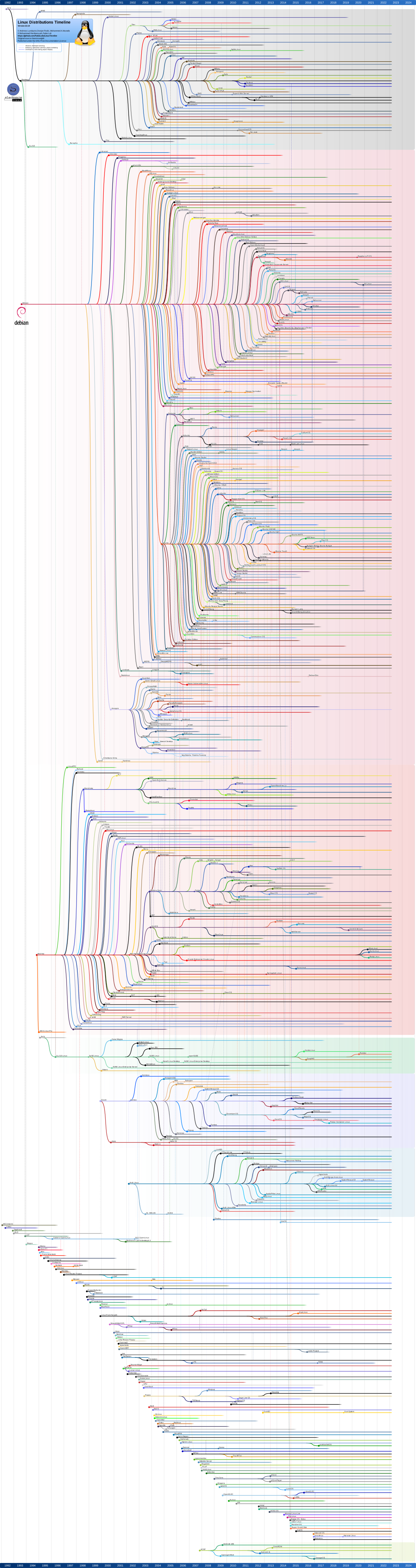
> On Mar 7, 2016, at 2:20 PM, Sean Rickerd <[email protected]> wrote: > > I'd have to disagree with the server comment. > > In the enterprise space, there is very little Debian. You'll be looking at > SUSE and Red Hat in that space. That said, those two are the most > stable/dependable when it comes to running production servers. > > Also ,your statement about the packaging management system is nothing more > than opinion. > > Debian may be the best for you, and that is perfectly fine, but I would point > out there is a lot of bias in that conclusion. > > Sean Rickerd > Ingénieur Commercial/Sales Engineer > [email protected] <mailto:[email protected]> > 514.834.5778 > ------------------------------------------------ > <suse_logo_color-smaller.png> > On 07/03/16 01:41 PM, Yves Legault wrote: >> Here is my personal path in the Linux world: >> - Caldera Linux, before 1999 It was not easy to find and install the proper >> video and audio drivers back then! >> - Red Hat 7 8 and 9, somewhere between 2002 and 2003 >> - Fedora Core1, 2, 3 and 4, from about 2003 to 2005 >> - Debian 3, 4, 5, 6, 7 and currently 8, from about 2006 until today. >> - I have been using UbuntuStudio for music related work for few years. >> Beside some issues with updates, I never had problem with this distribution >> which has a lot of goodies included in their default setup. >> - There has also been short trials of Suse, Mandraque, DamnSmallLinux, >> Ubuntu and more recently Mint. >> - Knoppix is also to be noted as I used it some times to rescue windows as >> well as Linux machines sometimes. >> - Since Debian is likely the most stable OS there is, it can behave as an >> OS, meaning I can forget about it's existence while getting ahead with my >> work. >> - It is the father, or grand father of over 60% of all linux distributions. >> - In the desktop OS it is not the most popular, but not by much. >> - It is the best distribution when server installation comes to mind, which >> is a tribute to it's stability. >> - It has the best packaging management system there is. >> - Updates very rarely create issues. >> - Now a day, the Debian installer does provide a choice of desktop at >> install time. Gnome, KDE, Xfce and LXDE are among the choices available. >> This is the single most important improvement that recently occurred with >> Debian, allowing installation of a GUI (or not) on vintage machines, giving >> them a second life. >> My main PC is currently built around 120GB SSD for the operating system, 1TB >> HDD for the /home folder, 12GB SDRAM, AMD Phenom X4 925 CPU and a GeForce >> 9500GT video card connected to two 27 inches screens, a scanner, a webcam >> and an HP2600N printer. >> This setup has been running virtually unstopped since 2012... Except for 3 >> power failures, a few times when I moved the PC to another room, a dead UPS >> battery that needed to be swapped, and annual heatsink dust cleanup. >> I have several PC's running Debian around the house, most of them have a up >> time of more than 2 months. There is a small 9 inches screen eeePC that ran >> for over 387 days without a reboot. >> I am currently running these softwares on my main PC form time to time: >> - Eclipse, especially for software development with atmel MCU's in mind. >> - MPLABX for Microchip MCU's development. >> - Arduino IDE >> - DOSBOX to run some old DOS games I still like to play sometimes. >> - Oracle's VirtualBox, when I need access to several machines at the same >> time to do network topology development or when a friend need help on >> Windows stuff. >> - LibreOffice applications. >> - Do not forgent the web browser Iceweasel and the Evolution mail client, >> which are quite often the most used. >> So, for the last 10 years, I can say that Debian Linux has held it together >> without major issues for me. >> >> Therefore, I conclude with the personal understanding that Debian is the >> overall best distribution there is. >> All the above being said, note that we have seen over 800 Linux >> distributions created that had some significance, although there might be >> less than 300 currently available. This is more than enough choices to pick >> from when a specific need comes around. >> >> Sources: >> https://distrowatch.com/search.php?ostype=All&category=All&origin=All&basedon=All¬basedon=None&desktop=All&architecture=All&package=All&rolling=All&isosize=All&netinstall=All&status=All >> >> <https://distrowatch.com/search.php?ostype=All&category=All&origin=All&basedon=All¬basedon=None&desktop=All&architecture=All&package=All&rolling=All&isosize=All&netinstall=All&status=All> >> https://upload.wikimedia.org/wikipedia/commons/1/1b/Linux_Distribution_Timeline.svg >> >> <https://upload.wikimedia.org/wikipedia/commons/1/1b/Linux_Distribution_Timeline.svg> >> >> YLL >> >> > _______________________________________________ > mlug mailing list > [email protected] > https://listes.koumbit.net/cgi-bin/mailman/listinfo/mlug-listserv.mlug.ca
_______________________________________________
mlug mailing list
[email protected]
https://listes.koumbit.net/cgi-bin/mailman/listinfo/mlug-listserv.mlug.ca