Hello Morhpometricians -

Caveat:
I am very new to the field of morphometrics. In fact, I am neither a
biologist or an anthropologist. I am a PhD student of computer graphics
and my work involves warping and deformation of objects, thus my
interest in morphometrics. I hope this explains why I might be asking
questions that may appear trivial as well as my repeated use of layman's
terms and my occasional misuse of technical terms ;) .
Question:
I have just implemented the 3D TPS method/algorithm described in Chapter
15 pp. 391-392 of "Geometric Morphometrics for Biologists (A Primer)" by
M. L. Zelditch et. al.  On visualizing the deformation, I noticed that
the deformation/warp does not produce a smooth, curvature continuous object.

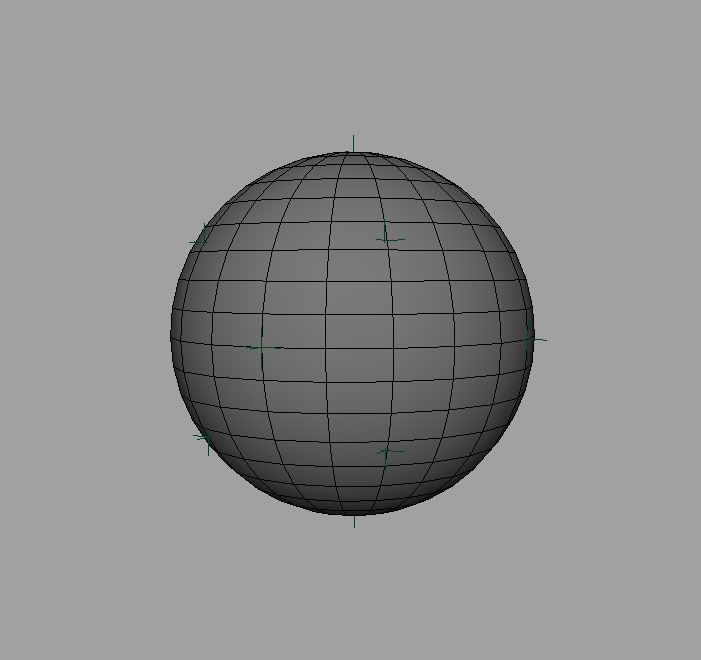
For instance, the images below show a sphere (of 10 units radius), with
the following 14 landmarks (? I suppose thats what the equivalent a
"deformation point" would be):

[The points are "moved" as indicated by the arrows]
A: ( 10.0,   0.0,   0.0 ) ->  A': ( 15.0,   0.0,   0.0 )
B: (-10.0,   0.0,   0.0 ) ->  B': (-15.0,   0.0,   0.0 )
C: (  0.0,  10.0,   0.0 ) ->  C': (  0.0,  15.0,   0.0 )
D: (  0.0, -10.0,   0.0 ) ->  D': (  0.0, -15.0,   0.0 )
E: (  0.0,   0.0,  10.0 ) ->  E': (  0.0,   0.0,  15.0 )
F: (  0.0,   0.0, -10.0 ) ->  F': (  0.0,   0.0, -15.0 )

[These points are not moved]
G: ( +7.071,  +7.071,  +7.071 )
H: ( -7.071,  -7.071,  -7.071 )
I: ( +7.071,  +7.071,  -7.071 )
J: ( +7.071,  -7.071,  +7.071 )
K: ( -7.071,  +7.071,  +7.071 )
L: ( -7.071,  -7.071,  +7.071 )
N: ( -7.071,  +7.071,  -7.071 )
O: ( +7.071,  -7.071,  -7.071 )

Sphere before deformation:
http://i17.photobucket.com/albums/b52/videohead/sphere_before.jpg

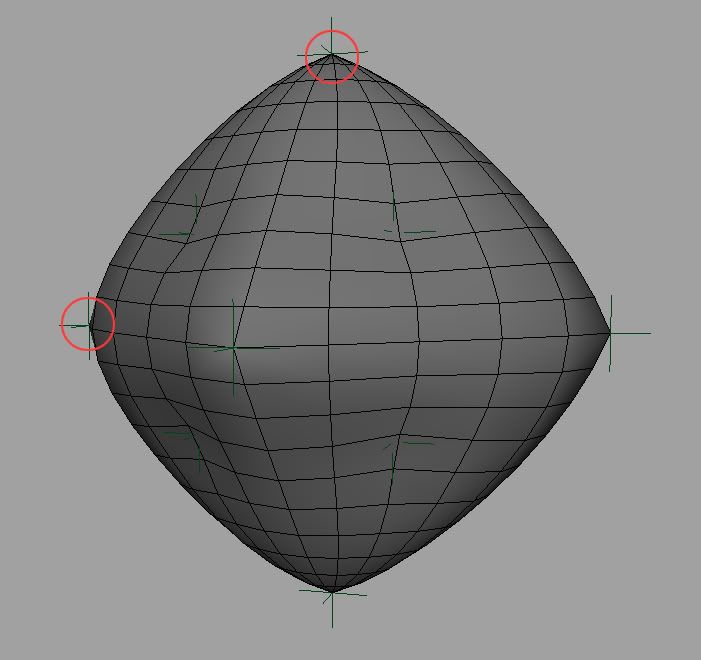
Sphere after deformation:
http://i17.photobucket.com/albums/b52/videohead/sphere_after.jpg

(Green crosses indicate the positions of the points in both images)

The latter image highlights a few "unsightly" discontinuities in
gradient/curvature of the deformed sphere at the points A' - F', which
after some consideration wasn't much of a surprise considering that the
linear combination of weights and the radial basis function U = |P -
P[i]| is discontinuous where P = P[i]. That is to say if:

F(P) = k0 + k1.P[x] + k1.P[y] + k1.P[z] + SUM_i( W[i].|P - P[i]| )

Where i = 1 .. N (N = no of points/landmarks). The derivative F'(P) (wrt
to x, y, or z) is undefined at every P[i].

I suppose none of this is new to you experts, so my question is what
would be the standard or recommended way of removing these
discontinuities? I'm looking for some method that warps a 3D object but
produces smooth i.e. continuous optimal deformations that minimize
bending energy (something that makes the 2D TPS method so appealing) BUT
for a 3D problem.

Help, someone. Anyone?

Thanks for bearing with me.

- Olumide
   [EMAIL PROTECTED]
--
Replies will be sent to the list.
For more information visit http://www.morphometrics.org