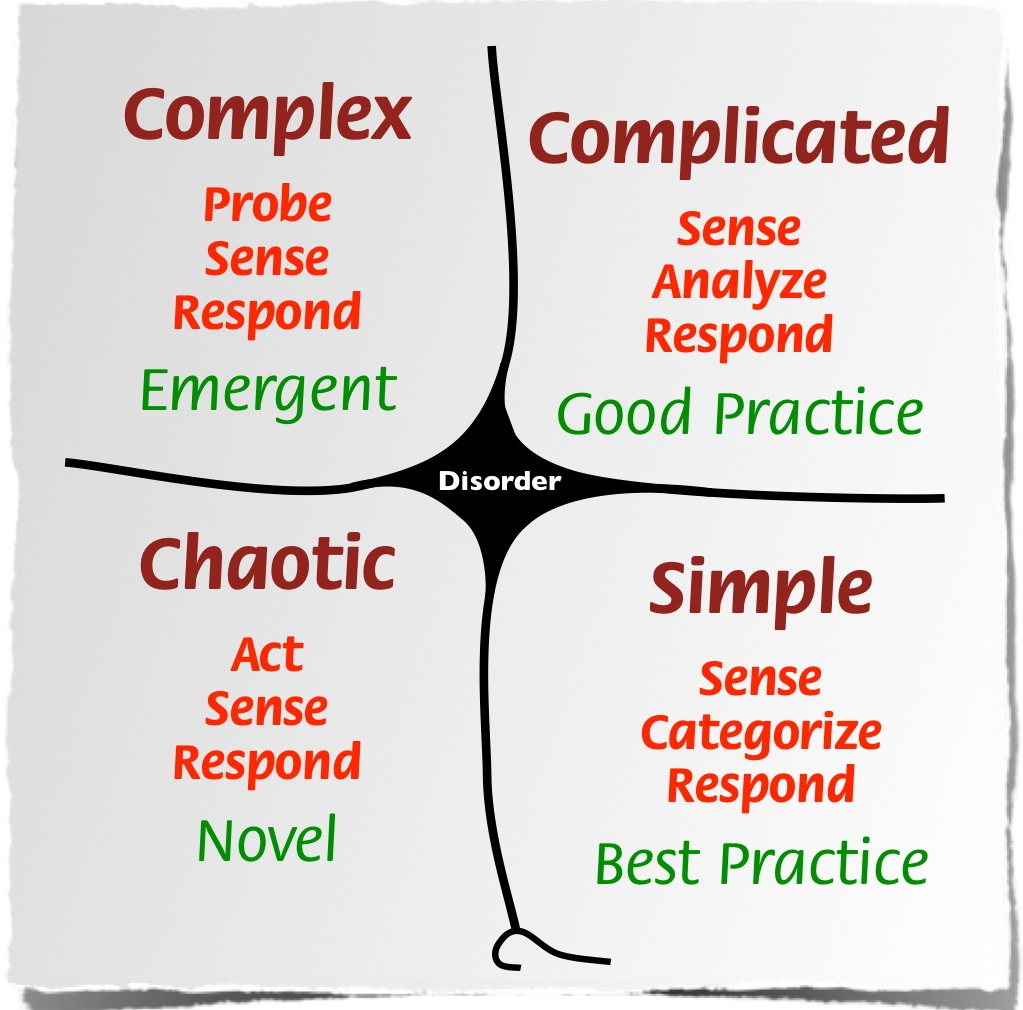
While Snowden and others introduced Cynefin in 2007, they have continued to
work on it in incredible amounts of detail.  Far more than is useful to recite
here.  But I would suggest that you visit http://www.cognitive-edge.com to
track the further development of this framework.
We could get sidetracked into a whole thread on this, but what is interesting
to note from a technical perspective is that the Cynefin framework is actually
an ontology - meaning that it describes ways of being rather than ways of
knowing - and it helps people to understand what to do when confronted by
certain situations.

I find it a really really useful framework, but in my 6 or more years of
exploring it have come to realize that it needs careful and appropriate
application.

At a base level however, the distinction between the minds of problems that
require emergent solutions and those requiring technical solutions has been a
useful distinction when working with clients who are struggling with a variety
of responses to the kinds of situations they face in their work.  It has been
the most useful way.

If you can stand it, there is a 55 minute recording of me giving a teleseminar
online on the use of Cynefin to understand complexity especially in respect to
using participatory processes like Open Space:

http://www.youtube.com/watch?v=mRn3BM56W74

Chris


On Jul 24, 2014, at 7:58 AM, Daniel Mezick <[email protected]> wrote:

> Harold,
>
> Yes, and more and more work is actually tipping into the complex/chaotic
> state as depicted on the Cynefin diagram. I suspect this trend is being
> powered by increases in the rate of change in the society, driven primarily
> by technology.
>
> Every day, more and more work is complex and chaotic. Loads of change, all
> day, every day.
>
> Maybe the Cynefin diagram needs to allocate more space to complex and chaotic
> work, to depict it more accurately:
>
> Diagram:
> http://upload.wikimedia.org/wikipedia/commons/4/45/Cynefin_framework_Feb_2011.jpeg
>
>
>
> Fewer and fewer projects are qualifying for the traditional ABC management
> approach. More and more complex & chaotic work tends to favor empirical
> approaches and may explain the popularity of Agile. It also might explain the
> rise of Open Space as a legitimate tool for manifesting high performance in
> business. "Management" as important as ever, is a function of the
> self-organizing system. It is not a role.
>
> This link explains how Microsoft is laying off 18000 people and beginning
> what appears to be a forced march to Agile:
> http://www.tgdaily.com/enterprise/120066-is-microsoft-adopting-a-more-agile-approach
>
> ...this, from what was once a very, very successful software vendor.
>
> Ouch.
>
> Are we all being swept along by a tide of relentless change? I see some
> crazy-looking folks way out there, in the water, wearing wet suits, on
> surfboards. They appear to be greatly enjoying themselves.
>
> Daniel
>
> On 7/24/14 6:15 AM, Harold Shinsato wrote:
>> Chris,
>>
>> Thank you for bringing in the Cynefin framework! After hearing about
>> Snowden's framework at an agile software conference, it quickly spread
>> through the Agile community. Agile is even referenced in the wikipedia
>> article about Cynefin. I'd recommend that folks take a look at the article
>> at least for the simple graphic that helps understand the
>> model:http://en.wikipedia.org/wiki/Cynefin
>>
>> It's interesting that although Snowden's article was published in 2007 in
>> HBR, a good chunk of the useful ideas had been worked on by Brenda Zimmerman
>> and others starting in 1998 after being inspired by the study of chaos
>> theory.
>>
>> Simple (or obvious) is like baking a cake. (Maybe things don't always go to
>> plan, but following a simple recipe at sea level with good tools and
>> ingredients will usually work).
>>
>> Complicated is like sending a rocket to the moon. Yes, many moving parts in
>> mission control. Many things can go wrong. But working the plan does most of
>> the work.
>>
>> Complex is like parenting a child. What you learn raising a child from birth
>> to age six does not give the answers for the next six years, let alone for
>> raising the next one.
>>
>> Snowden also adds a Chaotic and Disorder domain, and interesting boundaries
>> and relationships between the five domains. What's also interesting about
>> Cynefin is that the focus is on our knowledge or understanding of a system -
>> not really a description of the Universe or piece thereof.
>>
>> It's a mistake to dismiss the utility of Cynefin as a lens simply by stating
>> that the universe is self-organizing. If anything, this model's utility is
>> mostly in showing how traditional management processes (i.e. command and
>> control) are mostly inadequate for most issues especially in today's
>> environment. Cynefin has been used a great deal to help promote agile
>> practices in organizations, and surely can also be used to promote OST.
>>
>>     Harold
>>
>>
>>
>> On 7/22/14 12:57 PM, [email protected] wrote:
>>> I seek simplicity in trying to describe where and how Open Space does it’s
>>> magic.
>>>
>>> One of the ways I have had excellent success over the years in describing
>>> this work is derived from David Snowden’s work on the Cynefin framework.
>>>
>>> The short story is this:
>>>
>>> We are faced all the time with problems that are basically knowable, and
>>> problems that aren’t.  Knowable problems mean that with the right knowledge
>>> and expertise, they can be fixed.  A technical team can come together and
>>> analyse the causes, work with what’s available and craft a solution.  Then
>>> they can get an implementation plan in place and go ahead and do it.  These
>>> kinds of problems have a start line and a finish line.  When you are done,
>>> you are done.  Building a bridge is one of those kinds of problems.  You
>>> build it and there is no tolerance for failure.  It needs to be failsafe.
>>>
>>> Open Space doesn’t work well for those kinds of problems because the
>>> solution is basically already known, or at least knowable.
>>>
>>> Then there are problems for which no know solution exists, and even if you
>>> did get a solution, you can’t really “solve” the problem because the
>>> problem is due to a myriad of causes and is itself emergent. For example,
>>> racism.  Look around and you will find very few people that identify
>>> themselves as racists, but look at the stats for Canadian society for
>>> example and you see that non-white people are trailing in every indicator
>>> of societal success.  Essentially you are seeing the results of a racist
>>> society but no racists anywhere.  This is an emergent problem.  Racism
>>> itself is a self-organizing phenomenon, notwithstanding the few people that
>>> actively engineer racist environments.  Such a problem didn’t really start
>>> anywhere and it can’t really end either.  What is needed is a way of
>>> addressing it, moving the system away from the negative indicators and
>>> towards something else.
>>>
>>> In other words, this is a complex problem.
>>>
>>> The way to solve complex problems is to create many “strange attractors”
>>> around which the system can organize itself differently.  Open Space nis
>>> the best method I know of for creating such strange attractors, as they are
>>> born from the passion and responsibility of those that want to create
>>> change, and they are amplified by people coming together to work on these
>>> things.
>>>
>>> It’s “post and host” rather than “command and control.”
>>>
>>> And because you can’t be sure if things are going to work out, you have to
>>> adopt a particular mindset to your initiative: one that is “safe to fail.”
>>> In other words, if it doesn’t work, you stop doing it.  If it does work,
>>> you do more of it.  And all the way along you build in learning, so that
>>> the system can see how change is made and be drawn towards those
>>> initiatives that are currently making a difference.  Certainly this kind of
>>> problem solving is not useful for building a bridge, as you cannot afford a
>>> failure there.  But for problems with no known solutions, it is brilliant.
>>>
>>> Harrison has spent decades outlining this simplicity in even less words
>>> than I have now and his writing and thinking is, and continues to be far
>>> ahead of it’s time and maybe a little under appreciated because it is
>>> delivered in simple terms like “don’t work so hard.”  But ultimately this
>>> is the best and most important advice for working in complex systems.
>>>
>>> Open Space.  Do it.  Learn. Do it again. Don’t work so hard.
>>>
>>> More than that really starts to build in the delusion that people can
>>> possibly know what to do.  From that place solutions will be deluded.  That
>>> they may work is pure luck.  Open Space offers us a disciplined approach to
>>> addressing complexity in an ongoing way.  Don’t be fooled by its simplicity.
>>>
>>> Chris
>>>
>>
>>
>> --
>> Harold Shinsato
>> [email protected]
>> http://shinsato.com
>> twitter: @hajush
>>
>>
>> _______________________________________________
>> OSList mailing list
>> To post send emails to [email protected]
>> To unsubscribe send an email to [email protected]
>> To subscribe or manage your subscription click below:
>> http://lists.openspacetech.org/listinfo.cgi/oslist-openspacetech.org
>
> --
> Daniel Mezick, President
> New Technology Solutions Inc.
> (203) 915 7248 (cell)
> Bio. Blog. Twitter.
> Examine my new book:  The Culture Game : Tools for the Agile Manager.
> Explore Agile Team Training and Coaching.
> Explore the Agile Boston Community.
> _______________________________________________
> OSList mailing list
> To post send emails to [email protected]
> To unsubscribe send an email to [email protected]
> To subscribe or manage your subscription click below:
> http://lists.openspacetech.org/listinfo.cgi/oslist-openspacetech.org
_______________________________________________
OSList mailing list
To post send emails to [email protected]
To unsubscribe send an email to [email protected]
To subscribe or manage your subscription click below:
http://lists.openspacetech.org/listinfo.cgi/oslist-openspacetech.org