BODY { font-family:Arial, Helvetica, sans-serif;font-size:12px;
}List
        My concern in these discussions about 'science' and 'truth' is how
are we to differentiate between what can be empirically justified as
truth and what is believed to be truth? Isn't such a distinction
necessary to prevent the fundamentalism that leads to such things as
religious wars or, eg, the Salem Witch Trials?

        Because one can set up a syllogistic argument that is valid, does
this mean its conclusion is also a truth?

        That is, if one begins with a belief - as one must - and in this
instance, it is that both the devil and god are real and can
influence human behaviour, if one so chooses - then, how do you
differentiate between the two types of behaviour and their causes?

        Edwina
 On Fri 24/05/19  2:21 PM , John F Sowa [email protected] sent:
 Jon AS, Gary F, Edwina,
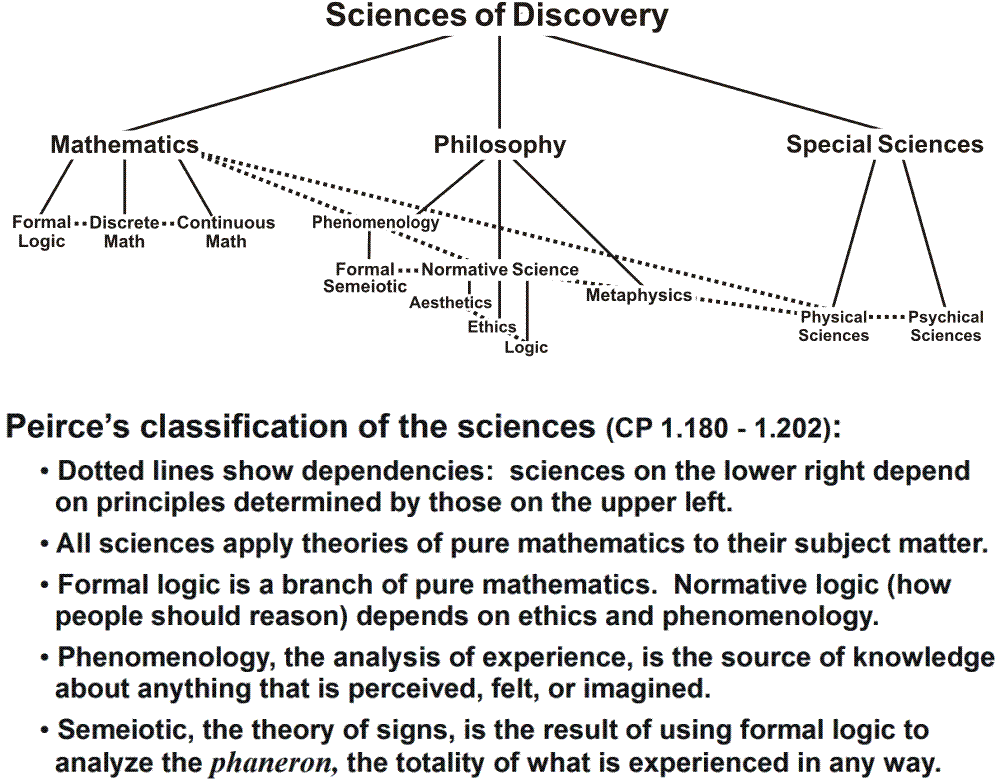
 Peirce's classification of the sciences (1903 with refinements
before
 and after) has never been surpassed or even approximated by anyone
 in the past century.  I believe it's fundamental to understanding
 many issues about science, engineering, philosophy, *and* religion.
 See the diagram http://jfsowa.com/ikl/cspscience.png [1]
 For example, see the comment by Victor Lowe, as quoted by Jaime
Nubiola
 (p. 4 of

https://www.academia.edu/attachments/40941552/download_file?st=MTU1ODcwNTk1MCw3MC4yMy4zNi4xNzMsNDQ3MDEzOQ%3D%3D&s=swp-toolbar
[2]
 )
 VL
 > How shall metaphysics be pursued? — As a science among the
sciences,
 > says Peirce. Not so, says Whitehead; it seeks truth, but a more
 > general truth than sciences seek" (Lowe 1964, 440).
 But that is just a trivial distinction based on their definitions
 of 'science':  Peirce's definition is closer to the German word
 'Wissenschaft', which includes includes philosophy.  If asked, I'm
 sure that Whitehead would have agreed with the top level of that
 diagram.  In fact, he might have agreed with most or all the
details.
 > JAS: If "God" is indeed "the definable proper name," then might it

 > not also be the exception to the rule that acquaintance with the
 > Object of a Sign requires Collateral Experience/Observation?
 >
 > GF: Quite possibly; and that would explain why “knowledge of
God”
 > is indeed exceptional, and not at all like our knowledge of Peirce

 > or any person who has existed.
 These questions also depend on the definitions of the terms and the
 way they're used in normal discourse.
 First, every term of mathematics is based on a definition, not on
 collateral experience.  But anyone who reads any book or article
 on mathematics must use collateral experience to understand which
 definition(s) the author is using.
 Second, children learn about God in the same way they learn numbers:

 by the contexts in which the words are used.  Any definition of the
 word 'God' is an invention of theologians.  Religions are rarely,
 if ever, founded on a priori definitions.  Sacred texts begin with
 stories or hymns, usually based on oral transmissions.  Theologians
 don't define the terms until the "faithful" begin to doubt them.
 Third, the distinction between knowledge and belief is vague.
 Gettier (1963) raised puzzling questions about the definition of
 knowledge as justified true belief.  But long before Gettier, Peirce

 pointed out that any of our cherished beliefs might be falsified.
 ET
 > Peirce's use of 'fancy' is different from our modern day
understanding
 > of the word.
 Yes.  It's important to read more of CP 1.321:
 > We live in two worlds, a world of fact and a world of fancy...
 > I doubt not that much the greater part of the reader's labor is
 > expended on the world of fancy, yet it is near enough the truth
 > for a first approximation. For this reason we call the world of
 > fancy the internal world, the world of fact the external world.
 This implies that the world of fancy includes everything we know or
 believe about all the sciences of discovery and all the practical
 sciences.
 Religion includes aspects of every branch of philosophy
(phenomenology,
 semeiotic, aesthetics, ethics, normative logic, metaphysics) *and*
of
 the special sciences, both physical and psychical.  In fact, it's
hard
 to find any science of discovery that is not in some way related to
 some aspect of religion.  That point is not surprising, since
primitive
 societies rarely make any distinction between them:  the religious
 leader is often the "medicine man".
 The practical sciences include practical ethics (as distinguished
 from theoretical ethics as a normative science).  Religion has a
 great deal to say about that.  The chief political/military leader
 is usually distinct from the chief science/religious leader.  But
 the two of them work together in both primitive and modern
societies.
 ET
 > I think the Chinese perspectives, and there are quite a few, are
not
 > similar to monotheism, since, to me the very ancient Chinese
'forces
 > of the world' which move in cycles are not similar to the singular

 > hierarchy of monotheism. And Confucian 'ren' [also 'jen' in
pinyin]
 > to me, is more of a system of societal norms --and this isn't
 > monotheistic. The Taoist perspective is also societal [as are all
 > religions] but - it acknowledges a metaphysical force in the
world.
 I agree.  But again, the lines aren't sharp.  The translation of
 the New Testament to Chinese maps 'Logos' to 'Tao'.  Then John's
 equation Theos = Logos would become Theos = Tao.  That definition
 would facilitate the goals of the missionaries, but it seems to
 have some basis in the experiences called mystical or religious.
 Re fact and fancy:  As Peirce said, symbols grow.  That is true
 about the way that every child's vocabulary develops during a
 lifetime *and* about the way that the vocabulary of any science
 or religion develops.  That means it's a psychological distinction.
 It can't be used to distinguish science and religion.
 John


Links:
------
[1]
http://webmail.primus.ca/parse.php?redirect=http%3A%2F%2Fjfsowa.com%2Fikl%2Fcspscience.png
[2]
http://webmail.primus.ca/parse.php?redirect=https%3A%2F%2Fwww.academia.edu%2Fattachments%2F40941552%2Fdownload_file%3Fst%3DMTU1ODcwNTk1MCw3MC4yMy4zNi4xNzMsNDQ3MDEzOQ%253D%253D%26s%3Dswp-toolbar
-----------------------------
PEIRCE-L subscribers: Click on "Reply List" or "Reply All" to REPLY ON PEIRCE-L
to this message. PEIRCE-L posts should go to [email protected] . To
UNSUBSCRIBE, send a message not to PEIRCE-L but to [email protected] with the
line "UNSubscribe PEIRCE-L" in the BODY of the message. More at
http://www.cspeirce.com/peirce-l/peirce-l.htm .