Hi Nick,

Thanks for your reply!
On 14-01-14 12:48 PM, Nick Oosterhof wrote:
On Jan 12, 2014, at 9:40 PM, Marius 't Hart wrote:
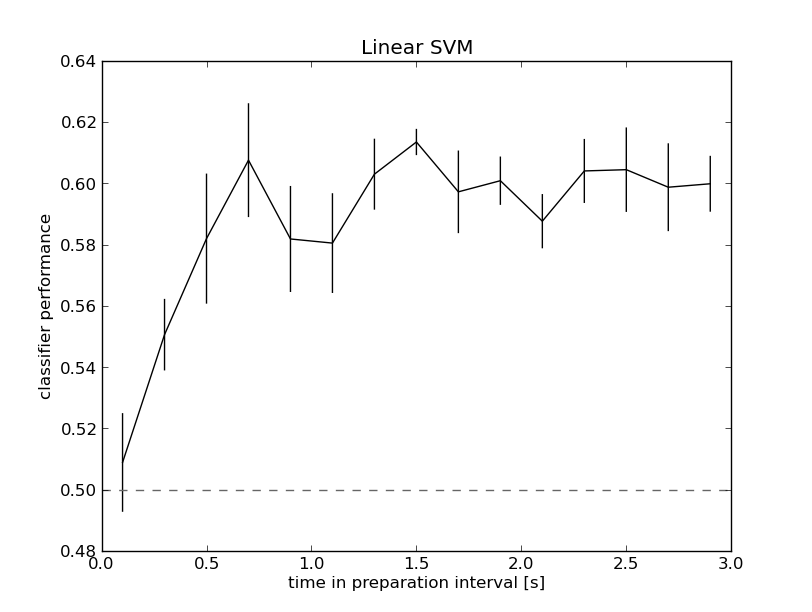
My toy problem is to classify the two most extreme conditions (two targets)
based on averaged Cz and Pz activity (two features) for every 200ms epoch in
the preparation interval. An N-fold partitioner using a linear SVM performs at
chance at the start of the interval, and then reaches a plateau at about 60%
pretty quickly. Not spectacular maybe, but I was pretty excited to get some
results and hope it is good enough for what I want to do next. See performance
here:
http://www.mariusthart.net/images/LinSVM_Cz-Pz_c18_pp1-8.png
Did you provide an equal number of samples for each class (target)? Because if
you didn't then 60% could, in principle, be due to chance. That is, if 60% of
the samples are in one class in the training set, then a 'naive' classifier
that is just guessing that class all the time will give 60% accuracy.
Yes, after manual artefact rejection the number of trials in each
condition is different. I take the first N trials from each condition,
with N being the number of trials in the condition with the smallest
number of trials. This number is different for each participant.
Also: what preprocessing did you do? Any z-scoring, baseline correction etc?
I do baseline correction, but no Z-scoring. Should I do Z-scoring? If
so, over all data, within electrode or within trial?
In the CNV plot it looked like the usefulness of Pz and Cz for the
classifier(s) should flip at around 1 second in the preparation interval, so I
wanted to look at sensitivity. [...] That doesn't look like what I expected -
but I find it hard to judge if what I'm doing is actually correct. For example,
on inspecting all the different sensitivity datasets, it looks like the sign
that each feature gets is usually the same... but there are a few exceptions.
Does the sign actually mean anything in terms of a feature's usefulness?
As far as I know the sign is not that important - it's more about the relative
magnitude. If the sensitivity is further away from zero then that means the
feature is more important for discriminating the classes.
OK, so basically, although it looks like there is difference in the
usefulness of the electrodes for classifying the conditions, the
classifiers don't reflect that. Would it make sense to try different
classifiers, instead of Linear SVM?
When I look at the individual sensitivity datasets, they look like this:

In [19]: sensitivities[0]
Out[19]: Dataset(array([[ 0.14507451, -0.02963355]]),
sa=SampleAttributesCollection(items=[ArrayCollectable(name='targets', doc=None,
value=array([[8, 1]]), length=1), ArrayCollectable(name='biases', doc='Sequence
attribute', value=array([-0.63935516]), length=1)]),
fa=FeatureAttributesCollection(items=[]),
a=DatasetAttributesCollection(items=[]))

Now there is a number -0.63935516 that puzzles me. Second noob question: what
does this 'bias' number mean?
I'm not an expert on this... maybe it's the offset from the separating
hyperplane, i.e. all vectors x for which dot(a,x)=b with b the bias and a the
sensitivities?
Alright, so I can probably ignore that for my purpose of seeing if the
focus of the classifiers shifts from one electrode to the other.
_______________________________________________
Pkg-ExpPsy-PyMVPA mailing list
[email protected]
http://lists.alioth.debian.org/cgi-bin/mailman/listinfo/pkg-exppsy-pymvpa
Best,
Marius

_______________________________________________
Pkg-ExpPsy-PyMVPA mailing list
[email protected]
http://lists.alioth.debian.org/cgi-bin/mailman/listinfo/pkg-exppsy-pymvpa