The linked article contrasts them with the GoF-style iterators as well.

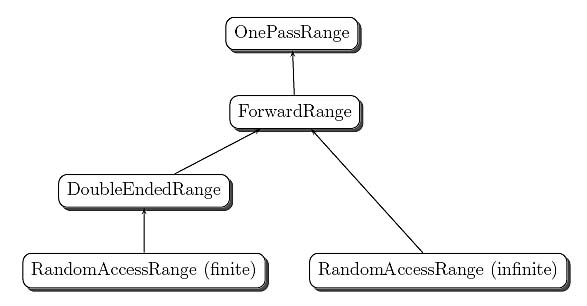
The Rust Iterator trait is similar to the "one pass ranges" (and possibly
forward ranges), but not double-ended ranges or random-access ranges. It's
the *family* of range-based iterators that makes it flexible (e.g. allowing
you to write an efficient in-place reverse without knowing the underlying
data structure, using a double-ended range).
See fig. 3:
http://www.informit.com/content/images/art_alexandrescu3_iterators/elementLinks/alexandrescu3_fig03.jpg


On Thu, Jun 6, 2013 at 8:16 PM, Daniel Micay <[email protected]> wrote:

> On Thu, Jun 6, 2013 at 11:01 PM, Sebastian Sylvan
> <[email protected]> wrote:
> >
> >
> > On Thu, Jun 6, 2013 at 7:22 PM, Bill Myers <[email protected]>
> wrote:
> >>
> >> Scala has a similar design, with the following traits:
> >> - TraversableOnce: can be internally iterated once (has a foreach()
> method
> >> that takes a closure)
> >> - Traversable: can be internally iterated unlimited times (has a
> foreach()
> >> method that takes a closure)
> >> - Iterable: can be externally iterated (has an iterator() method that
> >> returns an Iterator trait)
> >>
> >> The way it works is that Iterable extends Traversable, which extends
> >> TraversableOnce, and the for loop just uses TraversableOnce, and
> Iterable
> >> has a default implementation of the TraversableOnce foreach() function
> using
> >> the iterator() function.
> >>
> >> Also, the Iterator trait itself extends TraversableOnce, implementing
> >> foreach() by mutating itself.
> >>
> >> It might be a good idea to investigate copying this design.
> >
> >
> > I find Andrei Alexandrescu's argument about range-based iterators pretty
> > persuasive: http://www.informit.com/articles/article.aspx?p=1407357
> >
> > Seb
>
> Andrei usually talks about ranges in contrast with C++ iterators, so
> it's a bit different than comparing with the Iterator trait Rust is
> using. C++ iterators don't know when they've reached the end of the
> range, so you have to compare them with a sentinel end iterator. In
> that sense, Rust's iterator is a range and the `next` method is
> comparable to the pop method on D ranges.
>


--
Sebastian Sylvan
_______________________________________________
Rust-dev mailing list
[email protected]
https://mail.mozilla.org/listinfo/rust-dev