Neville Munn wrote:
You'll have silver in the solution with OR without Tyndall. We know
they're colloids, but what size are those colloids?
OK, let's seriously look at particle size for a moment.
Question 1 would be...At what *minimum* size do particles have a
tendancy to fall out of solution, or what size will they need to be
before gravity pulls them out of solution? I look forward to an
answer on this one. I'd say they'd have to be pretty big and
suggest larger than 1 micron. Nobody who produces EIS comes anywhere
remotely near that dimension.
There is no absolute maximum size. The maximum is set by both the size
and the zeta of the particle. If the zeta is 0 then even the smallest
particles will fall out.
Question 2 would be...What are the sizes of the smallest AND the
largest particles in the same solution? They won't all be the SAME
size, there are a different sized particles present to my knowledges,
we only hear about the smallest ones, which is probly why particle
size and ion/particle ratios don't appear on the bottle, it could come
back and bite them on the arse if someone gets an analysis done after
purchase. {I don't purchase any so I stand to be corrected if this
statement is not right}.
The smallest are likely to be around 2 angstroms, actually 1X2
angstroms. The largest will be indicated by the color to some extent.
Question 3 would be...What is the size of the largest particle in a
yellow solution? Remember, we're talking about nanometres here, not
microns, so they're pretty small as we all know.
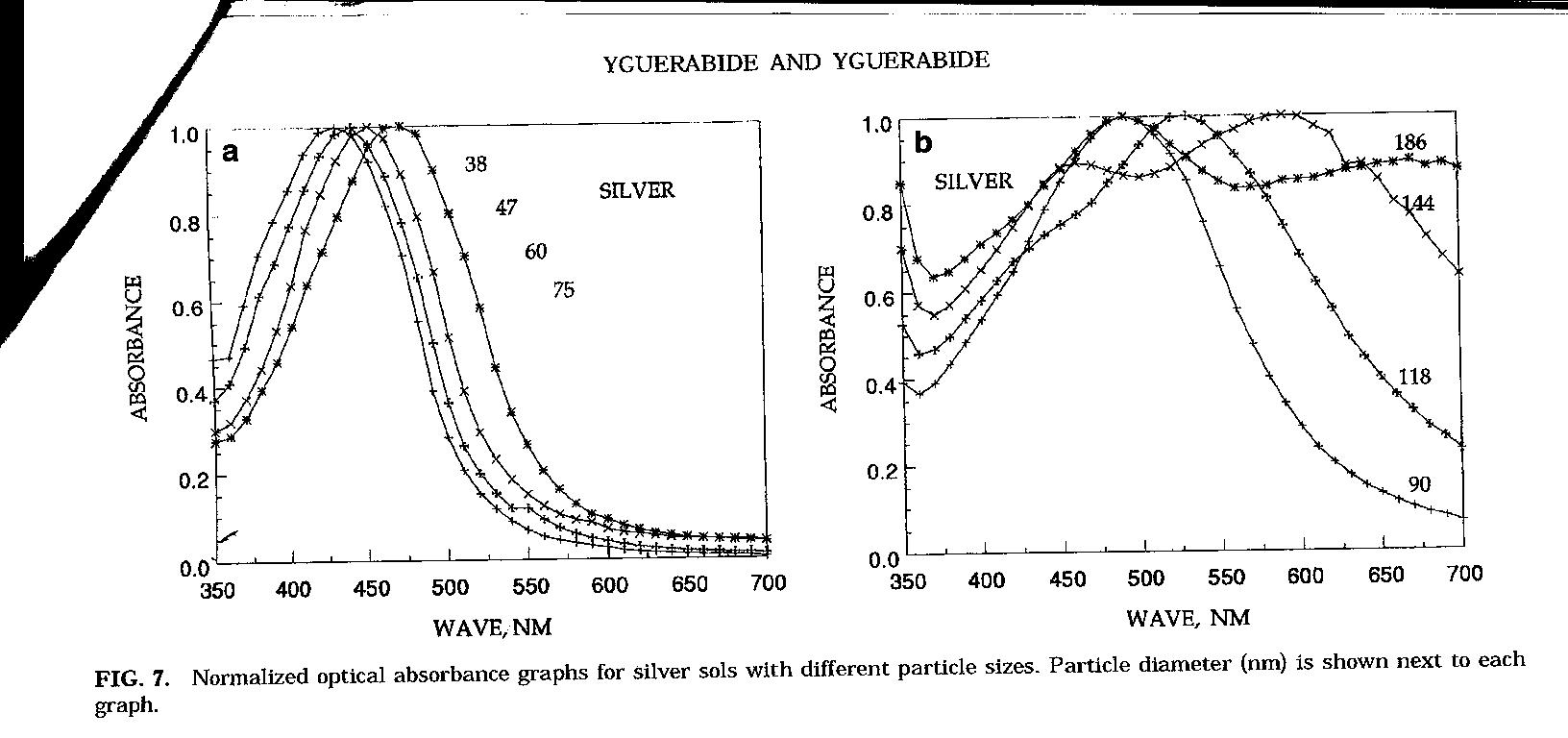
Particles with a peak absorption in the violet region (which gives
yellow) of 431 nm are 38 nm in diameter. Particles of this size have an
absorption curve that it 350 nm to about 480 nm fwhm. You really can't
say what the largest particle size is because particles absorb a broad
range of wavelengths, and if you have a large particle absorbing
primarily yellow for example, but the others are absorbing violet, the
yellow one will not appear violet, but rather grey, which is no color
because of the way the eye works.This can be easily seen when you look
at the curves at http://silver-lightning.com/cs-curves.jpg where the
sizes from left to right are 38 nm, 47 nm, 60 nm, 75 nm, 90mnm, 118 nm
and 144 nm.
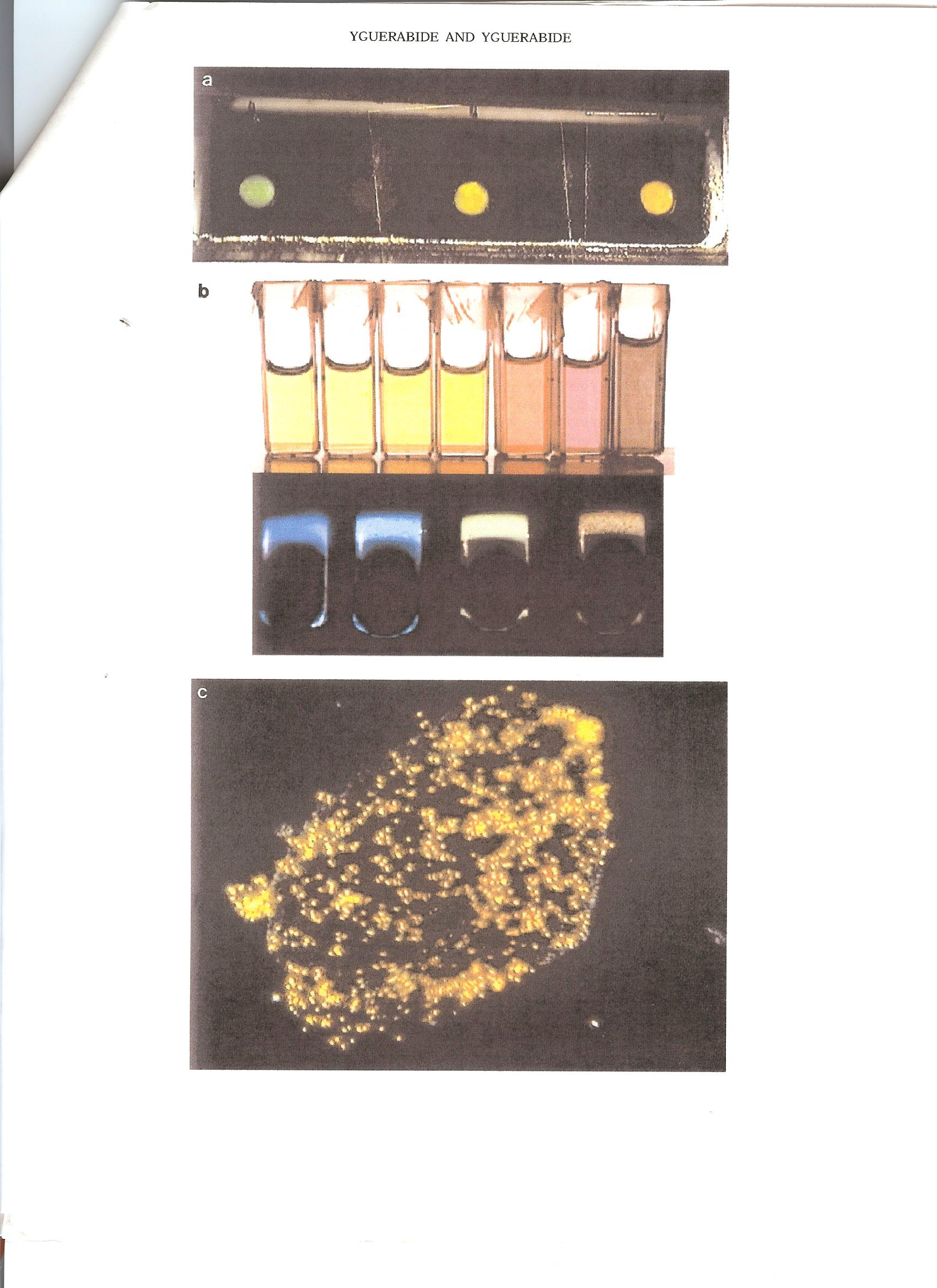
The broad range that yellow covers can be seen at
http://silver-lightning.com/cs-color.jpg where the test tubes of CS
appear yellow over a wide range of sizes.
When talking about EIS we are talking about nanometre dimensions, not
micron scale, soooo, I'd have to ask...If gravity has pulled NOTHING
out of a solution, be it a clear OR coloured solution, what makes
anyone think there is any problems with yellow solutions, providing
that the colour is pure and transparent as I've explained before?
Because the problem with large particles is not fall out, but rather
absorption. If the particles are too large they cannot penetrate the
stomach wall or move into some of the hiding places of bacteria. Also
the effectiveness which is proportional to the surface area goes down
linearly as the size goes up. That is a particle that is twice as big
has 8 times the silver in it, but only 4 times the surface area, thus
the effectiveness is only half as much.
And I know about particle surface area, but what makes one think that
ALL those particles will be larger than suggested by popular press.
You're going to lose some ions to particle clusters or crystals after
24 hours of solution sitting anyway, doesn't make it any less efficacious.
If EIS is being made appropriately one should have particles WAY WAY
below 1 micron.
If it is yellow then it will be below 50 nm, although a few can be much
larger.
OK, my analysis showed some particles failed to pass thru a .45 micron
filter paper...What does that mean to me? Nothing, absolutely
nothing, zero, zilch, cos agglomeration would have had it's way during
the filtering process, soooo, another question could be...What was the
ACTUAL size of those particles BEFORE being put thru that paper
filter? Logic tells me they would have been WAY WAY below 450 nm. If
one follows the popular press, refraction of light on colloids not
only signifies particles of a particular minimum size, but ALSO
indicates vast numbers of particles, which one will a person choose to
go by, size or number, or both?
Refraction and reflection of light are a different matter. Those
contribute to Tyndall, color is primarily from absorption of light.
There is no minimum size for Tyndall, it occurs all the way down to the
minimum particle size of 2 anstroms, but the intensity drops off at the
4th power of the size if my memory serves me correctly. I have posted
the equations here before. The peak scattering of silver particles
occurs very close to that of the absorption.
I know the method of producing our EIS today produces the smallest
particles possible, and any/all particles in any of my solutions are
WAY below half a micron, and when reading how small a particle must be
to pass thru the stomack lining, capillaries etc in the circulatory
system, organs, even the blood brain barrier {can't remember now cos
it's years ago I read that material so delete the blood brain barrier
thing if it's incorrect}, that encourages me to believe ALL my silver
solutions, clear or coloured, are perfectly bioavailable and super
efficacious.
I am unable to find any good references that give the absorption vs
molecular size for the stomach. Some years ago I found that the
absorption begins dropping off at around 15 nm, but I cannot find that
now. One reference seems to indicate that significant dropoff occurs
above 85 nm.
Final note: With all the people around the globe producing this
stuff, including among you people here, does one think for one
nanosecond {pun intended} that all their/your particles in their/your
solutions are of the smallest size which popular press 'suggests?'
they should be? Somehow I doubt that very much, one must look at this
stuff with more logic I think, and relax a little more. Most of
the information which abounds in the public domain regarding EIS/CS is
supposition, inuendo, best guess senario, techno babble, trying to
suck people in, or just plain BS. With laboratory analysis I
understand this much clearer, and with all I've read over the years
I'm totally comfortable with what I produce, and how I produce it, I'm
as cool as a cucumber with not a worry in the world about what I make
and take...clear or yellow.
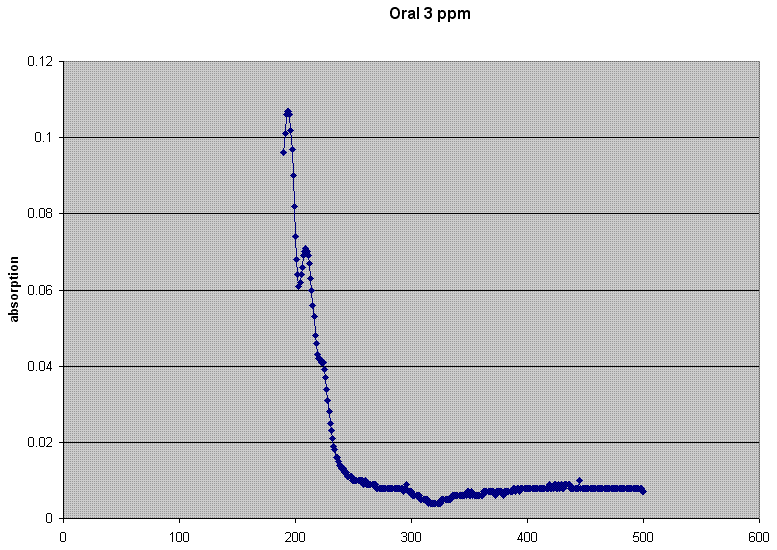
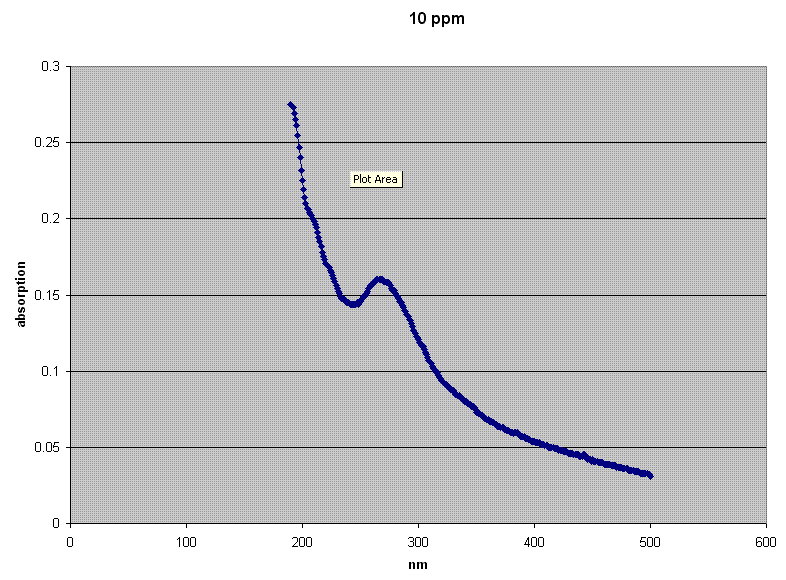
If you look at the absorption curve of some EIS I made that was around 3
ppm at http://www.silver-lightning.com/hach/oral.GIF you will see that
there are two peaks, one at 193 nm and the other at 209 nm. It was
totally clear. Particle sizes from the graph appear to be less than 1 nm
from the absorptions.
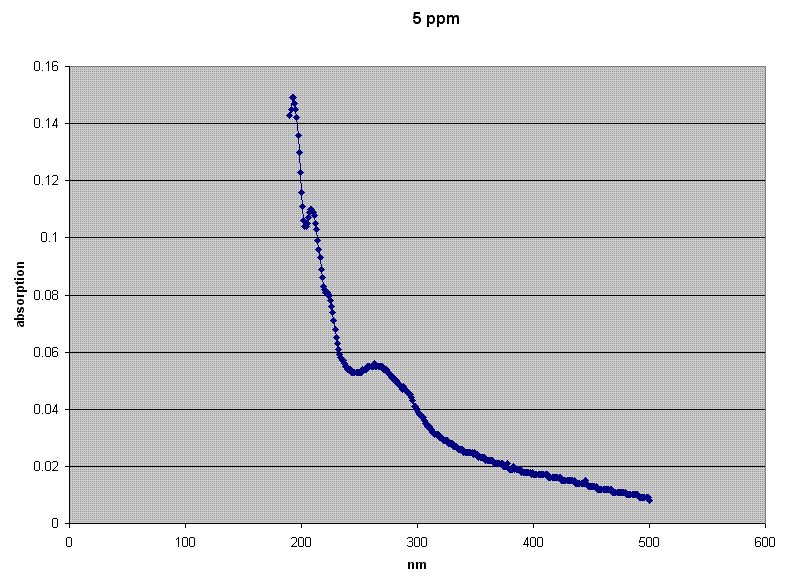
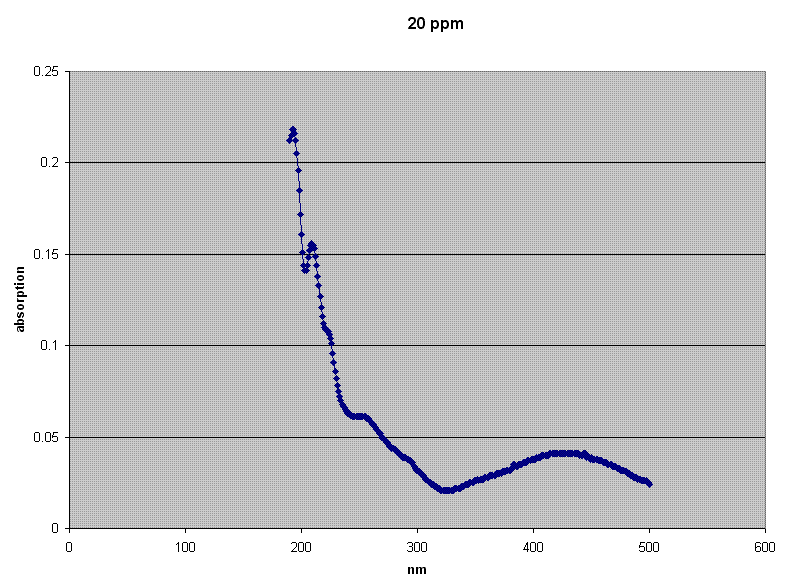
The graph at http://www.silver-lightning.com/hach/oral2.GIF show some
which was higher ppm and was slightly yellow. However the vast majority
of the absorption was below 350 nm.
The graph at http://www.silver-lightning.com/hach/oral3.GIF was very yellow.
The graph at http://www.silver-lightning.com/hach/topical.GIF was gold
and it still has most of the absorption below 350 nm but has a broad
hump that peaks around 420 nm which is what contributes the gold color.
I believe that the peaks at 200, 215 and 230 nm in all of them
correspond to particles with sizes of 1, 2 and 3 atoms in a direction.
That is a 2 atom particle will give the first two peaks, depending of
whether it is resonating lengthwise or widthwise, and a 3 and 4 atom
particle with give the second peak, and a 5 atom and larger in some
modes will give the third peak if the mode is 3 atoms in length.
Marshall
N.
> Subject: Re: CS>where is everyone? now - serious CS questions
> From: [email protected]
> Date: Mon, 12 Apr 2010 18:52:36 +0100
> To: [email protected]
>
The red laser pointer is to test the finished CS for 'tyndall effect'
which shows that you actually have silver in your solution. If you
have, it makes a clear red line through the CS water. dee
>


------------------------------------------------------------------------
Find it at CarPoint.com.au New, Used, Demo, Dealer or Private?
<http://clk.atdmt.com/NMN/go/206222968/direct/01/>
--
The Silver List is a moderated forum for discussing Colloidal Silver.
 Rules and Instructions: http://www.silverlist.org

Unsubscribe:
 <mailto:[email protected]?subject=unsubscribe>
Archives:
http://www.mail-archive.com/[email protected]/maillist.html
Off-Topic discussions: <mailto:[email protected]>
List Owner: Mike Devour <mailto:[email protected]>