---------- Forwarded message ----------
From: Jean-Francois Darcq <[email protected]>
Date: Fri, Jun 5, 2015 at 6:47 AM
Subject: Fwd: “Abandoning the Victims of Genocide in Darfur,” The
Huffington Post, 3 June 2015
To: Elisabeth Janaina <[email protected]>
---------- Forwarded message ----------
From: Eric Reeves <[email protected]>
Date: Wed, Jun 3, 2015 at 9:30 PM
Subject: “Abandoning the Victims of Genocide in Darfur,” The Huffington
Post, 3 June 2015
To: Eric Reeves <[email protected]>


*“Abandoning the Victims of Genocide in Darfur,” The Huffington Post, 3
June 2015  *

*      That was then...*

[image: The-annihilation-of-Darfur]
<http://sudanreeves.org/wp-content/uploads/2015/06/The-annihilation-of-Darfur.jpg>

*Village destruction in Darfur in 2004, as photographed by Brian Steidle,
military attaché to the African Union force of the time (AMIS); the
deployment of UNAMID on January 1, 2008 was to have halted such destruction*

There was a time when Darfur, in western Sudan, galvanized an extraordinary
coalition of activists in this country. The National Islamic Front/National
Congress Party regime in Khartoum had begun in 2003 a genocidal
counter-insurgency against the region’s African tribal groups, perceived as
the civilian base of support for rebel groups. So potent was the campaign
to halt genocide in Darfur that it forced its way onto the national agenda.
Both houses of Congress—in a unanimous, bipartisan vote of July
2004—declared that genocide was occurring in Darfur. Others followed suit,
including then-Secretary of State Colin Powell, testifying to the Senate
Foreign Relations Committee in September 2004. His testimony was based on
very substantial research along the Chad/Darfur border in August 2004.
Human rights groups, genocide scholars, church and synagogue congregations,
and legions of students made this remote and unknown region, in the very
middle of Africa, a cause to be reckoned with.

As a presidential candidate Barack Obama saw the electoral possibilities of
a strong stance on Darfur. He chided the Bus administration for what he saw
as its excessive accommodation of Khartoum’s ethnically-targeted
destruction. He declared fulsomely, invoking Rwanda and Bosnia, that “the
United States has a moral obligation anytime you see humanitarian
catastrophes”:

“When you see a genocide in Rwanda, Bosnia or in Darfur, that is a stain on
all of us, a stain on our souls. We can’t say ‘never again’ and then allow
it to happen again, and as a president of the United States I don’t intend
to abandon people or turn a blind eye to slaughter.” (video clip at |
https://www.youtube.com/watch?v=QEd583-fA8M#t=15 )

And early in his presidency Obama again characterized Darfur as the site of
“genocide.” That was then. Seven years later we hear nothing of
consequences from the administration about Darfur.

*    This is now...*

[image: page-3-1-8.13.13-PM]
<http://sudanreeves.org/wp-content/uploads/2015/06/page-3-1-8.13.13-PM.jpg>

*Despite its explicit mandate to protect civilians and humanitarians per
its authorizing resolution (UNSC R. 1769, July 2007), UNAMID has failed
badly.  Here a village completely destroyed by Khartoum-allied militia
forces last year.*

Largely as a consequence of this loss of focus, today the Darfur
genocide—the first genocide of the 21st century and the longest one in more
than a century—is about to achieve another distinction. It will be the
first genocide in which the victims are abandoned. An international
peacekeeping force authorized in 2007 to halt violence against civilians
and humanitarians—the United Nations-African Union Mission in Darfur, or
UNAMID—is on the verge of being gutted and perhaps eliminated altogether.
In less than a month, unless the UN Security Council votes to re-authorize
the force, it will be obliged to leave. This fact gives the Khartoum regime
what it considers irresistible leverage in negotiations that are ongoing,
with what still appear to be major disagreements between the UN and African
Union on one side and Khartoum on the other. The current expiration of
UNAMID’s mandate is June 30—less than a month.

The stakes are extraordinarily high. More than 3 million people have been
internally displaced or turned into refugees in eastern Chad; almost
500,000 were displaced last year alone. Mortality estimates vary, but we
must of necessity speak of several hundred thousands of deaths—perhaps half
a million
<http://sudanreeves.org/2010/08/07/quantifying-genocide-darfur-mortality-update-august-6-2010/>—from
violence and its consequences, and all indications are that mortality rates
are rising along with acute malnutrition. The victims continue to be
overwhelmingly civilians from the African tribal groups that have been
targeted for more than twelve years.

It seems perverse that *génocidaires* in Khartoum are being allowed to
decide the fate of their victims in Darfur, but in fact they are insisting
that an "exit strategy"—foolishly agreed to in principle by the UN Security
Council last August—be executed as rapidly as possible. The force has
already been cut by 10,000 and stands at approximately at 17,000 uniformed
personnel. The regime wants another 15,000 gone this year.

Criticism of UNAMID is longstanding; indeed it preceded official deployment
of the civilian-protection mission in January 2008. For the mission was set
up to fail, largely because Khartoum was given excessive control over the
deployment of personnel and equipment. This led to poor troop quality, with
the regime rejecting many highly qualified peacekeeping contributions (such
as a Swedish-Norwegian engineering battalion). Essential weaponry and
aircraft were also denied. Despite a status-of-forces agreement that was
supposed to give UNAMID unrestricted access, Khartoum has systematically
obstructed, delayed or compromised countless protection and monitoring
missions.

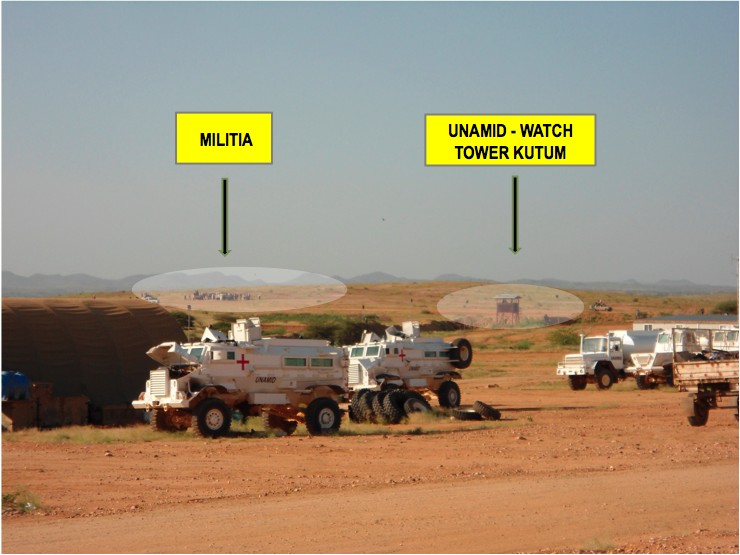
[image: Picture-2-UNAMID-watching-militia-attack1]
<http://sudanreeves.org/wp-content/uploads/2015/06/Picture-2-UNAMID-watching-militia-attack1.jpg>

*UNAMID has often, as here, refused to take action even in the face of
conspicuous assaults on civilian non-combatants (the location is near
Kutum, North Darfur). See Colum Lynch, “They Just Stood Watching,” **Foreign
Policy, **7 April* *2014   *
*http://www.foreignpolicy.com/articles/2014/04/07/special_report_darfur_united_nations_peacekeeping_investigation
<http://www.foreignpolicy.com/articles/2014/04/07/special_report_darfur_united_nations_peacekeeping_investigation>
*

As badly as UNAMID has performed, however, it is all that allows
international humanitarian organizations to remain in Darfur. If UNAMID
withdraws, or is hopelessly compromised, these organizations may well be
forced to end their work. To date, some 25 to 30 major international relief
organizations have been expelled by Khartoum or withdrawn because of
insecurity. This has occurred against a backdrop of extreme malnutrition in
many locations, a desperate lack of clean water and sanitation, and a
rapidly collapsing system for providing primary medical care.

*The moment of truth...*

At this very moment decisions are being made that will affect the lives and
security of millions of people in Darfur, and yet we hear nothing of
significance from the Obama administration about the urgency of preserving
key elements of the force. Yes, a facile international chorus has declared
"Darfur won't be abandoned," but there are reasons to be skeptical. Leading
this chorus is the expedient Hervé Ladsous, head of UN peacekeeping
operations, who not so long ago argued that a drawdown of UNAMID was
justified by improved security conditions, even as violence has escalated
for three years.

Moreover, a brute geopolitical fact defines current planning. UNAMID must
be re-authorized *before* June 30. But Khartoum has veto-wielding friends
on the Security Council in the form of China and Russia; they are likely to
support the regime even in its most unreasonable demands. Russia is of
particular concern, given President Vladimir Putin's general hostility to
any Western initiative. In a revealing show of perverse solidarity, Russia
sided with Khartoum in rejecting a recent report by Human Rights Watch that
authoritatively documented the mass rape last fall of more than 220 girls
and women by Khartoum's army troops in the town of Tabit
<http://www.hrw.org/reports/2015/02/11/mass-rape-darfur>. The evidence in
the report is so overwhelming that the Russian denial of its findings
suggests an unwillingness to look at Darfur’s realities except through
Khartoum's eyes.

Depending on the character of the newly authorized force—assuming one is
authorized at all—humanitarian organizations may be forced to withdraw from
what is already a terribly insecure environment. The epidemic of sexual
violence will continue to accelerate, with the Arab militias most
responsible continuing to operate with total impunity. More than half
Darfur's pre-war population of 6.5 million people are in need of
assistance, and yet humanitarian capacity is shrinking. UN agencies such as
the World Food Program cannot function without implementing partners,
precisely the function that has been fulfilled by the organizations
contemplating withdrawal. If they leave, the death toll could be
catastrophic.

We need to hear President Obama’s voice now; we need to hear the same moral
passion on which he so effectively traded in 2008—seven years ago. This
will require foregoing the unseemly, finally disgraceful trade-off his
administration has engaged in with the Khartoum regime: the U.S. offers the
possibility of rapprochement, including lifting longstanding economic
sanctions, in exchange for receiving putatively valuable counter-terrorism
intelligence, and a possible listening post in Khartoum. The new embassy,
costing hundreds of millions of dollars, has already been built but does
not yet house the listening and intercept equipment that will make it so
valuable, in addition to providing an actual presence in the middle of the
region that seems destined to become the major battleground against radical
Islam. The Obama administration intelligence community lusts for full
access to the embassy.

[image: PIX-02-Barack-Obama]
<http://sudanreeves.org/wp-content/uploads/2015/06/PIX-02-Barack-Obama.jpg>

*Photograph of Barack Obama in 2006, accompanying his position paper on
Darfur: "TOPIC:* *Foreign Policy & Defense, February 15, 2006;** Darfur:
Current Policy Not Enough Security"**  In the intervening nine years,
insecurity has risen and fallen, but has been accelerating dangerously for
several years.  The gutting or withdrawal of UNAMID---which will
dramatically increase insecurity, especially for humanitarian
organizations---is not a topic the President has addressed with any force.*

The value of the counter-terrorism intelligence to date is dubious, and was
challenged vigorously by former Senator Russ Feingold while he was chairman
of the Africa subcommittee of the Senate Foreign Relations Committee and a
member of the Senate’s Select Committee on Intelligence. Perhaps more
telling are the leaked minutes of a meeting of senior military and security
officials last August 31st
<http://sudanreeves.org/2014/10/22/new-and-exceedingly-accurate-translation-into-e/>:
Defense Minister Abdel Rahim Mohamed Hussein is recorded as scoffing at
what the U.S. actually gets in the way of intelligence, and the
significance of what is deliberately being withheld about radical Islamist,
terrorists, and the international Islamic movement.

This deal should never have been made (as candidate Obama declared when
chiding the Bush administration) and must surely give way before moral
importance of avoiding a deepening “stain on our souls,” the inevitable
consequence of leaving the people of Darfur completely at the mercy of
Khartoum’s regular and brutal militia forces.

The United States must take the lead and, with Britain and France,
muscle-up politically in the Security Council; otherwise the fate of Darfur
will be dictated by the very men who began the genocide 12 years ago. This
would be unprecedented in the grim history of genocide.

[*Eric Reeves* is a professor at Smith College and the author of
author of *Compromising
with Evil: An Archival History of Greater Sudan, 2007-2012.*]

Eric Reeves
Smith College
Northampton, MA  01063
       413-585-3326
       [email protected]

       Skype: ReevesSudan

       Website:   www.sudanreeves.org

*Compromising With Evil: An archival history of greater Sudan, 2007-2012  *
www.CompromisingWithEvil.org <http://www.compromisingwithevil.org/>

--
To post to this group, send email to [email protected]
To unsubscribe from this group, send email to
[email protected]
Visit this group at https://groups.google.com/d/forum/southsudankob
View this message at
https://groups.google.com/d/msg/southsudankob/topic-id/message-id
For more options, visit https://groups.google.com/d/optout
---
You received this message because you are subscribed to the Google Groups
"South Sudan Info - The Kob" group.
To unsubscribe from this group and stop receiving emails from it, send an email
to [email protected].
To post to this group, send email to [email protected].
Visit this group at http://groups.google.com/group/SouthSudanKob.
To view this discussion on the web visit
https://groups.google.com/d/msgid/SouthSudanKob/CAJb14ooJWddYB2z%2BG-QF6dybrO99f79AFcgDSQp78f3qwkAtYQ%40mail.gmail.com.
For more options, visit https://groups.google.com/d/optout.