Zanzibar: election re-run raises likelihood of confrontation
Posted on January 26, 2016
<http://africanarguments.org/2016/01/26/zanzibars-election-re-run-raises-likelihood-of-confrontation/>
by Maïlys Chauvin <http://africanarguments.org/author/mailys-chauvin/>
*With the political crisis still unresolved and tensions rising, Zanzibar
is at risk of returning to the instability seen in the early 2000s.*
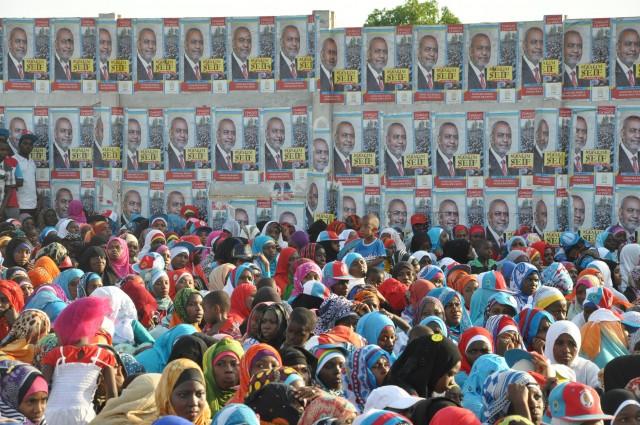
[image: At a CUF rally in Zanzibar. Credit: Mailys Chauvin.]
<http://africanarguments.org/wp-content/uploads/2016/01/zanzibar-shein-e1453896458216.jpg>

At a CUF rally in Zanzibar. Credit: Mailys Chauvin.

After a long period of negotiations, it was announced on Friday that
Zanzibar will hold a re-run of elections on 20 March. The news was
accompanied by a deployment of security forces in the semi-autonomous
archipelago and was greeted with anger by many on the streets of the
capital.

“We have been cheated,” exclaimed one resident of Stone Town. “They will be
here up to the 20 March, there is no freedom in Zanzibar,” said another.

 The decision comes three months after elections in October 2015 were
controversially annulled by the Zanzibar Electoral Commission chairman,
Jecha Salim Jecha, who claimed that there had been irregularities. The
Tanzanian army had a strong presence in Stone Town and had surrounded the
Commission.

The opposition Civic United Front (CUF) – whose leader Seif Sharif Hamad
told reporters he had seen the estimations which showed the results
strongly favoured him – denounced the annulment. Many citizens claimed the
move was a political ruse by the ruling Chama Cha Mapinduzi (CCM) to
maintain power. Meanwhile, international observers concurred that the
election had been credible and urged the commission to complete the count
and declare the results.

Since then, Zanzibar has been locked in a political and constitutional
crisis. The opposition has opted for dialogue over demonstrations, but with
CCM politicians reportedly undermining the talks by claiming a rerun of
elections was being prepared, frustrations and feelings of injustice have
grown.

The recent announcement of election re-runs could lead popular discontent
to escalate even further. Moreover, with a march set to take place tomorrow
(27 January) to commemorate the deaths of at least 35 demonstrators in 2001
(with the CUF’s estimates of the death toll closer to 65) – an event that
followed allegedly rigged elections in 2000 – confrontation is possible.
The organisers have called for a peaceful procession along a route going
from Malindi to Maisara, but with the police having banned the march and
the presence of security forces high, there is high potential for violence.

*A dubious dialogue*

It was arguably the events of 2000-2001 – in which protests were supressed
by force – that has led CUF’s Hamad to participate in dialogue rather than
call for popular demonstrations over the past few months. He has met with
the incumbent and CCM candidate, Ali Mohamed Shein, on several occasions
since November, but in the absence of any external mediator, many observers
have questioned the fairness of these negotiations. It is telling that
these talks are typically referred to as a “committee” that is “chaired” by
Shein in the Tanzanian press.

At the same time, CCM has been accused of clamping down on dissent around
Zanzibar. For instance, a number of media organisations have allegedly been
targeted with Radio Swahiba FM forced to close, copies of Mwana Halisi
newspaper confiscated, Hits FM radio studio burnt down, and more recently
the Mawio paper being banned. Some local opposition members have also
claimed that they have been threatened, with the popular ‘Commonwealth’
baraza in Michenzani area of Stone Town where opposition residents meet
regularly being razed in mid-December.

In the face of this crisis, the US-based Millennium Challenge Corporation
has suspended a grant worth $472 million to the Tanzanian government.
Zanzibari diaspora have organised demonstrations in the likes of Canada,
the UK, Sweden, Norway and Somalia. And at a press conference in Dar es
Salaam on 11 January, Hamad expressed his disappointment about the talks
and called for the intervention of Tanzania’s new president, John Pombe
Magufuli.

Hamad’s call, however, fell on deaf ears, and the very next day, CCM’s
Shein announced unilaterally that the elections would be re-run.

This declaration happened to fall on the anniversary of Zanzibar’s 1964
Revolution in which the new independent government led by the Sultan of
Zanzibar was overthrown by insurgents of mostly African origin. This event,
which was followed by reprisal killings of thousands of Arabs, Comorians
and Asians, has been used ever since to construct political narratives
based on racial divisions between Arabs and black Africans. In fact, at the
celebrations to commemorate the anniversary, one young CCM supporter was
seen holding a placard <http://allafrica.com/stories/201601141071.html>
reading “Zanzibar is a country of black people”. News of this incident
angered citizens across Tanzania; the CCM called the act “shameful” and
vowed to conduct an investigation.

The 1964 revolution also marked the start of Zanzibar’s union with mainland
Tanganyika, an issue that is still subject to debate today. Some opposition
figures want much greater autonomy for the region. Meanwhile, during the
CCM campaign, the spectre of the Sultanate returning to Zanzibar has been
invoked, albeit as an implausible scare story to mobilise xenophobic
sentiments.

Despite the fact that Zanzibar’s citizenry has been shaped by countless
multi-cultural marriages and the intermingling of people from myriad
origins, intolerant racialised rhetoric is still instrumentalised and finds
support in some quarters.

*Back to 2001?*

Since the announcement on Friday that Zanzibar’s new elections will be held
on 20 March, however, it is a different anniversary that has been more
readily cited – that of the post-election violence in 2001. Lawyers and the
opposition are currently working to prevent the re-run of elections, and
the march scheduled for 27 January is intended to be peaceful.
Nevertheless, tensions are running high and the kind of confrontation seen
in the early 2000s may be possible once again, especially with some CCM
youth elements reportedly using divisive language.

The current crisis in Zanzibar could undermine a long-running
reconciliation process that allowed a Government of National Unity. With
President Magufuli still keeping silent, a strong security presence on the
streets, and a sense that the elections were stolen from the CUF rising,
Zanzibar’s peace could be at risk.

This crisis is a Tanzanian issue more broadly too. Last November, the new
parliament was inaugurated in absence of the figure many see as the
legitimately-elected president of Zanzibar. This unprecedented incident was
opposed by the parliamentarians from the opposition UKAWA coalition who
claimed Hamad should be present and withdrew from parliament. The ongoing
crisis also illustrates Tanzania’s ruling elites’ rootedness to a
party-state culture and reluctance to allow for a true multi-party
democracy. If unresolved, the Republic as a whole could face greater
uncertainty, instability and disunity.

*Maïlys Chauvin is a geographer of Les Afriques dans le Monde, Political
Sciences Institute of Bordeaux, France.*

*[Correction (28/1/16): The article originally stated that the new
parliament was inaugurated “in the absence of representatives of Zanzibar”.
Zanzibar MPs were in fact present, but the figures many see as the
legitimately and newly-elected president and vice-president were not. This
has now been corrected.]*
If you enjoyed this post, please consider leaving a comment
<http://africanarguments.org/2016/01/26/zanzibars-election-re-run-raises-likelihood-of-confrontation/#comments>
or subscribing to the RSS feed <http://africanarguments.org/feed/> to have
future articles delivered to your feed reader.
This entry was posted in African Politics Now
<http://africanarguments.org/category/politics-now/>. Bookmark the permalink
<http://africanarguments.org/2016/01/26/zanzibars-election-re-run-raises-likelihood-of-confrontation/>.

--
To post to this group, send email to [email protected]
To unsubscribe from this group, send email to
[email protected]
Visit this group at https://groups.google.com/d/forum/southsudankob
View this message at
https://groups.google.com/d/msg/southsudankob/topic-id/message-id
For more options, visit https://groups.google.com/d/optout
---
You received this message because you are subscribed to the Google Groups
"South Sudan Info - The Kob" group.
To unsubscribe from this group and stop receiving emails from it, send an email
to [email protected].
To post to this group, send email to [email protected].
Visit this group at https://groups.google.com/group/SouthSudanKob.
To view this discussion on the web visit
https://groups.google.com/d/msgid/SouthSudanKob/CAJb14ooMXLVtcVmWnvmqAX5jEXpnUT7MUEWA08XUPTAndHTrYA%40mail.gmail.com.
For more options, visit https://groups.google.com/d/optout.