I can see it is time to look at the proposed test methods. The 50% ash looks
like a showstopper for many good substrates like manures or straws with high
nutrient contents.
I would be interested in the reasoning behind the 50% ash level. That would
rule out a lot of manure ash and certainly the 50% ash (40% carbon) rice husk
char we saw in Kyoto.


You require 50% maximum ash, then to make the char work you add 1/3 clay and
1/3 poultry litter to make an organo-mineral complex (S Joseph) so you wind up
with 15% or less char and 80% ash? Or you make a biochar based fertilizer (BBF,
China) that probably also has more than 50% inorganic in the blend.


Tom


From: [email protected]
[mailto:[email protected]] On Behalf Of
[email protected]
Sent: Saturday, October 15, 2011 8:49 PM
To: Discussion of biomass cooking stoves; Biochar-production; Andrew Heggie
Subject: [biochar-production] Re: [Stoves] Stoves Digest, Vol 14, Issue 17


Andrew (cc 2 lists)

   See below

  _____

From: [email protected]
To: "Discussion of biomass cooking stoves" <[email protected]>
Sent: Saturday, October 15, 2011 5:31:07 AM
Subject: Re: [Stoves] Stoves Digest, Vol 14, Issue 17

On Saturday 15 October 2011 06:56:03 Ron Larson wrote:
> Trevor, Paul, and lists
>
>     See Table 1 on p 12 of the draft IBI guidelines, which states that
> the ash content shall be less than 50%.  If you think this is the wrong
> level, now is the time to speak up.
>
>    See
> http://www.biochar-international.org/sites/default/files/IBI_Guidelines
>_for_Specifications_of_Biochars_for_October_2011_Public_Review.pdf
>

Ronal, does this refer to total ash after the sample has been incinerated
and include ash in the char matrix as well as "free" ash in a partly
incinerated air starved fire? I can see the desire to not have loose ash
in a product sold as biochar.

   RWL:   I am sure this IBI guideline refers to everything in the
"representative" char sample that one has been unable to remove by raising a 1
gram sample to 950C for a specified time period.  But the detail is even more
specific than that - including particle size distribution for the test.

   I should have given the further instructions from IBI's Table 1 for the ash
test - which says (in full):

"Apply loss on ignition (ASTM D1762-84) to ascertain
total non-carbonate ash, then add back inorganic
carbon as carbonate."

    This standard (like all ASTM standards) costs money.    Interested
individuals might find it available in a local library.   But if one googles a
little, you might find something on the web.  What I found and summarized above
may not be the most current.  In a Webinar last week, I heard that alternative
tests are not permitted - for ash or for anything else.  Bit more below.  This
not being my area of interest - I am uncertain on the statement above about
inorganics (carbonates) - which I don't find in the ATM standard.  But the
guidelines also call for that measurement - so I think there may be some room
for confusion here  (and so am including Kelpie Wilson in this response as
well)  Re inorganic carbon, the pertinent box from Table 1, says:

"C, H, N analysis by dry combustion (Dumas method),
before (total C) and after (organic C) HCl addition;
inorganic C is the difference between total and organic
C."

   This is undoubtedly clear to those doing this regularly.  An example is on
the last page of the guidelines.

> > If we gasified all volatile matter,
> > the fixed carbon content of the char would rise to about 43%,
> > and the ash content would rise to about 57%.
> > But typically rice hull biochar has an ash content of about 40%.
> > This means that there is still a lot of volatile matter that remains
> > in the biochar.
> >


I've still not seen rice husks so take my comments with a pinch of salt.

I'd be careful about using the term "gasified" in the first sentence, it
could be taken to mean using sufficient oxygen to deliberately gasify the
fixed carbon in the husks. If this is done completely then the
incinerated sample would be 100% ash.

    [RWL:  Thanks for this reminder on "gasification".  IBI and biomass
community avoid the word "gasified" - unless they truly are talking about the
very small amount of material (mostly ash) when one is gasifying (usually to
put the gas into an engine) and to then get minimum char out.   I wouldn't go
so far as to say that gasifiers give 100% ash - but gasifier folk (and we have
a sister list doing only that) certainly strive to minimize char.

A pyrolysed sample would keep all the ash locked in a char matrix. The
amount of char would depend on the rate of temperature rise ( which we
could expect to be high in the thin, low mass hulls) and the final
temperature attained in the treatment

   [RWL:  And the input biomass material.  I suppose some input
biomassmaterials may have an inherently difficult time achieving the 50%
maximum ash limit, if they operate at high temperatures.   This is agreeing
with your next paragraph.]

A typical gasifier would still have some fixed carbon in the ash because
the air supply is restricted to below that necessary to react out all the
carbon, because things are not perfect and it is better to discard char
than have any free oxygen downstream of the gasification process. This is
the opposite of the internal combustion process where a slight excess air
is necessary to prevent soot and CO being carried into the exhaust.

> > In the case of rice hulls,
> > the amount of volatile matter that remains in the biochar is
> > determined by the rate of gasification. At times the yield in rice
> > hull biochar by weight is as low as 30%. At times the yield is as
> > high as 50%.

Yes, this I would expect, biochar will consist of two parts, the fixed
carbon ( which usually  is usually dependant largely on lignin content of
the feedstock and soots redeposited from secondary reactions) and the
higher temperature tars. These latter are volatilised as temperature
increases.

   [RWL:  And the Biochar community refers to the volatile not-so-permanent
part as the labile component.]

> > If the rate of gasification is high, high temperatures within the
> > reactor are reached. With high temperatures, more volatile matter is
> > gasified.

Yes, the heat of burning the carbon raises the temperature and this
volatilises any surviving tars.
> >
> > We need operating temperatures well beyond 1000 C before fixed carbon
> > gets gasified.

Well the fixed carbon will remain static above 900C in an airless
environment but if any oxygen is present it will continue to react with
any carbon it meets but some carbon will have changed from an amorphous
form to less reactive graphene like clumps. I'd like to learn more about
how carbon graphitises with increased temperatures, we know diamond will
do this but I see little about how biomass derived carbon might undergo
this change.

   RWL:   The ASTM testing talks about 950 C - and probably because little is
happening even at 900 C. .  I too hope to learn more.  The experts do a lot of
this testing with spectrographs.  In Kyoto we heard one can learn a lot from
light reflectivity tests.   But indeed more graphene comes with higher
temperatures.  I haven't heard of any correlations with diamonds.

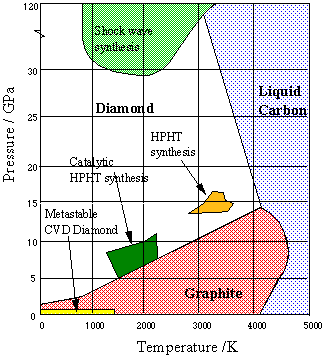
 http://www.bris.ac.uk/Depts/Chemistry/MOTM/diamond/cphased.gif

shows a phase diagram that suggests at low pressures and high temperatures
graphite is favoured.


> > In my opinion it makes little sense to gasify fixed
> > carbon.

Then keep air away and quench it fast.

My question is: why do you want fixed carbon? It is after all a small
portion of normal charcoal.

    [RWL:   Andrew -  I was OK with your remarks up to here.  I think the
meaning is/was:  let's pyrolyze and end up with char - rather than gasify and
end up with mostly combustible gases.  Can you clarify?  We want fixed carbon
(charcoal) for soil augmentation and carbon sequestration reasons
(de-emphasizing energy).    Ron

> >
> > http://lists.bioenergylists.org/mailman/listinfo/stoves_lists.bioener
> >gylists.org
> >
> > or, via email, send a message with subject or body 'help' to
> >        [email protected]
> >
> > You can reach the person managing the list at
> >        [email protected]
> >
> > When replying, please edit your Subject line so it is more specific
> > than "Re: Contents of Stoves digest..."

 ... and please try not to repost whole digests to the list.

AJH

_______________________________________________
Stoves mailing list

to Send a Message to the list, use the email address
[email protected]

to UNSUBSCRIBE or Change your List Settings use the web page
http://lists.bioenergylists.org/mailman/listinfo/stoves_lists.bioenergylists.org

for more Biomass Cooking Stoves,  News and Information see our web site:
http://www.bioenergylists.org/

__._,_.___

Reply to
<mailto:[email protected]?subject=Re%3A%20%5BStoves%5D%20Stoves%20Digest%2C%20Vol%2014%2C%20Issue%2017>
 sender | Reply to
<mailto:[email protected]?subject=Re%3A%20%5BStoves%5D%20Stoves%20Digest%2C%20Vol%2014%2C%20Issue%2017>
 group | Reply
<http://groups.yahoo.com/group/biochar-production/post;_ylc=X3oDMTJwcjE3MTNvBF9TAzk3MzU5NzE0BGdycElkAzI5MDkxNjg5BGdycHNwSWQDMTcwNzQxODYxMgRtc2dJZAM4MTAEc2VjA2Z0cgRzbGsDcnBseQRzdGltZQMxMzE4NzM2OTMx?act=reply&messageNum=810>
 via web post |
<http://groups.yahoo.com/group/biochar-production/post;_ylc=X3oDMTJmc28xbHVzBF9TAzk3MzU5NzE0BGdycElkAzI5MDkxNjg5BGdycHNwSWQDMTcwNzQxODYxMgRzZWMDZnRyBHNsawNudHBjBHN0aW1lAzEzMTg3MzY5MzE->
 Start a New Topic

Messages in this topic
<http://groups.yahoo.com/group/biochar-production/message/809;_ylc=X3oDMTMzazY4M3ZuBF9TAzk3MzU5NzE0BGdycElkAzI5MDkxNjg5BGdycHNwSWQDMTcwNzQxODYxMgRtc2dJZAM4MTAEc2VjA2Z0cgRzbGsDdnRwYwRzdGltZQMxMzE4NzM2OTMxBHRwY0lkAzgwOQ-->
  (2)

Recent Activity:

·
<http://groups.yahoo.com/group/biochar-production/members;_ylc=X3oDMTJnaWhubDVpBF9TAzk3MzU5NzE0BGdycElkAzI5MDkxNjg5BGdycHNwSWQDMTcwNzQxODYxMgRzZWMDdnRsBHNsawN2bWJycwRzdGltZQMxMzE4NzM2OTMw?o=6>
 New Members 1


<http://groups.yahoo.com/group/biochar-production;_ylc=X3oDMTJmMjc0MDZhBF9TAzk3MzU5NzE0BGdycElkAzI5MDkxNjg5BGdycHNwSWQDMTcwNzQxODYxMgRzZWMDdnRsBHNsawN2Z2hwBHN0aW1lAzEzMTg3MzY5MzA->
 Visit Your Group

MARKETPLACE

Stay on top of your group activity without leaving the page you're on - Get the
Yahoo! Toolbar now.
<http://global.ard.yahoo.com/SIG=15obmlrmg/M=493064.14543979.14562481.13298430/D=groups/S=1707418612:MKP1/Y=YAHOO/EXP=1318744131/L=c2d47cfe-f7a9-11e0-9056-0f1a2881dfeb/B=18iuDtGDJGQ-/J=1318736931169239/K=oK8toR35hG7W4MR9sEU94A/A=6060255/R=0/SIG=1194m4keh/*http:/us.toolbar.yahoo.com/?.cpdl=grpj>


http://us.bc.yahoo.com/b?P=c2d47cfe-f7a9-11e0-9056-0f1a2881dfeb&T=1d5l338p5%2fX%3d1318736931%2fE%3d1707418612%2fR%3dgroups%2fK%3d5%2fV%3d2.1%2fW%3dH%2fY%3dYAHOO%2fF%3d3371587916%2fH%3dY29udGVudD0iQXVjdGlvbnM7QXV0b3M7TWVzc2FnZV9Cb2FyZHM7U2hvcHBpbmc7U21hbGxfQnVzaW5lc3M7R3JvdXBzO1llbGxvd19QYWdlcztGaW5hbmNlO1dlYXRoZXI7UGVvcGxlOyIgZGlzYWJsZXNodWZmbGluZz0iMSIgc2VydmVJZD0iYzJkNDdjZmUtZjdhOS0xMWUwLTkwNTYtMGYxYTI4ODFkZmViIiBzaXRlSWQ9IjQ0NTI1NTEiIHRTdG1wPSIxMzE4NzM2OTMxMTM1NzM1IiA-%2fQ%3d-1%2fS%3d1%2fJ%3d9C238962&U=13cpn608m%2fN%3d18iuDtGDJGQ-%2fC%3d493064.14543979.14562481.13298430%2fD%3dMKP1%2fB%3d6060255%2fV%3d1


<http://groups.yahoo.com/;_ylc=X3oDMTJlaGtvcWI1BF9TAzk3NDc2NTkwBGdycElkAzI5MDkxNjg5BGdycHNwSWQDMTcwNzQxODYxMgRzZWMDZnRyBHNsawNnZnAEc3RpbWUDMTMxODczNjkzMQ-->
 Yahoo! Groups

Switch to:
<mailto:[email protected]?subject=Change%20Delivery%20Format:%20Traditional>
 Text-Only,
<mailto:[email protected]?subject=Email%20Delivery:%20Digest>
 Daily Digest •
<mailto:[email protected]?subject=Unsubscribe>
Unsubscribe •  <http://docs.yahoo.com/info/terms/> Terms of Use

.

http://geo.yahoo.com/serv?s=97359714/grpId=29091689/grpspId=1707418612/msgId=810/stime=1318736931/nc1=5191953/nc2=4025321/nc3=4507179

__,_._,___
<<image001.gif>>
<<image002.gif>>
_______________________________________________
Stoves mailing list

to Send a Message to the list, use the email address
[email protected]

to UNSUBSCRIBE or Change your List Settings use the web page
http://lists.bioenergylists.org/mailman/listinfo/stoves_lists.bioenergylists.org

for more Biomass Cooking Stoves,  News and Information see our web site:
http://www.bioenergylists.org/