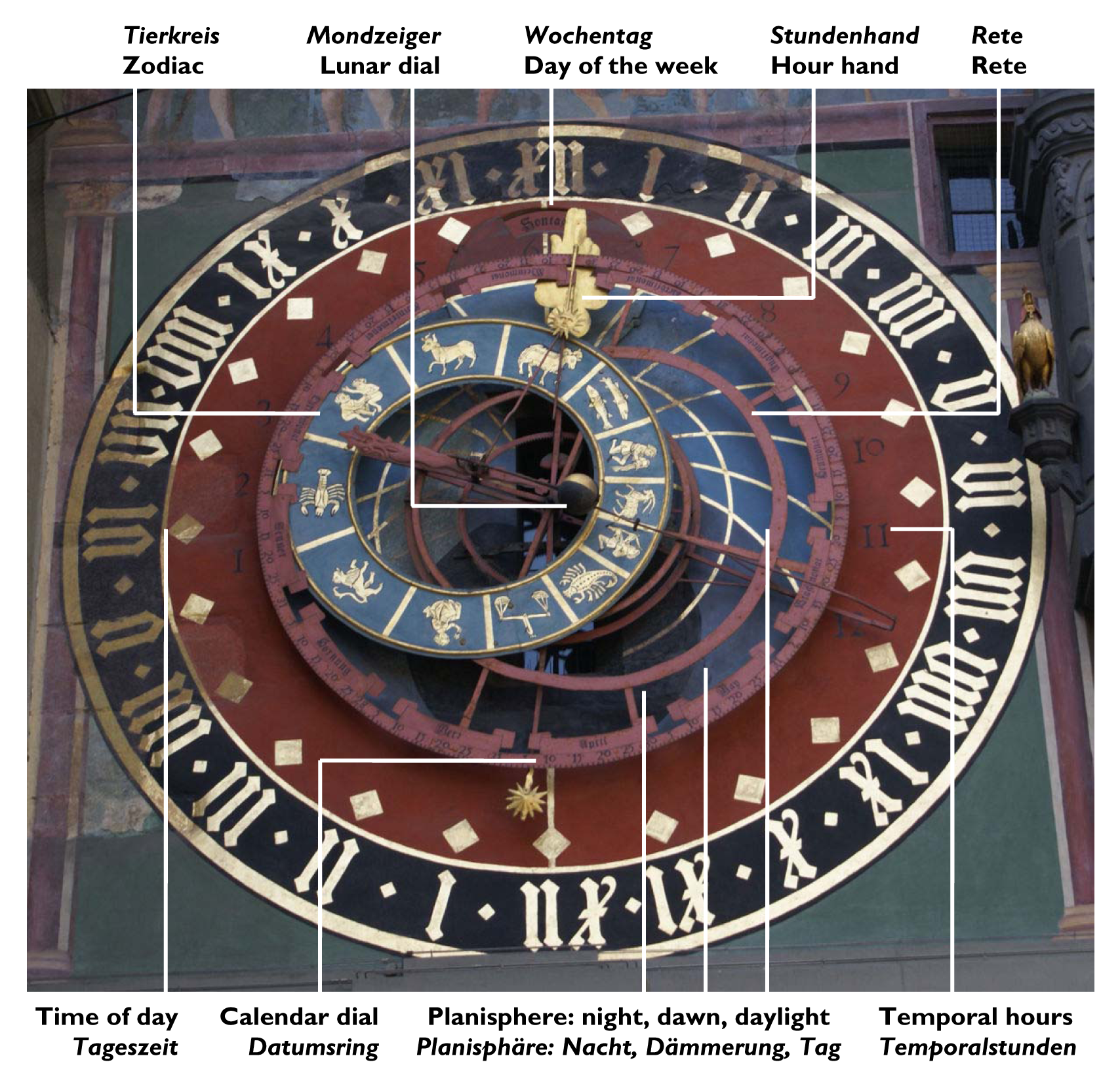
More than the clock in Prague the clock in Bern has a calendar dial built in
and an indication of the day of the week.
The calendar in Prague is located separately under the clock.
See
http://upload.wikimedia.org/wikipedia/commons/5/5e/Zytglogge_astronomical_clock_with_labels.png

Willy Leenders
Hasselt in Flanders (Belgium)

Visit my website about the sundials in the province of Limburg (Flanders) with
a section 'worth knowing about sundials' (mostly in Dutch):
http://www.wijzerweb.be


Op 22-mrt-2011, om 11:26 heeft Willy Leenders het volgende geschreven:

> Jan,
>
> A better photo of the clock in Bern is at
> http://www.photographersdirect.com/buyers/stockphoto.asp?imageid=1511348
>
> This clock has at first sight a similar design as the clock in Prague.
> However, it has not a outer ring that moves to and fro to indicate Italian or
> Bohemian hours.
> An indication of sidereal time is also missing.
>
> Willy Leenders
> Hasselt in Flanders (Belgium)
>
> Visit my website about the sundials in the province of Limburg (Flanders)
> with a section 'worth knowing about sundials' (mostly in Dutch):
> http://www.wijzerweb.be
>
>
>
>
>
>
>
> Op 22-mrt-2011, om 01:02 heeft Jan Bielawski het volgende geschreven:
>
>> Is the Prague clock of the same design as the one in Bern? See e.g.
>> http://starswebworx.lc-stars.com/swiss_photo/Bern.htm (scroll down a
>> bit).
>>
>> --
>> Jan
>>
>> On Mon, Feb 28, 2011 at 09:15, James E. Morrison
>> <[email protected]> wrote:
>>> Perhaps some background would be useful to those on the list who are not
>>> familiar with astrolabes and astrolabe clocks.
>>>
>>> The Prague clock is based on an astrolabe with the projection origin at the
>>> north celestial pole.  This orientation causes the horizon arc to arc in the
>>> reverse direction from a normal astrolabe, but it gives a more intuitive
>>> representation of the Sun's position.
>>>
>>> The clock has three moving parts.  A hand with a Sun figure rotates once in
>>> a mean solar day and the Sun's longitude is indicated by the position of the
>>> Sun figure on the ecliptic (which is divided by the zodiac).  The astrolabe
>>> rete, which has only the projection of the ecliptic on the clock, rotates
>>> once in a sidereal day.  The difference in the rate of the two components
>>> keeps the Sun figure on the (approximately) correct position on the
>>> ecliptic.  The third hand shows the position and phase of the Moon.
>>>
>>> The Prague clock, and all other devices based on the astrolabe, indicates
>>> apparent time with the Sun hand.  The only adjustment needed for it to
>>> indicate approximate civil time would be to simply move the Sun hand to a
>>> time.  No changes in gearing are needed.  But the Sun's position in the
>>> ecliptic (zodiac) would no longer be correct and any events (sunrise/set,
>>> culmination, etc.) would no longer be valid.  That is, the Sun figure no
>>> longer represents the real Sun,
>>>
>>> It could be made to show apparent time again by simply moving the Sun hand.
>>>
>>> Best regards,
>>>
>>> Jim
>>> James E. Morrison
>>> [email protected]
>>> Astrolabe web site at http://astrolabes.org
>>> ---------------------------------------------------
>>> https://lists.uni-koeln.de/mailman/listinfo/sundial
>>>
>>>
>>>
>> ---------------------------------------------------
>> https://lists.uni-koeln.de/mailman/listinfo/sundial
>>
>
> ---------------------------------------------------
> https://lists.uni-koeln.de/mailman/listinfo/sundial
>
---------------------------------------------------
https://lists.uni-koeln.de/mailman/listinfo/sundial