Thanks Archontis, that is very useful. I'll try that, it seems to
corroborate what I had in mind initially. What's the worse that can
happen, right? :)
Thanks for the help!

- martin

On 9 February 2016 at 22:34, Politis Archontis
<[email protected]> wrote:
> Hi Martin,
>
> HOA are not limited to icosahedra or only uniform arrangements (which exist
> also beyond the 5 platonic solids). It would be very hard to claim them
> flexible or universal if that was the case. Uniform arrangements though
> simplify decoder design significantly.
>
> As I mentioned you would need some more recent decoder methods for a
> hemisphere, however these methods are available and not so sensitive to
> speaker placement (no need for quests for magical geometries). My two cents,
> start with a regular horizontal ring, covering the case of horizontal
> decoding too, and spread the rest of the speakers evenly at the hemisphere,
> covering roughly equal area partitions. You can also fix one straight above
> and work with the rest. I believe the system should be capable of decoding
> 3rd order signals to half-space for such an arrangement, but that needs some
> checking.
>
> I mentioned two publicly available resources for decoding to such a setup. I
> forgot to mention however that there exist also professional tools for that.
> I think Blue Ripple Sound’s decoder can handle hemispheres and irregular
> setups (haven’t tried it myself) and also the latest Spat from IRCAM has
> implemented the more advanced HOA decoders I mentioned.
>
> Best,
> Archontis
>
>> On 10 Feb 2016, at 00:16, Martin Dupras <[email protected]> wrote:
>>
>> I have no objection to using fewer than 16 speakers; it's just the
>> maximum I have available to me.
>>
>> The reason I had not considered the icosahedron vertices setup is
>> because, according to the wikipedia page, it's capable of 2nd order,
>> not 3rd order. Is that not the case?
>>
>> Again from wikipedia: "Since stacked rings are somewhat wasteful at
>> higher elevations and necessarily have a hole at the zenith, they have
>> been largely surpassed by hemispherical layouts since mature methods
>> for decoder generation have become available. As they are difficult to
>> rig and require overhead points, hemispheres are usually found either
>> in permanent installations or experimental studios, where expensive
>> and visually intrusive trussing is not an issue."
>>
>> That's the whole reason why I was considering a hemispherical setup
>> originally. It talks about "mature methods for decoder generation" so
>> I (wrongly, perhaps) assumed that there were capable decoders, and
>> there would likely be already available "templates" or "typical
>> scenarios" to use as a starting point.
>>
>> Thanks,
>>
>> - martin
>>
>>
>> - martin
>>
>> On 9 February 2016 at 22:02, Augustine Leudar <[email protected]>
>> wrote:
>>> I know Im treading on thin ice here around all these ferocious maths
>>> guys... but might it be that there is not a suitable array that uses 16
>>> speakers? I know if you have 16 speakers you will want to use all of them
>>> but an Icosahedron is only 12 speakers (vertices) but it might be the best
>>> option.
>>> Also you could try ICST ambisonics plugins in max - they let you put the
>>> speaker array in and it adjusts accordingly.
>>>
>>> On 9 February 2016 at 21:51, Martin Dupras <[email protected]> wrote:
>>>
>>>> Thanks for all the responses. Much appreciated.
>>>>
>>>> I'll re-phrase the question in light of some of the answers I've been
>>>> given.
>>>>
>>>> I will be using third-order Ambisonics. My aim mostly is to experiment
>>>> to get a good sense of what is possible with Ambisonics with height. I
>>>> have experimented successfully with 8-channel planar Ambisonics some
>>>> time ago. My primary intent is to spatialise multiple monophonic
>>>> (synthesised) sources using 3rd-order Ambisonics spatialisation, and
>>>> the playback of mixed sources (spatialised monphonic and stereophonic
>>>> sources as well as B-format 4-channel recordings.)
>>>>
>>>> At this moment in time, I have the opportunity to deploy (next week) a
>>>> 16-channel array, so I would like some advice on a configuration that
>>>> would be a good start to experiment with Ambisonics with height.
>>>> Someone suggested that I consult the wikipedia page on Ambisonics.
>>>> That is indeed where I got the idea that an "upper hemisphere" setup
>>>> might be suitable, since I only have on this occasion 16 speakers.
>>>> There is however no suggestion as to what a suitable hemispherical
>>>> configuration might be for a 16-speaker array, which is why I asked my
>>>> original question.
>>>>
>>>> So let me ask a new question. Given the constraint that I can only use
>>>> 16 speakers at the moment, and that I need to deploy this next week,
>>>> can somehow point me in the direction of what might be a suitable and
>>>> reasonable geometric configuration to try out? It seems to me that the
>>>> only really practical options here are two stacked rings (stacked
>>>> octagons) or a hemisphere. I would have thought that the hemisphere
>>>> would be the better choice, and in my scenario, a full lighting rig
>>>> allows me theoretically speaking to have speakers at the required
>>>> positions.
>>>>
>>>> Again, thank you for all the responses.
>>>>
>>>> - martin
>>>>
>>>>
>>>> On 8 February 2016 at 15:19, Martin Dupras <[email protected]> wrote:
>>>>> Hi,
>>>>>
>>>>> I'm intending to try setting up a 16-speaker Ambisonics array next
>>>>> week in a small TV studio. I'm trying to figure out the practical
>>>>> arrangements for setting up the speakers. I was wondering if anyone
>>>>> with experience might be able to offer some advice or point me in the
>>>>> right direction?
>>>>>
>>>>> What I'm planning at the moment is a half-sphere arrangement which
>>>>> would likely consist of:
>>>>>
>>>>> - 8 speakers in a circle of radius 2m at a height of approximately 1.6m
>>>>> - 6 speakers in a smaller circle at an elevation of 45 degrees
>>>>> - 2 speakers at an elevation of approximately 75 degrees
>>>>>
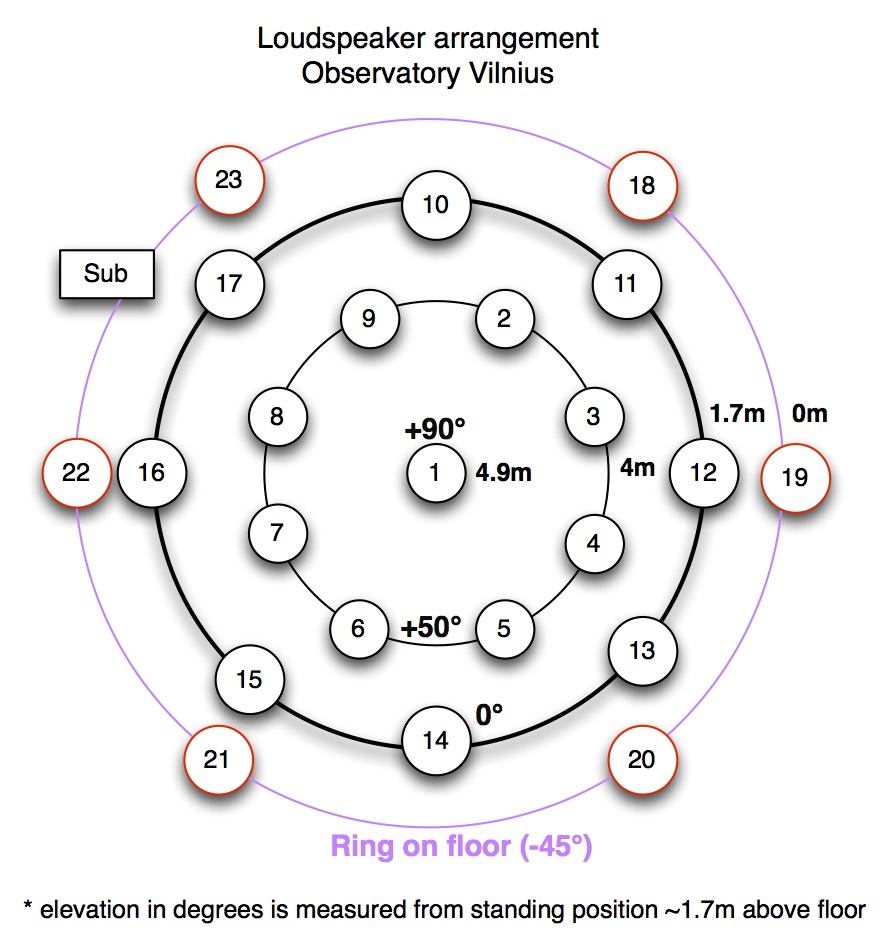
>>>>> Alternatively, I would be happy with an arrangement similar to the
>>>>> first 16-speakers in this diagramme:
>>>>>
>>>> http://www.matthiaskronlachner.com/wp-content/uploads/2013/10/loudspeaker-plan-observatory.jpg
>>>>>
>>>>> I've been trying to find out if there is a convention or "most usual"
>>>>> arrangement but couldn't find anything. I'm not particularly attached
>>>>> to the actual arrangement, I just want to find an arrangement that
>>>>> will work well enough with 16 speakers. Any advice?
>>>>>
>>>>> The other thing I would welcome is advice on how to mount the speakers
>>>>> to lighting rigs in a manner that is practical enough to offer some
>>>>> good compromise between precision and ease of setup. I believe the
>>>>> speakers we'll be using for the upper tiers will be Genelec 8060s.
>>>>>
>>>>> Many thanks. Any advice will be greatly appreciated!
>>>>>
>>>>> Cheers,
>>>>>
>>>>> - martin
>>>> _______________________________________________
>>>> Sursound mailing list
>>>> [email protected]
>>>> https://mail.music.vt.edu/mailman/listinfo/sursound - unsubscribe here,
>>>> edit account or options, view archives and so on.
>>>>
>>>
>>>
>>>
>>> --
>>> www.augustineleudar.com
>>> -------------- next part --------------
>>> An HTML attachment was scrubbed...
>>> URL:
>>> <https://mail.music.vt.edu/mailman/private/sursound/attachments/20160209/6d5ca824/attachment.html>
>>> _______________________________________________
>>> Sursound mailing list
>>> [email protected]
>>> https://mail.music.vt.edu/mailman/listinfo/sursound - unsubscribe here,
>>> edit account or options, view archives and so on.
>> _______________________________________________
>> Sursound mailing list
>> [email protected]
>> https://mail.music.vt.edu/mailman/listinfo/sursound - unsubscribe here, edit
>> account or options, view archives and so on.
>
> _______________________________________________
> Sursound mailing list
> [email protected]
> https://mail.music.vt.edu/mailman/listinfo/sursound - unsubscribe here, edit
> account or options, view archives and so on.
_______________________________________________
Sursound mailing list
[email protected]
https://mail.music.vt.edu/mailman/listinfo/sursound - unsubscribe here, edit
account or options, view archives and so on.