--- In [email protected], "ddailey" <[EMAIL PROTECTED]> wrote:
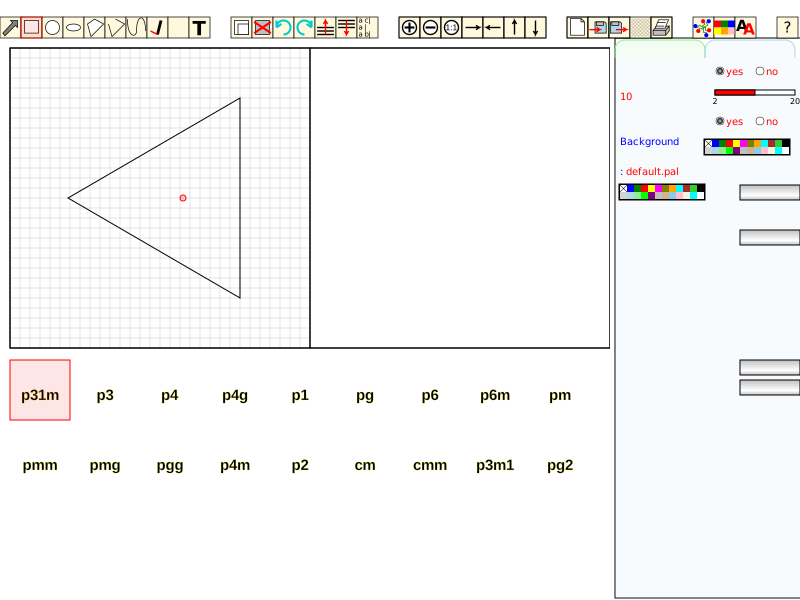
You can define your triangle and transform it, here by translation to
cover your rectangular pattern, so gradients will be correct.

Michel

Look at http://pilat.free.fr/tiling_loc/tile.svg where pattern is
used to draw tilings


> The triangular tiling visible (through IE/ASV and Opera9.2.3) at
> http://srufaculty.sru.edu/david.dailey/svg/triangles4.svg
> is created with script: a pair of tightly nestled equilateral
triangles has been put in a group that is then cloned across the
visible region.
>
> Odd and even numbered triangles are filled with different gradients
(mainly since if the fy attribute of the gradient is not tweaked then
the center of the gradient defaults to the center of the bounding
rectangle which is rather different than the perceptual center of the
triangle).*
>
> I sought to try simplifying things by building the tiling it with
<pattern> rather script. I think any periodic tiling of the plance
can be simulated with a rectangular pattern. To simulate the two
adjacent equilateral triangles, I split one of them into two halves --
 both right triangles -- and appended these halves on either side of
the whole one. The pseudo-triangles tile just fine, as can be seen at
> http://srufaculty.sru.edu/david.dailey/svg/triangles5.svg **
>
> The problem is that I can find no way to fill the adjacent half-
triangles with what would appear to be a shared radial gradient --
even by adjusting the horizontal offset "fx" of the gradients of
each. If they share the same radial gradient, then that gradient
appears centered relative to the bounding box of each half-triangle
individually.
>
> What I want to do is to create something identical to
http://srufaculty.sru.edu/david.dailey/svg/triangles4.svg but with
<pattern> instead of DOM. My thought is that it oughta be faster --
but who knows? maybe it won't be. Any insights on the relative speeds
of such things?
>
> Any ideas?
>
> TIA,
> David
>
>
> *The gradient is (of course) animated with SMIL (shouldn't
gradients always be animated?) and has its stop-color rotated through
JavaScript with synchrony between the SMIL and JavaScript being
handled by "begin='indefinite' onend='animate()' " in the SMIL and
animatedObject.beginElement() in the script (without the synchrony,
the two animations tend to diverge in ways that, while not
unpleasant, are a bit chaotic.
>
> ** Incidentally, I think the fact that IE/ASV changes the size of
the pattern space, making little edges appear at times during the
SMIL, is probably a bug in ASV. Opera doesn't do it.
>
> [Non-text portions of this message have been removed]
>


-----
To unsubscribe send a message to: [EMAIL PROTECTED]
-or-
visit http://groups.yahoo.com/group/svg-developers and click "edit my
membership"
----
Yahoo! Groups Links

<*> To visit your group on the web, go to:
    http://groups.yahoo.com/group/svg-developers/

<*> Your email settings:
    Individual Email | Traditional

<*> To change settings online go to:
    http://groups.yahoo.com/group/svg-developers/join
    (Yahoo! ID required)

<*> To change settings via email:
    mailto:[EMAIL PROTECTED]
    mailto:[EMAIL PROTECTED]

<*> To unsubscribe from this group, send an email to:
    [EMAIL PROTECTED]

<*> Your use of Yahoo! Groups is subject to:
    http://docs.yahoo.com/info/terms/