Hi, David-

Thanks for the honest response. I'll try to address your comments as
best I can, and I hope you can bear with me in detailing your issues so
we can arrive at a mutual understanding of the situation.
On 6/5/13 10:41 AM, David Dailey wrote:
>
> I suspect you already know that I’ll not be happy until much more is
> accomplished

What do you mean by "much more"? Wrapping text to arbitrary shapes? That
is also coming, but as part of a more complex proposal that will also
hopefully be part of SVG 2 (but may be deferred a bit, since we are
trying to be have an aggressive schedule to move SVG 2 forward).

Simple CSS text wrapping is meant for the most common case, a basic
rectangular area.


> and am rather dismayed that it has taken more than a
> decade to get even rudimentary text areas into SVG in a way that will
> work across browsers.

Same here, which is why I'm trying as hard as I can to push this
forward, and trying to drum up support for it, to illustrate to the
browser vendors that this should be a priority.


> Coupling the fate of SVG with developments in CSS seems like putting
> the cart before the horse and seems to be slowing down progress in
> SVG.

In my view, it's just the opposite (as I may have mentioned to you
before). Here's a rationale:

1) We have limited people editing the specs for SVG; having people from
the CSS WG edit specs increases both the number and the range of
expertise of people available to edit (for example, Alan Stearns is an
expert in arbitrary text-wrapping from years of work on InDesign, etc.,
and is editing the CSS Shapes spec, which SVG will use);

2) SVG is *much* less popular than CSS, and is therefore a much lower
priority for implementers; by piggybacking on features defined in CSS,
we increase the likelihood and the speed of initial implementation, and
decrease the cost and improve the rate of maintenance; this may also
make the browsers more favorably disposed toward SVG in general, because
it's less work for them;

3) By sharing features with CSS/HTML, we dramatically increase the
number of authors (developers and designers) who are familiar with and
excited by the feature, decreasing the barrier to entry for people just
starting out with SVG who are already familiar with CSS and HTML (e.g.,
the overwhelming majority).

The downside, of course, is that there is a little bit of adjustment up
front... growing pains. The SVG WG is doing extra work to clean up SVG 2
and make sure things are defined in a way that works well with CSS (and
working with the CSS WG to ensure that they define things in a way that
works for SVG). Some implementations are being adjusted. But on the
whole, it shouldn't affect authors that much (mostly the aforementioned
delays on new features), and it should pay big dividends going forward.
And I don't really see many other downsides.


On the particular topic of this thread, text-wrapping, there is no
evidence to support the notion that coordinating with CSS is slowing us
down (in fact, the CSS WG's advice was extremely helpful), and explicit
evidence to show that this feature would not have moved forward if it
were SVG-only: SVG Tiny 1.2 has had a very well-defined <textArea>
element [1] for text wrapping that has been around for 4.5 years (!),
and has only one browser implementation, Opera (and it's possible
Opera's implementation may go away as they move their engine from Presto
to Blink... a real shame...). By contrast, within a day of suggesting
this to Cameron MacCormack, he had a rough first-pass implementation of
text wrapping using 'width', precisely because it came for nearly free
by using CSS.


I suspect that part of your frustration is not "moving features to CSS"
in general, but rather the specific topic of SMIL (and maybe also SVG
Fonts). This was not so much a matter of CSS, as it was the specific
decisions of Microsoft, Google, Apple, and to some degree Mozilla, all
disliked SMIL, and some refused to implement it (or planned to remove
existing code bases); it was simply not going to be interoperable, and
for most authors, that's a deal-killer. The good news is that, in
addition to all the script libraries out there that let you animate in
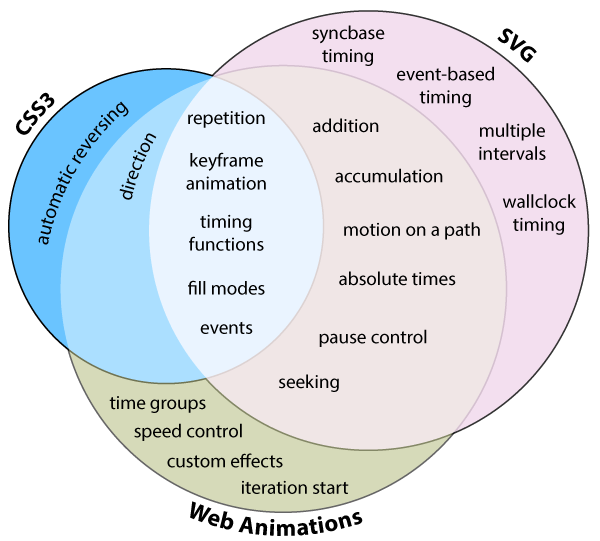
SVG, the new Web Animations 1.0 spec [2] was approved for First Public
Working Draft; it is generally more powerful and easier to use than SMIL
[3], and a declarative syntax for SVG is planned that should mimic SMIL
as much as possible for backwards compatibility.


If I've misinterpreted or misunderstood the nature of your concerns,
please set me straight.


> I suspect my sentiments on such matters are already well known, but I
> would be remiss in my obligation to other authors who share this
> perspective if I did not say it again.

Forgive my ignorance, but is this a common sentiment? I don't hear it
expressed much; most of the time when I mention that SVG is deferring to
CSS on functionality, it's met with relief, because more people know CSS
than SVG.

I'd be happy to discuss this more on a dedicated thread. I'm curious
what the detailed concerns are, and how many people feel the way you've
expressed.


[1] http://www.w3.org/TR/SVGTiny12/text.html#TextAreaLayout
[2] https://dvcs.w3.org/hg/FXTF/raw-file/tip/web-anim/index.html
[3] https://wiki.mozilla.org/images/f/f6/CSS-SVG-Web-Animations.png

Regards-
-Doug


------------------------------------

-----
To unsubscribe send a message to: [email protected]
-or-
visit http://groups.yahoo.com/group/svg-developers and click "edit my
membership"
----Yahoo! Groups Links

<*> To visit your group on the web, go to:
    http://groups.yahoo.com/group/svg-developers/

<*> Your email settings:
    Individual Email | Traditional

<*> To change settings online go to:
    http://groups.yahoo.com/group/svg-developers/join
    (Yahoo! ID required)

<*> To change settings via email:
    [email protected]
    [email protected]

<*> To unsubscribe from this group, send an email to:
    [email protected]

<*> Your use of Yahoo! Groups is subject to:
    http://docs.yahoo.com/info/terms/