A1     "COW-AFRICAN ELEPHANTS" ? Kindly explain if written elsewhere. Tusks
and names assigned in many languages are many. How do the tusks people will
assume as great warriors and the rest are not? And what was significantly
made known to us in the answer?
A2      Indiand do not know or pretend that they are so enamoured of the
western tastes, they refuse to accept as replies are from western names
only?
A3       Without a problem there is a solution?; so Maths is the answer as
G provides and then the Q is framed in a second , so \Q and A does not
match well?.
A4       We call 100years as birth and not evolution and earth is not
involution. Gravity is a variable factor in space and may not exist in
vacuum and black hole two way. So How Gravity is a determinate to
evolution?. Neither the Q nor the A is perfect.
A10     1  Trans Siberian gopalakrishnan learnt when he was in school is
untrue  since more or less in 50s only all of us did our schooling when
these international Geography or history was never taught in India. I wrote
about it in this group but a human must have honesty to admit it.
II     THE RIVERS 'VOLGA' AND 'GANGA' AND THE SANSKRIT CONNECTION TO THEIR
NAMES
*The River Volga! Russians call it 'Volga Matushka' (Mother Volga). It is
said that the name probably derives from Proto Slavic*  'vòlga' which means
'wetness' or 'moisture'.Here's a look at the Sanskrit connection. A word
that corresponds to Volga and its meaning 'moisture', and is at the same
time a cognate of 'Volga' is the Sanskrit word 'Vigala' (विगल्), which
means 'flow' or 'ooze away' and 'drain-off'. A derivative of 'vigal', is
'vigalita' (विगलित) which has the same meaning. 'Volga' may just be a
distortion of the word 'Vigal' or 'Vigalita'.In Sanskrit the sound 'vi'
(वि) means 'apart' or 'away'; and 'vI' (वी) (with emphasis on 'i') means
'set in motion'. 'Gala' (गल) means 'oozing'. 'GAla' (with emphasis on 'a')
(गाल), means 'liquefying' and also 'flowing'.Hindi speakers are familiar
with the word 'pigala' (पिघल) which means 'melt away' or 'ooze'. This Hindi
word has the same Sanskrit origin.The etymology of Volga as proposed by
Russian historian and Linguist Nikolai Trubetzkoy (1890-1938), in his
lectures at the University of Vienna,  links the name 'Volga' to the Slavic
'Julga', which he says in course of time changed to 'Volga'. *

*Roman Jakobson, Russian linguist and literary theorist, quoted Nikolai
Trubetzkoy's research thus, **"In primitive eastern Slavic, un-rounded
front vowels changed into rounded back vowels before a tauto-syllabic 'l',
so that 'jilga' must have changed to julga; the initial j was lost before
rounded vowels in eastern Slavic, and the initial u acquired an obligatory
prothetic 'v'. Thus the form 'vulga' arose, and short 'u' changed in the
12th–-13th centuries into 'o'. So through a long series of changes Jilga
became Volga". *

*Here is the actual quote from Ramon Jakabson's 'The Balts- Ancient Peoples
& Places':*
' 205 Notes CHAPTER I 1 Tacitus (90), XLV. 2 Orosius (87). 3 Adam of Bremen
(82), 199. 4 G. Gerullis, Die altpreussischen Ortsnamen, Berlin-Leipzig,
1922; A Salys, “Prūsai,” Lietuvių Enciklopedija, XXIV (Boston), pp. 146-57.
5 L. Kilian, “Baltische Ortsnamen westlich der Weichsel,” Altpreussen, IV,
3 (1939), pp. 67-68; H. Krahe, “Baltische Ortsnamen westlich der
Weichsel?,” Altpreussen, 1943: I, pp. 11-12. 6 V. N. Toporov, “Dve zametki
iz oblasti baltijskoj tomonimii,” Rakstu krājums veltījums audd. J
Endzelīnam, Riga, 1959, pp. 251-66. 7 A. Kamiński, Jaćwieź, Terytorium,
ludnosć, stosunki gospodarcze i spoleczne (Jatvingia. Territory,
population, economy and social structure), Ĺódź, Societas Scientiarum
Lodziensis, sectio II, No. 14, 1953. 8 Polnoe sobranie russkikh letopisej,
I, 1, Petersburg, 1908. 9 Būga (1). 10 Vasmer (6). 11 The etymology of Volga as
proposed by the linguist Trubetzkoy — in his lectures at the University of
Vienna — was as follows: in primitive eastern Slavic, unrounded front
vowels changed into rounded back vowels before a tauto-syllabic l, so
that jilga
must have changed to julga; the initial j was lost before rounded vowels in
eastern Slavic, and the initial u acquired an obligatory prothetic v. Thus
the form vulga arose, and short u changed in the 12th-13th centuries into
o. So through a long series of changes Jilga became Volga. (Oral
information by Roman Jakobson.) 12 Thomsen (4) 13 B. A. Serebrennikov, “O
nekotorykh sledakh izcheznuvshego indoevropejskogo jazyka v centre
Evropejskoj chasti SSSR, blizkogo k baltijskim jazykam” (Traces of an
extinct Indo- European language related to the Baltic in the centre of the
European part of the USSR), Lietuvių Mokslų Akademijos Darbai (Trudy AN
Litovskoj SSR), serija A, vyp. 1 (2), Vilnius, 1957. 14 M. Vasmer, “Die
alten Bevölkerungsverhältnisse Russlands im Lichte der Sprachforschung,”
Vorträge and Schriften der Preussischen Akademie, No. 5, 1941. ' IN

*It is more likely that the original name was 'Julga' rather than 'jilga'
if one were to loke at the name through the Sanskrit lens. 'Jala' (जल) is
'water', both in Sanskrit and in Hindi. The suffix 'ga' (ग) means going or
moving. Hence 'Julga' in Sanskrit means 'moving water'. The name 'Jilga'
however cannot be explained through Sanskrit.*

*Also 'Julga' is very close to the name 'Ganga' - the** Sanskrit name of
the great Indian river - the Ganges. Incidentally the name Ganga (गङ्गा)
means 'swift goer' or 'fast moving'. Indians call it 'Ganga Ma' - 'Mother
Ganga' just as the Russians call Volga 'Volga Matushka'.*

*"I am convinced that everything has come down to us from the banks of the
Ganges". - Francois Voltaire*


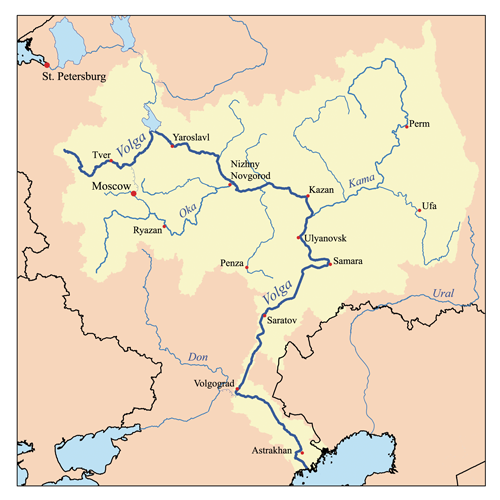
<https://3.bp.blogspot.com/-O5ViQNNPin8/Uj_v5YRYr5I/AAAAAAAABHg/fZwzhdbPlzw/s1600/Volgarivermap.png>


*Rivers 'Kama' and 'Vyataka' flow into the River Volga.In Sanskrit the verb
'vyati' means both to  'flow on' and 'vanish'.'Kama' means 'desire' and is
also the name of Lord Vishnu.*
*The Volga flows into the Caspian Sea. The name Caspian is said to be
derived from the ancient Vedic name of the Caspian, which was 'Kashyapa',
named after the sage 'Kashyapa' who in the Vedic tradition is the father of
all 'devas', 'asuras', 'nagas' and of all humanity.*
*III    *Siberia is a region in North Asia, separated from Russia's primary
territory by the Ural Mountains in the west and bounded by the Pacific
Ocean in the east. In the north and south, it is delimited by the Russian
state border. Siberia covers an area of over 13 million sq km and accounts
for 77 percent of the area of modern Russia. But there was a time when
"Siberia" was the name of a separate country. How did it come into being
and why did it disappear? Where does the name "Siberia" come from?  Nobody
knows for sure, but there are several theories. In the Turkic languages
"Siber/Chiber" means "beautiful", in the Tatar language "seber" means
"blizzard" and in the Mongolian language "shibir" translates as "swamp".
The name "Siberia" could come from any of these words. In The Secret
History of the Mongols – dating from the 1240s, it is the oldest surviving
Mongolian text – the word "shibir" is mentioned in connection with a story
about the conquest of the lands and peoples living in southern Shibir
between the rivers Ob' and Irtysh by Genghis Khan’s son, the military
commander Jochi. About 1,500 BC, Iranian-speaking tribes began to settle in
Siberian territory. A thousand years later, in the 6th century BC,
Turkic-speaking peoples arrived, and by the 12th-13th centuries AD, as a
result of the mixing of Iranian, Turkic and native Ugric tribes, the ethnic
group of Siberian Tatars had evolved. So Siberia is marked by a
different name apart from its Volga and Amur rivers in the Bharatha varsham
.   KR IRS 12423

On Wed, 12 Apr 2023 at 07:00, '[email protected]' via iyer123 <
[email protected]> wrote:

> *CULTURAL QA 04-2023-11*
>
> *Q1         What are some animal facts you didn’t know about?*
>
> A1         Lousie, Worked at Own Business Apr 3
>
> I read that recently.*If an elephant doesn't have tusks, it doesn't mean
> he's not a bull.*
>
> There are male elephants with tusks, they are called "Tuskers".
>
> *Those without tusks are called "Makna" or "Mukna".*
>
> And the latter are said to be surprisingly more dangerous and sneaky than
> the Tusker.
>
> They can only be recognized by their stature, but can easily be mistaken
> for cows.
>
> Zoos often have a Tusker because it is more spectacular and they like to
> show it off.
>
> Upali, a Makna
>
> The tusks are useful.The elephant can use them to dig for water, debark
> trees, move branches and trees.
>
> But they are also used for display, marking trees and as weapons in
> battle. Elephants , like us, have right-left preferences.
>
> There are left or right tuskers. And how cool: The favourite tusker is
> called Master Tusk.
>
> *My note- I have read elsewhere that cow African elephants too may have
> tusks.*
>
> *Q2         What shocking things do most Indians not know?*
>
> Mark Rhysand, Anthropology Studies (2020–present) Mar 31
>
> India is the world's largest democracy: While many Indians are aware that
> their country is a democracy, they may not realize that India is the
> world's largest democracy in terms of population.
>
> India has the second-largest English-speaking population in the world:
> While English is not the primary language in India, it is widely spoken and
> understood, with the country having the second-largest English-speaking
> population in the world after the United States.
>
> India is home to the world's largest film industry: Bollywood, India's
> Hindi-language film industry, produces more films and sells more tickets
> annually than any other film industry in the world, including Hollywood.
>
> India has a rich history of science and mathematics: Many important
> mathematical concepts, such as zero and decimal notation, originated in
> India. Indian scientists and mathematicians also made important
> contributions to fields such as astronomy and medicine.
>
> India has a diverse range of languages and cultures: While many Indians
> are aware of the diversity within their own country, they may not realize
> that India is home to over 2,000 ethnic groups and more than 1,600
> languages.
>
> India has made significant progress in reducing poverty: While poverty
> remains a major challenge in India, the country has made significant
> progress in recent years. According to the World Bank, the percentage of
> Indians living in poverty has fallen from over 60% in the 1980s to around
> 20% today.
>
> *Q3         What are some good math jokes?*
>
> A3         Samyak Datta, Graduate Research Assistant at Georgia Institute
> of Technology (2017–present)Updated 9y
>
> A mathematician was being interviewed for a job. The interviewer asks him
> - "You are walking towards your office and running late for a very
> important meeting and you glimpse a building on fire with people screaming
> for help. What will you do?".
>
> The mathematician thinks for a while and replies : *"People's lives are
> more important than an office meeting. I would immediately call for a fire
> brigade and help the trapped to the best of my abilities*".
>
> The interviewer seems to be impressed with the mathematician's answer and
> moves on to the last question. Just to check his sanity, she asks: *"And
> what if the building is not on fire?".*
>
> After a moment of thought, the mathematician replies with confidence :
>
> "I will set the building on fire. Now, I have reduced it to a problem that
> I have already solved before!"
>
> *Q4         If evolution is scientifically true, why does it only occur
> once every million years? Why does one animal evolve into another only once
> after millions of years?*
>
> A4         Claire Jordan, Degree in biology and folklore; programmer,
> shop owner, secretary on newspaper Apr 5
>
> *Gravity is science, and it’s always occurring, not just randomly when
> it’s convenient.*
>
> Evolution is constant, but in large animals like humans it’s fairly slow
> because we have a long generation time, so it may take hundreds of
> thousands (not usually millions) of years to really notice the difference.
>
> *New types of bacteria and viruses only take a few months or even days to
> evolve, and do so continuously.*
>
> Q5         Does a bogie in a train mean the same as a coach or is it
> different?
>
> A5         Prashant Tiwari, Indian Railways Enthusiast Mar 30
>
> Both are different.
>
> In the context of Indian Railways, "bogie" and "coach" are often used
> interchangeably, but there is a slight difference between the two.
>
> A "bogie" refers to the wheeled undercarriage that supports a train's cars
> or coaches. Each bogie typically has two or more axles with wheels
> attached to a frame that connects to the car or coach.
>
> A "coach" is the passenger-carrying car that is attached to the bogie.
>
> A coach can have several bogies attached to it, depending on its length
> and weight. Each coach typically has seats or berths for passengers, as
> well as amenities such as toilets, air conditioning, fans and lights.
>
> So in summary, a bogie is the wheeled undercarriage that supports a coach,
> while a coach is the passenger-carrying car that is attached to the bogie.
>
> *Q6         Why diesel engines are not used in motorbikes?*
>
> A6         Digital Services And Products, CEO, Motivational Speaker &
> Online Entrepreneur at Freedom Guider (2019–present) Mar 28
>
> Diesel engines are not commonly used in motorcycles for a number of reasons.
>
>
> First and foremost, diesel engines are significantly heavier and larger
> than gasoline engines, which makes them impractical for use in
> motorcycles. The additional weight and size of a diesel engine would make a
> motorcycle much less maneuverable and agile, which is a key consideration
> for many riders.
>
> Another reason why diesel engines are not used in motorcycles is that
> they are more difficult to start in cold weather. Diesel engines require
> a higher compression ratio to ignite the fuel, which means that they need
> to be warmed up before they can operate effectively. In colder climates,
> this can be a significant challenge, as it may take several minutes for the
> engine to warm up enough to start.
>
> In addition, diesel engines are typically less responsive than gasoline
> engines, which can make them less suitable for use in motorcycles. Diesel
> engines have a slower response time, which means that they are less
> effective at delivering power quickly when the rider needs it. This can be
> a significant disadvantage in situations where the rider needs to
> accelerate quickly or make sudden maneuvers.
>
> Another factor that makes diesel engines less suitable for use in
> motorcycles is their emissions. Diesel engines typically produce more
> emissions than gasoline engines, which can be a significant concern for
> riders who are concerned about environmental impact.
>
> Diesel engines also require more maintenance than gasoline engines, which
> can be a significant disadvantage for riders who want a low-maintenance
> vehicle.
>
> Finally, ***diesel fuel is not as widely available as gasoline, which can
> make it difficult for riders to find a place to refuel their motorcycle.
> While diesel fuel is becoming more common in some parts of the world, it is
> still not as widely available as gasoline, which makes it less practical
> for use in motorcycles.
>
> In conclusion, there are several reasons why diesel engines are not
> commonly used in motorcycles. Diesel engines are heavier and larger than
> gasoline engines, which makes them less maneuverable and agile. They are
> also more difficult to start in cold weather and less responsive than
> gasoline engines. Additionally, diesel engines produce more emissions and
> require more maintenance than gasoline engines.
>
>  Finally, diesel fuel is not as widely available as gasoline, which makes
> it less practical for use in motorcycles.
>
> My note- ***All bunks are having diesel and petrol except the bunks
> selling gas for autos.
>
> *Q7                Which fruit in India is underrated?*
>
> A7         Jai Narayan, Mar 20
>
> Wood Apple is the most underrated fruit in India. It is called as
> vilaampazham in Tamil and Bel in Hindi.
>
> This fruit is famous during festive seasons like Ramanavami, vinayakar
> chaturthi and gokulashtami. It has a hard and woody outer shell inside
> which, there is a soft and spongy fruit pulp. It has lots of health
> benefits , some of which I have mentioned below.
>
> *It will cure digestive problems   Improves immunity    Cures skin
> problems    Improves metabolism    It also treats joint pains and
> hypotension in adults.*
>
> There are many different ways in which one can consume wood Apple. But I
> used to mix the fruit pulp with jaggery and eat. It's a healthy way of
> eating this fruit with high iron content.
>
> *My note- In Kerala it’s use is rare. In Chennai also it’s users are
> there. It is generally not sold in the fruit shops.*
>
> *Q8         What is the weirdest historical event to have happened?*
>
> A8         Mark Rhysand, Apr 1
>
> One little-known historical event that stands out as particularly bizarre
> is the Great Emu War that took place in Australia in 1932. It may sound
> like a joke, but this event was a real and deadly serious military
> operation conducted by the Australian army against a group of wild emus.
>
> That’s right, a war against emus.
>
> *In the early 20th century, Western Australia was facing a problem with
> overpopulation of emus. The large, flightless birds were causing
> significant damage to crops and farms, and farmers were struggling to
> control the population*. In an effort to address the problem, the Australian
> government authorized the use of military force to cull the emus.
>
> *On November 2, 1932, a team of soldiers armed with machine guns and
> mounted on trucks set out into the Australian outback to confront the emus*.
> At first, the soldiers were confident that they could easily eradicate the
> birds, but they soon discovered that the emus were much more difficult to
> deal with than they had anticipated.
>
> Despite their heavy weaponry, the soldiers were unable to kill large
> numbers of emus. The birds proved to be agile and fast-moving, and they
> quickly scattered and disappeared into the brush. In some cases, the emus
> even charged directly at the soldiers, who found themselves outmaneuvered
> and overwhelmed by the sheer number of birds.
>
> After several weeks of futile attempts to control the emu population, the
> military operation was called off. The emus emerged victorious, and
> continued to wreak havoc on the Western Australian countryside for years to
> come.
>
> *The Great Emu War may seem like a comical footnote in history,* but it
> is a fascinating example of the complex relationship between humans and
> nature. It also highlights the limitations of military force in dealing
> with natural phenomena, and the importance of understanding and respecting
> the ecosystems in which we live.
>
> Today, the Great Emu War is remembered as a cautionary tale about the
> dangers of overreliance on violence and force in addressing complex
> environmental problems
>
> *Q9         Is a cooling pad useful? If not, what can I use?*
>
> A9         Gopala Krishnan, Former Assistant General Manager 1996-2004 at
> Department of Telecom (1966–2004) Just now
>
> Before a decade the Laptops were very heavy. Old laptops used to get
> heated. Inside some cooling fans may not function. So it was normal to
> place a cooling pad underneath the bottom. Power supply to cooling pad was
> taken through a USB.
>
> Now things are changed. Laptops are not even 1/3rd weight of the old ones.
> A lot of technology has changed. Present day laptops do not heat, just
> warm at bottom.
>
> So if your laptop is light weight and heat, better get attended by
> computer technicians.
>
> Note- Still I keep just as a memory item, the cooling pad purchased in
> 2008’s
>
> Q10       What are some interesting facts about Siberia?
>
> A10       Mark Rhysand, Anthropology Studies (2020–present)Tue
>
> Siberia is home to the world's largest freshwater lake, Lake Baikal,
> which contains about 20% of the world's unfrozen freshwater.
>
> The coldest temperature ever recorded in the Northern Hemisphere was in
> Siberia, at -96.16 degrees Fahrenheit (-71.2 degrees Celsius) in 1924.
>
> The Siberian tiger is the largest cat in the world and can weigh up to
> 660 pounds (300 kilograms).
>
> There are over 100 different indigenous groups living in Siberia, each
> with their own distinct culture and language.
>
> Siberia is home to some of the world's largest deposits of gold, diamonds,
> and other precious minerals.
>
> The Trans-Siberian Railway, which runs from Moscow to Vladivostok, is the
> longest railway in the world, spanning over 5,772 miles (9,289 kilometers).
>
> My note- Nostalgic memories of answering the question on Longest railway
> in the world as Trans Siberian railway comes to me on reading this in the
> middle school examination
>
>  Siberia has some of the world's most extreme weather, with temperature
> variations of over 100 degrees Fahrenheit (55 degrees Celsius) between
> summer and winter.
>
> The Russian city of Norilsk, located in Siberia, is the world's
> northernmost city with a population over 100,000.
>
> Siberia has over 3 million lakes, which make up about 25% of the world's
> total freshwater supply.
>
> The Siberian Husky dog breed was originally bred by the Chukchi people of
> Siberia as a sled dog.
>
> The Yakutian horse, a breed native to Siberia, is adapted to survive in
> extreme cold and can withstand temperatures as low as -58 degrees
> Fahrenheit (-50 degrees Celsius).
>
> The Putorana Plateau in Siberia is one of the few places on Earth where
> you can find the rare Snow Leopard.
>
> *Q11       Why is my fridge not cooling when turned on?*
>
> A11       Ken Knudson,30 years in refrigerator safety/energy efficiency
> compliance.7y
>
> Several things cause a refrigerator to stop cooling altogether or perform
> poorly:
>
> . Dust-clogged condenser (air-cooled condensers require periodic cleaning)
>
> . Stuck/faulty fan motor (either condenser or evaporator)
>
> . Iced-up evaporator (the coil inside the fridge)
>
> . Bad light switch that causes lights to remain on with the door closed
>
> . Bad fan switch that prevents the fan from turning on when the door is
> closed
>
> . Door not closing all the way
>
> . Insufficient refrigerant gas (usually due to a leak in the plumbing)
>
> . Poor air circulation inside, possibly due to improper product loading
> (e.g., packages blocking air vents)
>
> *** Unusually high room temperature, causing the fridge to run all the
> time without being able to keep up with the heat load
>
> . Plugged refrigerant tubing (especially a blockage in the very thin
> capillary tube)
>
> . Faulty compressor overload or relay, either of which can prevent the
> compressor from starting
>
> . Faulty compressor (this is usually the most expensive single part to
> replace on a fridge)
>
> Most of the above apply equally to refrigerators, combination
> refrigerator/freezers, freezers and wine chillers.
>
> *** My note- This is the reason Refrigerator is not desirable in the
> kitchen. However in many flats and homes the designer provide plug point in
> the kitchen.
>
> *All the above QA are from  Quora  website  on   12-04-2023*
>
> *Quora answers need not be 100% correct answers .*
>
> *Compiled **and posted by R. Gopala Krishnan, 79,  former ITS on
> 12-04-2023*
>
>
>
> --
> You received this message because you are subscribed to the Google Groups
> "iyer123" group.
> To unsubscribe from this group and stop receiving emails from it, send an
> email to [email protected].
> To view this discussion on the web visit
> https://groups.google.com/d/msgid/iyer123/973814190.1845809.1681308028170%40mail.yahoo.com
> <https://groups.google.com/d/msgid/iyer123/973814190.1845809.1681308028170%40mail.yahoo.com?utm_medium=email&utm_source=footer>
> .
>

--
You received this message because you are subscribed to the Google Groups
"Thatha_Patty" group.
To unsubscribe from this group and stop receiving emails from it, send an email
to [email protected].
To view this discussion on the web visit
https://groups.google.com/d/msgid/thatha_patty/CAL5XZorNt145LsJPUyxa7Rhpca1p%2Bj4PQQUeRGyY8%3DTT-oYgbA%40mail.gmail.com.