TidBITS#871/19-Mar-07
=====================
  Issue link: <http://db.tidbits.com/issue/871>
  Remember Gopher? The Internet protocol for retrieving files that
  preceded the World Wide Web isn't dead, writes Cameron Kaiser, but
  surviving (where else?) underground. Glenn Fleishman notes new
  capabilities for the Pando file-sharing service that drastically cut
  the costs of hosting large, popular files such as podcasts. Also in
  this issue, Adam notes a New York Times program that gives free
  TimesSelect access to higher-education faculty and students and
  points to interesting new research about why hard drives fail; Andy
  J. W. Affleck records the praises of Freeverse's Sound Studio 3.5
  update; and Jeff Carlson passes on news of Mark/Space's public beta
  of The Missing Sync for BlackBerry. Finally, Apple last week
  released Mac OS X 10.4.9 and Security Update 2007-003, as well as
  bug-fix updates iTunes 7.1.1 and iPod Reset Utility 1.0.

Articles
    Grab Bag of Security Fixes and Patches for Mac OS X
    Mark/Space Adds BlackBerry Sync
    iTunes 7.1.1 and iPod Reset Utility 1.0 Fix Bugs
    TimesSelect Free for Higher Ed
    Sound Studio 3.5 Adds Numerous Features
    Hard Drive Failures and Contributory Storage
    Pando Further Eases Big File Distribution
    Down the Gopher Hole
    Hot Topics in TidBITS Talk/19-Mar-07


------------ This issue of TidBITS sponsored in part by: --------------

* READERS LIKE YOU! Support TidBITS with a contribution today!
  <http://www.tidbits.com/about/support/contributors.html>
  Special thanks this week to Richard Mageau, Bob Van Andel,
  Vincent Simanca, and Jack Kells for their generous support!

* SMALL DOG ELECTRONICS: Featuring 4000+ Mac-friendly products.
  TidBITS Exclusive for Mar 19-Mar 26: Save on external EZQuest
  Monsoon FireWire/USB 2.0 hard drives: 320 GB for $139.99
  or 400 GB for $169.99! Order at <http://www.smalldog.com/tb/>

* FETCH SOFTWORKS: Fetch 5.2 makes FTP and SFTP easy!
  Upload, download, mirror, and manage your Web site. Dozens of
  new features to make file transfers easier and more reliable.
  Get your free trial version at <http://fetchsoftworks.com/>!

* WebCrossing Neighbors Creates Private Social Networks
  Create a complete social network with your company or group's
  own look. Scalable, extensible and extremely customizable.
  Take a guided tour today <http://www.webcrossing.com/tour>

* Bare Bones Software's BBEdit 8.6 -- Latest version offers a
  major interface overhaul, new prefs, text clippings, improved
  JavaScript, new Ruby/SQL/YAML/Markdown support, code folding.
  Over 160 new features in all! <http://www.barebones.com/>.

* MARK/SPACE, INC: Introducing SyncTogether, Mac-to-Mac syncing
  of contacts, calendar events and tasks, notes and more. Perfect
  for a single user with multiple Macs or groups that need to sync
  selected iCal calendars. <http://www.markspace.com/bits>

* CheckIt System Performance Suite bundles three top Mac utilities!
  TechTool Platinum diagnoses and repairs your disk, Spring Cleaning
  organizes your files and Retrospect Express backs up your data.
  Buy today for only $79.99! <http://www.allume.com/tidbits/>

* Microsoft's MacBU: Supporting Mac users with Office 2004.
  Supporting the Mac community through tech support newsgroups,
  user group appearances, our new team blog, and more!
  Check out our team blog at <http://blogs.msdn.com/macmojo/>

---------- Help support TidBITS by supporting our sponsors ------------


Grab Bag of Security Fixes and Patches for Mac OS X
---------------------------------------------------
  by Glenn Fleishman <[EMAIL PROTECTED]>
  article link: <http://db.tidbits.com/article/8907>

  Last week Apple updated Mac OS X 10.4 Tiger to version 10.4.9 and
  provided a security update for Mac OS X 10.3.9 Panther. The security
  update is incorporated into the Tiger update, and could have been
  labeled "Fixes for the Month of Apple Bugs," a project we have
  written about before (see "MoAB Is My Washpot," 2007-02-19).

<http://docs.info.apple.com/article.html?artnum=304821>
<http://docs.info.apple.com/article.html?artnum=305214>
<http://db.tidbits.com/article/8869>

  Security Update 2007-003 and the related code in Mac OS X 10.4.9 fix
  dozens of problems reported in the Month of Apple Bugs, including
  what was the most serious remaining problem, a way to exploit a flaw
  in Software Update by "enticing a user to download and open a
  Software Update Catalog file." We haven't seen reports of this - or
  any of the rest of the bugs - in the wild. Most of the non-MoAB
  exploits fixed by the security update require local users with
  access to an account and software that isn't enabled by default in
  Mac OS X.

  There's no simple way to summarize 10.4.9's general enhancements.
  Like the last few updates to Tiger, this one is a grab bag of fixes
  for numerous individual problems, and it's likely the last big
  hurrah for Tiger, as Mac OS X 10.5 Leopard's ostensible ship date
  moves ever closer. Although Apple could release a 10.4.10, history
  shows us they prefer the numerical purity of single digits. (Jaguar
  ended its run with 10.2.8 and Panther with 10.3.9.)

  Notable among the general changes are improvements to .Mac
  synchronization. As a regular .Mac sync user, I have seen lots of
  inconsistent behavior and long delays. I'm hoping 10.4.9 eliminates
  these problems. Another fix related to USB modems I have to call out
  as "I fax in your general direction": the note says that the update
  improves reliability in faxing in France or Belgium when using the
  Apple USB Modem.

  Apple has made available separate incremental and combo updates for
  PowerPC and Intel systems running both Mac OS X and Mac OS X Server;
  you can use Software Update to download the best updater for your
  system or view all eight updates from the Apple downloads page. The
  combo updates work for 10.4.0 and later; the incremental releases
  work for 10.4.8. Set aside some download time, since the size of the
  updates runs from 72 MB (PowerPC incremental) to 350 MB (Mac OS X
  Server Intel combo). Panther's Security Update 2007-003 is also
  available both via Software Update and as standalone downloads for
  both Mac OS X (36 MB) and Mac OS X Server (49.5 MB).

<http://www.apple.com/support/downloads/>

  As always, if you experience any unusual problems after updating,
  particularly with applications not launching, download and install
  the combo updater for your Mac, since it can provide a cleaner
  installation.

  Apple also released iPhoto 6.0.6, which "addresses issues with EXIF
  data compatibility and photocasting." The photocasting fix is in
  response to another Month of Apple Bugs report. It's also available
  via Software Update or as an 8 MB standalone download.

<http://www.apple.com/support/downloads/iphoto606.html>


Mark/Space Adds BlackBerry Sync
-------------------------------
  by Jeff Carlson <[EMAIL PROTECTED]>
  article link: <http://db.tidbits.com/article/8912>

  A few months ago, Glenn Fleishman and I wrote a feature article for
  Macworld about using smartphones with the Mac (see "Get in Sync" in
  the January 2007 issue). When we tested BlackBerry devices,
  PocketMac for BlackBerry, which TidBITS also covered a year ago in
  "Putting BlackBerries in Your PocketMac" (2006-02-06), was the only
  method of synchronizing data between RIM's smartphones and the Mac.

<http://www.macworld.com/2006/12/features/sync_main/>
<http://www.blackberry.com/>
<http://www.pocketmac.com/products/pmblackberry/>
<http://db.tidbits.com/article/8413>

  Recently, a new contender has emerged. Mark/Space is currently
  offering a fully functional public preview of The Missing Sync for
  BlackBerry as a 9.2 MB download. Like other versions of The Missing
  Sync, this one uses Mac OS X's Sync Services to synchronize data
  between the BlackBerry and Address Book, iCal, or other programs
  that also use Sync Services. It also features photo and music
  transfers from iPhoto and iTunes on the BlackBerry Pearl. Remember
  that this is still beta software; Mark/Space has posted a list of
  known issues. It requires Mac OS X 10.4.8 or later, and a BlackBerry
  device running version 4.0 or later of the operating system. The
  completed version of the program is expected to ship by the end of
  this quarter; pricing has not been announced.

<http://www.markspace.com/missingsync_blackberry.php>
<http://www.markspace.com/missingsync_bb_issues.html>


iTunes 7.1.1 and iPod Reset Utility 1.0 Fix Bugs
------------------------------------------------
  by Jeff Carlson <[EMAIL PROTECTED]>
  article link: <http://db.tidbits.com/article/8913>

  Apple has released iTunes 7.1.1, an update that "addresses a
  stability issue and minor compatibility problems in iTunes 7.1,"
  according to Apple. The update is available via Software Update or
  as a 28 MB stand-alone download. A 36.1 MB download for Windows is
  also available.

<http://www.apple.com/support/downloads/itunes711formac.html>
<http://www.apple.com/support/downloads/itunes711forwindows.html>

  The company also released iPod Reset Utility 1.0 for Mac (3.4 MB)
  and Windows (2.2 MB), which is designed to reset either generation
  of iPod shuffle if iTunes is unable to reset it.

<http://www.apple.com/support/downloads/ipodresetutility10formac.html>
<http://www.apple.com/support/downloads/ipodresetutility10forwindows.html>


TimesSelect Free for Higher Ed
------------------------------
  by Adam C. Engst <[EMAIL PROTECTED]>
  article link: <http://db.tidbits.com/article/8910>

  After all my puzzling over how to create permanent links to articles
  in the New York Times (see "Easier New York Times Linking,"
  2007-02-26), I was amused to hear from a friend that the New York
  Times is now making TimesSelect free to any student or faculty
  member with a valid college or university email address. TimesSelect
  includes access to articles from the New York Times Op-Ed and news
  columnists in both text and podcast forms, along with up to 100
  articles per month from the full New York Times Archive, which
  contains content back to 1851.

<http://db.tidbits.com/article/8881>
<http://www.nytimes.com/gst/ts_university_email_verify.html>


Sound Studio 3.5 Adds Numerous Features
---------------------------------------
  by Andy J. Williams Affleck <[EMAIL PROTECTED]>
  article link: <http://db.tidbits.com/article/8914>

  Freeverse has released Sound Studio 3.5, which adds many new
  features of interest to all users of this excellent audio editor and
  recorder. Sound Studio has long been my favorite tool for editing
  audio files, whether I'm producing a podcast, trimming a file in my
  iTunes library, or recording my son's funny snore one night (and
  later removing the laptop fan noise from the recording - it's
  important to have high quality embarrassment material for when he's
  a teenager).

<http://www.freeverse.com/soundstudio/>

  Among Sound Studio 3.5's many new features are the addition of new
  audio formats for opening and saving, including Apple Lossless, ADTS
  AAC, NeXT/Sun Audio, and Ogg Vorbis. In addition, Sound Studio now
  supports 8-, 16-, and 24-Kbps bit rates when saving MP3 format
  files.

<http://forum.freeverse.com/viewtopic.php?pid=3387>

  For podcasters, Sound Studio has added the capability to manage all
  iTunes-supported tags, including the podcast bit that determines
  whether a file appears in the Podcasts section of iTunes or in the
  regular Music section. This is a major boon to me, since I would
  like to move podcasts I want to keep into my music collection and
  let all others automatically delete themselves after listening,
  something that's been difficult to accomplish so far. Now I can open
  the file in Sound Studio, toggle the appropriate checkbox and
  re-import the file into iTunes where it appears in my Music section
  rather than in the Podcasts section. The reverse approach enables
  you to move spoken audio files from the Music section into the
  Podcasts section, if you so desire.

  Podcasters will also appreciate the fact that markers set by Sound
  Studio within audio files are now automatically saved as chapters in
  podcasts. In other words, when playing back in iTunes, the marker
  titles are listed within the Chapters menu and enable one to jump
  directly to that spot in the playback. (For more information on how
  to use Sound Studio for podcasting, see my ebook, "Take Control of
  Podcasting on the Mac.")

<http://www.takecontrolbooks.com/podcasting-mac.html?14@@!pt=TB871>

  Other enhancements in Sound Studio 3.5 include new preferences for
  how scrolling occurs during playback, the capability to loop sound
  in filter previews (rather than requiring you to play the sound over
  and over as you make adjustments), and new AppleScript support for
  referencing individual tracks and changing the pan and volume of
  each track.

  Finally, Sound Studio now provides an innovative way to set the
  beats per minute (BPM) of a track. BPM is a piece of metadata that
  appears in the iTunes tag editor and as part of the display grid of
  the main Sound Studio window; it can be useful for generating smart
  playlists of slow or fast music in iTunes. All you have to do to set
  the beats per minute is click a button in time with the rhythm of
  the music.

  Sound Studio 3.5 costs $80, and upgrades are free to registered
  owners of 3.0 or higher. Special upgrade pricing for users of
  earlier versions is available as well, as is a free demo (a 10.2 MB
  download) for anyone who hasn't yet tried Sound Studio.

<http://www.freeverse.com/download/select.php?name=soundstudio&platform=osx>
<http://dev.freeverse.com:16080/faq/index.php?action=artikel&cat=394881&id=84>


  [Andy J. Williams Affleck built Dartmouth College's first Web site
  in 1993, created the original Web site for the sitcom Friends, and
  started a virtual community that's still around a decade later. When
  he's not producing his Podcrumbs podcast or working on "Take Control
  of Podcasting on the Mac," he's a senior project manager and
  accessible Web design expert.]

<http://www.podcrumbs.com/>


Hard Drive Failures and Contributory Storage
--------------------------------------------
  by Adam C. Engst <[EMAIL PROTECTED]>
  article link: <http://db.tidbits.com/article/8911>

  At last month's 5th USENIX Conference on File and Storage
  Technologies, two academic papers - one from Bianca Schroeder and
  Garth A. Gibson of Carnegie Mellon University (CMU) and the other by
  Eduardo Pinheiro, Wolf-Dietrich Weber, and Luiz André Barroso of
  Google - looked at the reliability of hard drives in large-scale
  installations. Among other conclusions, the CMU team found that
  real-world replacement rates were much higher than would have been
  expected from vendor-provided mean time to failure (MTTF) estimates,
  and Google's researchers concluded that there was little correlation
  between failure and either elevated temperature or activity levels.
  The papers weren't written for the lay audience and aren't easy
  reading, but they are worth a look if you're interested in when and
  why hard disk mechanisms fail.

<http://www.usenix.org/events/byname/fast.html>
<http://www.usenix.org/events/fast07/tech/schroeder/schroeder_html/>
<http://labs.google.com/papers/disk_failures.pdf>

  Also interesting is the paper by James Cipar, Mark D. Corner, and
  Emery D. Berger of the University of Massachusetts Amherst on the
  Transparent File System (TFS). The goal of TFS is to create a
  contributory storage system in which multiple people could
  contribute unused disk space to a shared pool, much as the [EMAIL PROTECTED]
  project enables users to contribute unused CPU cycles to the shared
  task of analyzing radio telescope data. (And yes, there is still an
  active TidBITS team for [EMAIL PROTECTED]) Apparently, TFS can contribute
  all of the unused space on a disk while imposing only a negligible
  performance drag on the contributor. Prototype source code is
  available; I'll be curious to see if anyone cleans it up and ports
  it to MacFUSE (see "MacFUSE Explodes Options for Mac File Systems,"
  2007-01-29).

<http://www.usenix.org/events/fast07/tech/cipar/cipar_html/>
<http://setiathome.ssl.berkeley.edu/>
<http://setiathome.berkeley.edu/team_display.php?teamid=30293>
<http://prisms.cs.umass.edu/tcsm/TFS.html>
<http://code.google.com/p/macfuse/>
<http://db.tidbits.com/article/8835>


Pando Further Eases Big File Distribution
-----------------------------------------
  by Glenn Fleishman <[EMAIL PROTECTED]>
  article link: <http://db.tidbits.com/article/8908>

  The file-distribution system run by Pando has opened itself up to
  developers and podcasters (for more information about Pando and
  related services, see "Secure Transfer Using Civil Netizen and
  Pando," 2006-08-21). Instead of managing your own bandwidth and
  dealing with your service provider's limits or their overage charges
  on busy months, you can now employ Pando's combination of
  centralized and distributed downloading at no cost at all for files
  of up to 1 GB in size. Larger files can be distributed with Pando's
  paid levels of service.

<http://pando.com/>
<http://developers.pando.com/>
<http://db.tidbits.com/article/8649>

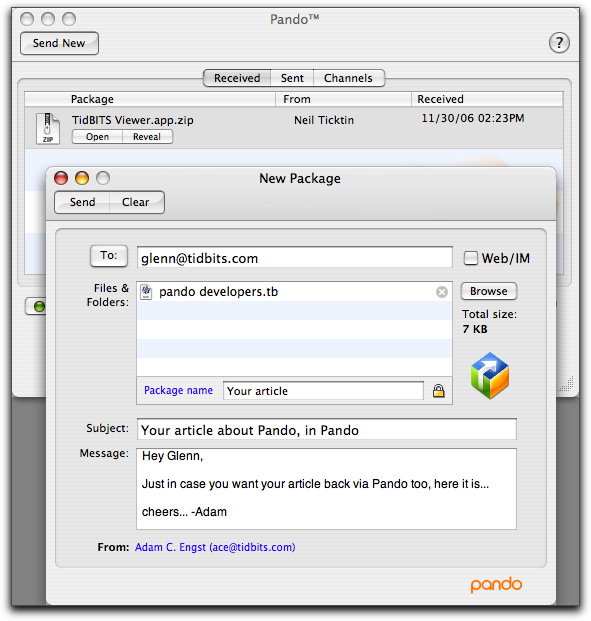
  With Pando, you upload an individual file or set of files (a
  "package") via a free application that incorporates advertising into
  its display. When you upload the package, you can provide email
  notification, where up to 10 people per transmission (for free
  publisher accounts) initially receive a Pando link to download the
  package or file. You can also receive a special link that you can
  send separately and some HTML to post on a Web site for download. In
  essence, Pando's client application works like a combination of an
  email application and a file manager. It's available for Mac OS X
  10.3.9 and later, along with Windows 2000 SP4, XP, and Vista.

<http://www.tidbits.com/resources/2007-03/Pando-interface.jpg>
<http://pando.com/download>

  The copy of Pando running on your computer is also a "peer," or a
  potential uploading server, in a peer-to-peer network that Pando
  uses to connect anyone who has downloaded or wants to download the
  package in question. For files you want to distribute as broadly as
  possible - like a podcast, software download, or white paper PDF -
  the more people running Pando with a downloaded copy of that item,
  the greater the distribution network.

  This method is what has driven the popularity of BitTorrent, but the
  addition of central servers to prime the pump and ensure a minimum
  level of bandwidth gives Pando some advantages. Pando requires
  accounts, and with a premium subscription as a publisher, you can
  even control who can download and use files.

<http://en.wikipedia.org/wiki/BitTorrent>

  With the addition of a developer site and associated toolkits and
  recipes for distributing files, you can bypass using the Pando
  program to upload files as a publisher. Anyone wanting to download
  files must first install Pando, but if you have sufficiently
  compelling content or if Pando really takes off - especially if they
  can get their software bundled by computer makers - that will be no
  bar. For anyone whose audience has no interest in using a separate
  application to retrieve files, Pando isn't yet a solution. But as a
  measure of their current popularity, Pando says they push 60
  terabytes of downloads a day across their network.

  For instance, you can convert your existing podcast RSS feed to work
  via Pando, and any audio or video enclosures are automatically
  retrieved by Pando and converted into retrievable packages.
  Currently, you need to request that Pando (the company) enable this
  option for your feed. But you can also use the Pando program to
  create URLs for uploaded files that you can embed in a Web page and
  that work in RSS feeds. A recent upgrade to the Pando application
  lets the program subscribe to Pando-compatible RSS feeds; for
  instance, they have a sample high-definition video channel that lets
  you download specific videos directly within Pando from that
  channel.

<http://developers.pando.com/rss-feed-converter>

  A software developer could offload some of the distribution burden
  for new files by using Pando's application programming interface
  (API), the programmer's toolkit, to create a package for files
  uploaded to the developer's Web site. Adding peers increases the
  efficiency of peer-to-peer networks; thus, a popular new application
  or update would have an extremely efficient Pando profile.

  Pando uses advertising to defray the costs of its free service. The
  company also recently added three tiers of paid service; if you pay,
  you can transfer larger files to larger initial distribution lists,
  and your files can remain on Pando's central servers for longer
  periods of time. Right now, the free service allows packages of up
  to 1 GB each to be transferred, and it keeps the files active on
  Pando's servers for either 7 days (for Pando-emailed or
  IM-distributed files) and 30 days (for Web posted files) after the
  most recent download or message forward through their system.

<http://www.pando.com/premium>

  All three higher level services - Plus, Pro, and Publisher - allow
  password protection of packages, weekday 24-hour technical support,
  and no advertising. They also let you send messages from within
  Pando to 100 people at a time rather than 10.

  The Plus ($5 per month) and Pro ($20 per month) service increase
  maximum package sizes to 3 GB and 5 GB, respectively, and both allow
  Pando-distributed and IM-distributed packages to remain for 30 days
  without any downloads or forwards, rather than 7. The Publisher
  package allows packages up to 50 GB, and unlimited persistence on
  Pando's servers.


**Pando versus Other Services** -- Let's compare these offerings with
  other typical bandwidth charges. Amazon's Simple Storage System (S3)
  costs 20 cents per GB transferred, plus 15 cents per GB stored each
  month. Many co-location firms charge $1 to $2 per GB transferred
  with some monthly included amount. And some ISPs offer truly insane
  transfer amounts, notably DreamHost, which includes 2 TB per month
  in its $10 per month accounts.

<http://www.amazon.com/gp/browse.html?node=16427261>
<http://www.dreamhost.com/hosting.html>

  At those prices, delivering, say, 10,000 one-megabyte files each
  month, or 10 GB of data, costs me nothing with Pando, $10 with
  DreamHost, $0 to $10 with a co-location host (if I'm under or over
  my allotment, respectively), and $2 with Amazon. Scale that up to 1
  TB a month of smaller-than-1 GB packages, and it's free with Pando,
  $10 with DreamHost (unless they decide my usage is abusive), at
  least $800 and as much as $1,800 with a co-location host (assuming
  100 GB to 200 GB of included usage), and $200 with Amazon (plus a
  few dollars for storage).

  I'm particularly interested in this subject because of the potential
  risk for average people as an increasing number of us host audio,
  video, and other huge files, and thus face the peril of popularity.
  Nearly four years ago, I ran into just this problem when I tried to
  give away an electronic version of "Real World Adobe GoLive," a book
  I co-authored with Jeff Carlson (for the full story see "Publish
  (Electronically) and Perish?" 2003-03-24 and "The Boy Who Cried
  Bandwidth," 2003-04-07). I wrote about how it all worked out in the
  end in the New York Times, but I could have been on the hook for up
  to $15,000. (In that case, an older method of sustained transfers
  had ridiculous tiered levels of fees: one toe over the line, and
  whammo!)

<http://db.tidbits.com/article/7115>
<http://db.tidbits.com/article/7144>
<http://www.nytimes.com/2003/04/24/technology/circuits/24band.html/partner/rssnyt>

  Most network service providers charge you for the bandwidth you use
  over your monthly allotment; these companies tend to run co-location
  facilities that house hundreds or thousands of servers. Many
  Internet service providers, along with Apple and its .Mac service,
  cut you off when you hit your limit; ISPs tend to provide bandwidth
  to residential and business customers, and they try to preserve
  bandwidth rather than serve hosting customers. It's annoying to be
  taken offline, but at least you know that you're just out of luck,
  but not out of pocket, when you hit the limit.

  I like the notion that Pando is bearing some of the risk for
  popularity, but balancing that with fees for higher levels of use
  and support. I also like the notion that bandwidth is such a
  commodity that Pando can use advertising to offset the cost of most
  file delivery. Pando needs to hit a mass audience to make the mental
  cost of downloading its application approach zero - or get
  pre-installed deals with computer makers - but this latest addition
  makes it increasingly likely that "Pando me that file" could become
  a common phrase.


Down the Gopher Hole
--------------------
  by Cameron Kaiser <[EMAIL PROTECTED]>
  article link: <http://db.tidbits.com/article/8909>

  [Editor's Note: Some of the URLs in this article use the gopher://
  scheme rather than the familiar http:// scheme. These gopher URLs
  can be viewed directly in Camino or Firefox, but if you are using
  Safari, which does not support the Gopher protocol, view these pages
  using the HTTP<->gopher proxy. For more information, check out this
  document describing Gopher support in most Web browsers.]

<http://gopher.floodgap.com/gopher/>
<http://gopher.floodgap.com/gopher/gw?gopher/0/gopher/wbgopher>

  Back in the early 1990s, when I was an undergraduate at the
  University of California camping out in the beat-up, 24-hour-a-day,
  VT100 terminal lab under one of the lecture halls, the World Wide
  Web was, well, not very wide and certainly didn't encompass much of
  the world. Graphical interface to the Internet? Are you kidding?
  Most of what the Internet had to offer then could be viewed on those
  text screens. All my activity happened while logged in over a serial
  port to one of the campus Unix servers.

  Still, that monochromatic interface was the gateway to an
  interconnected world of computers very much like the Web - a world
  accessible both to the people typing away on those ancient dumb
  terminals, and to the lucky folks on the spanking new Mac IIci
  computers in the Mac labs. It had weather, headline news, music,
  search engines, and even video clips (if I could use one of the
  Macs). This was Gopherspace, and it's still alive today.

<http://en.wikipedia.org/wiki/Gopher_(protocol)>
<gopher://gopher.floodgap.com:70/0/gopher/welcome>

  Back in 1991, Gopher sprang out of a University of Minnesota campus
  information service project aimed at building a "friendly" method of
  accessing university documents and services. (The University of
  Minnesota's sports teams are the Golden Gophers.) In those days,
  most campuses and corporations maintained their own walled-garden
  services and access policies, and almost all of them operated in
  unique and sometimes wildly different manners.

  In contrast, Gopher provided a unified, consistent hierarchical
  interface to access everything. The approach translated well to both
  text and graphical interfaces, and better still, it offered an easy
  way to connect a varied set of hosts using simple links. This beat
  the stuffing out of getting files via FTP, which usually required
  using a command line. Gopher's method was a large improvement over
  interacting with library and campus directory systems via Telnet and
  trying to remember how to compose searches from system to system.
  Thanks to Gopher, the public resources other servers offered weren't
  merely accessible - they were usable.

  Within a year or two, many other campuses were using Gopher for
  their own local operations, along with some private users and
  corporations. Gopher servers and gateways pulled together many
  disparate Internet resources, such as local directories and white
  pages (using CSO), and access to FTP servers and WAIS (Wide Area
  Information Servers - WAIS was an early standardized way to search
  remote databases).

<http://en.wikipedia.org/wiki/Wide_area_information_server>

  At the same time that Gopher's purview expanded, point-and-click
  Gopher clients appeared, including some for Macs - remember
  TurboGopher, anyone? An increasing amount of information started to
  pour into Gopherspace, including electronic books, email magazines,
  pictures, programs, software and more.

<gopher://gopher.floodgap.com/1/gopher/clients/mac>
<http://www.bio.net/bionet/mm/bio-soft/1992-October/003180.html>

  Sorting through that growing mass of content required yet another
  piece of software: a search engine called Veronica (its name was a
  play on Archie, the search engine for FTP). No accounting tells us
  exactly how many Gopher servers existing during Gopherspace's
  heyday, but I remember all seven Veronica servers being busy during
  the day. As the Web become more generally popular, Gopher links were
  still rampant on Web pages because a lot of data was still in
  Gopherspace.

<http://en.wikipedia.org/wiki/Veronica_(computer)>

  By 1995, Gopherspace had largely evaporated, thanks to a combination
  of the University of Minnesota's restrictive and expensive licensing
  policies (they eventually released Gopher under the open-source GPL
  license, but years too late) and the wide availability of a better
  technology. The new technology had the same interconnectedness of
  resources, while offering a prettier interface and wider
  possibilities for creative and informational communication.
  Naturally, that was - and is - the Web.

<http://listserv.uh.edu/cgi-bin/wa?A2=ind9303b&L=pacs-l&T=0&P=5660>
<http://www.gnu.org/copyleft/gpl.html>

  The University of Minnesota tried to salvage Gopher, with neat
  tricks like merging Gopherspace with virtual reality via the
  GopherVR project, but the Web had already passed Gopher by.
  Fascinated as I was with the Gopher world I used to inhabit, I threw
  together my first bits of HTML and put up my own home page on the
  Web in 1994, and Gopher became history to me, too.

<http://en.wikipedia.org/wiki/GopherVR>

  Or was it? In 1998, while working as a programmer for Point Loma
  Nazarene University in San Diego, I wondered what happened to the
  old world down the Gopher hole. I brought up my own Gopher server
  software on the Apple Network Server sitting in the office early in
  1999 and told it to go find the other Gopher servers out there.
  Surprisingly, a few answers came back.

  The University of Minnesota's Gopher pages still worked, and they
  still had most of their links to former Gopher peers. Many of those
  hosts had turned into Web sites, and some had utterly disappeared,
  but a few were not only still operating but also still maintaining
  their content. I started compiling a list and trying to index their
  content, and eventually I put my database up for searching and
  browsing as gopher.ptloma.edu (with the IT department's blessing),
  the host that was the forerunner of Floodgap's Gopher server.

<gopher://gopher.floodgap.com/>

  Other people had been wondering what happened to Gopher, too, and
  had erected their own servers independently. One day I got an email
  message from a fellow named John Goerzen, who had also written his
  own new Gopher software to run a service he whimsically called quux.
  Better still, along with his new content, he had managed to preserve
  a fair number of the archives of old Gopher sites that I thought had
  disappeared without a trace.

<gopher://gopher.quux.org/>

  John was only the first of many people I would hear from who
  remembered the quick simplicity of Gopherspace. It got to the point
  where I started tracking all the new hobby and user servers that
  were cropping up. I even received a letter from Mark McCahill, one
  of Gopher's original architects, after he noticed the new Veronica
  clone that I had thrown together out of the data the Gopher crawler
  had acquired.

<gopher://gopher.floodgap.com/1/v2/>

  Gopherspace had never disappeared after all; it had just gone
  underground. Even after the University of Minnesota finally turned
  off gopher.tc.umn.edu a few years later, Gopher hobbyists live on,
  writing new features (like the Gopher "phlog"), creating clients and
  software, and adding new content to their own little worlds. Plus,
  most of the old Gopherspace archives now have new homes, meaning
  most of their content is still available today.

<gopher://hal3000.cx/1/Phlog>
<gopher://home.jumpjet.info/>
<gopher://gopher.quux.org/1/Archives>

  Nevertheless, Gopher remains more than just a living fossil. In a
  world where flash (and sometimes Flash) is often more important than
  substance, Gopher replaces all the trappings with a clean, sterile,
  and consistent interface of folders and files. The Gopher sites that
  people visit have real content and real function, so there's nothing
  but a menu between you and gigabytes and gigabytes of data. You can
  still access Gopherspace with a dumb terminal just as well as you
  can with a Mac Pro. It loads quickly over a dial-up link, and it's
  instantaneous over a broadband connection. You can still get weather
  reports in Gopherspace, you can still read mailing lists and
  headline news, there are still lots of files for downloading, and
  heck, you can even read TidBITS! (Thanks to Adam Engst for granting
  permission.)

<gopher://gopher.floodgap.com/1/groundhog/>
<gopher://gopher.floodgap.com/1/feeds/>
<gopher://gopher.floodgap.com/1/feeds/tidbits/>

  More people are discovering that there's an alternative to the World
  Wide Web for many functions, and better still, an alternative that
  can co-exist seamlessly with the Web - all the Mozilla-based Web
  browsers work fine as Gopher clients too. Maybe it's for that reason
  that the Power Mac 7300+G3 that runs gopher.floodgap.com today still
  gets a few thousand hits daily.

  Yes, there are far fewer Gopher hosts than there used to be (86
  hosts and 740,000 unique resources, as I glance at the robot
  statistics file while I perform maintenance on the Veronica-2
  index). But the world down the Gopher hole is still alive more than
  15 years from its inception. If the Web seems to be a heavy or
  fluffy distraction as you wait for your browser to grind through
  another Flash animation and a pile of ads, perhaps it's time you
  took a trip back underground for a glance at the simpler and cleaner
  world that the Internet used to be.

  [Cameron Kaiser is a recovering database administrator and
  programmer who unwisely got an MD instead and now works as a county
  health physician in Southern California. He drives old United States
  highways, maintains old Commodore and Apple computers, and
  relentlessly implements old information technologies on his "$50
  Wal-Mart server rack" in his rapidly disappearing spare time. He has
  used Macs since 1987 except for a brief stint we shall not talk
  about.]

<http://www.floodgap.com/>


Hot Topics in TidBITS Talk/19-Mar-07
------------------------------------
  by TidBITS Staff <[EMAIL PROTECTED]>
  article link: <http://db.tidbits.com/article/8916>

**Nike+iPod Only for Fitness Runners** -- Adam's article about the
  running device elicits discussion of stride lengths and the
  variation in the Nike+iPod's readings. (14 messages)

<http://emperor.tidbits.com/TidBITS/Talk/1178/>


**TidBITS 2007 Reader Survey Results: Who Are You?** Readers respond
  to the first results of our reader survey, including readers under
  the age of 21 and a question of how the data breaks down. (3
  messages)

<http://emperor.tidbits.com/TidBITS/Talk/1179/>


**I lived through Daylight Saving 2007 and survived!** Disaster
  averted, readers note some of the side effects of this year's
  adjusted Daylight Saving Time. (3 messages)

<http://emperor.tidbits.com/TidBITS/Talk/1180/>


**Mac OS X update weirdness?** Mac OS X 10.4.9 causes some sporadic
  problems, which seem to be solved by using the combo updater on
  Intel-based Macs. Also, a new delay in ejecting discs appears to be
  a feature, not a problem. (11 messages)

<http://emperor.tidbits.com/TidBITS/Talk/1181/>


$$

This is TidBITS, a free weekly technology newsletter providing timely
news, insightful analysis, and in-depth reviews to the Macintosh and
Internet communities. Feel free to forward to friends; better still,
please ask them to subscribe!

Non-profit, non-commercial publications and Web sites may reprint or
link to articles if full credit is given. Others please contact us. We
do not guarantee accuracy of articles. Caveat lector. Publication,
product, and company names may be registered trademarks of their
companies. TidBITS ISSN 1090-7017.

Copyright 2007 TidBITS: Reuse governed by Creative Commons license.

Contact us at:    <[EMAIL PROTECTED]>
TidBITS Web site: <http://www.tidbits.com/>
License terms:    <http://www.tidbits.com/terms/>
Full text search: <http://www.tidbits.com/search/>
Subscriptions:    <http://www.tidbits.com/about/list.html>
Account help:     <http://www.tidbits.com/about/account-help.html>


--
If you want to unsubscribe or change your address, use this link
http://emperor.tidbits.com/webx?unsub@@.3c557dc4!u=306a67f9