TidBITS#875/16-Apr-07
=====================
  Issue link: <http://db.tidbits.com/issue/875>
  The big news this week is that Mac OS X 10.5 Leopard won't make its
  appearance until October 2007, so that Apple can focus on the
  iPhone. We have details and reactions from prominent Mac users.
  Apple also bagged attention by unveiling Final Cut Studio 2, which
  includes Final Cut Pro 6, Motion 3, Soundtrack Pro 2, Compressor 3,
  and a new application for video professionals, Color. Not to be
  outdone, Adobe announced that Creative Suite 3 is now shipping and
  made beta versions of Premiere Pro and After Effects available. We
  also note the AirPort Extreme N Firmware 7.1 Update and the Nisus
  Writer Pro public beta, plus look at some possible future
  technologies for batteries, displays, and networking. Lastly, can we
  have the car keys? TidBITS turns 17 today!

Articles
    Leopard Pushed to October 2007
    Apple Announces Final Cut Studio 2, Final Cut Server
    AirPort Extreme N Firmware 7.1 Update
    Adobe Ships Creative Suite 3, Offers Video Betas
    Nisus Writer Pro Released to Public Beta
    FutureBITS: Sweet Batteries, Faster P2P, Nanofiber Displays
    The Mystery of the Leopard Ship Date: Solved
    TidBITS Turns 17
    Hot Topics in TidBITS Talk/16-Apr-07


------------ This issue of TidBITS sponsored in part by: --------------

* READERS LIKE YOU! Support TidBITS with a contribution today!
  <http://www.tidbits.com/about/support/contributors.html>
  Special thanks this week to David L. Ellis, Harriet Lord,
  Joan Miller, and Keith Holzman for their generous support!

* SMALL DOG ELECTRONICS: TidBITS Exclusive for Apr 16-Apr 23:
  17" PowerBook G4, 1.67 GHz, 120 GB hard drive, SuperDrive,
  AP/BT, Tiger + Classic, Apple refurbished, one-year warranty
  Free shipping, $1389! Order at <http://www.smalldog.com/tb/>

* FETCH SOFTWORKS: Fetch 5.2 makes FTP and SFTP easy!
  Upload, download, mirror, and manage your Web site. Dozens of
  new features to make file transfers easier and more reliable.
  Get your free trial version at <http://fetchsoftworks.com/>!

* WebCrossing Neighbors Creates Private Social Networks
  Create a complete social network with your company or group's
  own look. Scalable, extensible and extremely customizable.
  Take a guided tour today <http://www.webcrossing.com/tour>

* Bare Bones Software's BBEdit 8.6 -- Latest version offers a
  major interface overhaul, new prefs, text clippings, improved
  JavaScript, new Ruby/SQL/YAML/Markdown support, code folding.
  Over 160 new features in all! <http://www.barebones.com/>.

* MARK/SPACE, INC: Introducing SyncTogether, Mac-to-Mac syncing
  of contacts, calendar events and tasks, notes and more. Perfect
  for a single user with multiple Macs or groups that need to sync
  selected iCal calendars. <http://www.markspace.com/bits>

* Microsoft's MacBU: Supporting Mac users with Office 2004.
  Supporting the Mac community through tech support newsgroups,
  user group appearances, our new team blog, and more!
  Check out our team blog at <http://blogs.msdn.com/macmojo/>

* DealBITS: Get the word out about your product AND generate sales!
  It's easy: give away a few copies and offer a discount to entrants.
  A DealBITS drawing is quick to set up and can easily pay for itself.
  For more info and rates, visit <http://www.tidbits.com/dealbits/>.

---------- Help support TidBITS by supporting our sponsors ------------


Leopard Pushed to October 2007
------------------------------
  by Jeff Carlson <[EMAIL PROTECTED]>
  article link: <http://db.tidbits.com/article/8948>

  Leopard will remain caged for a few more months. In a statement
  released last week, Apple announced that Mac OS X 10.5 Leopard will
  not be released until some time in October 2007. The delay is
  attributed to the company's focus on getting the iPhone ready for
  its June rollout, which required "borrowing some key software
  engineering and QA resources from our Mac OS X team," according to
  the statement. The iPhone reportedly remains on schedule, and those
  of us who don't live and die by our cell phones are hoping that it
  pays Leopard back with interest.

<http://biz.yahoo.com/prnews/070412/sfth056.html>
<http://www.apple.com/iphone/>

  The statement notes that Apple planned to release Leopard at the
  Worldwide Developer Conference (WWDC) in June. Now, a "near final
  version" will be shown at the conference and given to attendees for
  last testing before release. It remains to be seen if previously
  unannounced features will be added to Leopard in time for WWDC; as
  we wrote in "Mac OS X 10.5 Leopard Previewed at WWDC 2006"
  (2006-08-07), "Jobs offered overviews of ten new or improved
  features to be found in Leopard, and coyly referred to other 'top
  secret' features that weren't going to be shown..." Certainly, the
  delay provides Apple additional time to implement and test new
  features, along with those already announced.

<http://db.tidbits.com/article/8632>

  For reactions to the news, see "The Mystery of the Leopard Ship
  Date: Solved" (2007-04-16) and the thoughtful comments in TidBITS
  Talk.

<http://db.tidbits.com/article/8951>
<http://emperor.tidbits.com/TidBITS/Talk/1241/>


Apple Announces Final Cut Studio 2, Final Cut Server
----------------------------------------------------
  by Jeff Carlson <[EMAIL PROTECTED]>
  article link: <http://db.tidbits.com/article/8953>

  Kicking off the National Association of Broadcasters (NAB)
  conference this week, Apple reinvigorated its line of professional
  video applications, which will collectively be bundled as Final Cut
  Studio 2. The studio includes Final Cut Pro 6, Motion 3, Soundtrack
  Pro 2, and Compressor 3; DVD Studio Pro 4 is also included, though
  it hasn't been updated (perhaps because the high-definition DVD
  format war between Blu-Ray and HD-DVD continues to rage). In
  addition, Apple is including a new application, Color, which enables
  professional color grading and adjustment.

<http://www.nabshow.com/>
<http://www.apple.com/finalcutstudio/>

  The studio will be available in May 2007 for $1,300; owners of Final
  Cut Studio can upgrade for $500, while owners of any version of
  Final Cut Pro or Production Suite can get the latest set for $700.
  The applications are available only as part of the studio, and are
  not sold separately.

  Separately, Apple introduced Final Cut Server, a new application
  designed to manage the massive amount of video and audio assets a
  big project typically requires, and share that material with several
  members of a team. Final Cut Server is priced at $1,000 for a
  10-seat license or $2,000 for unlimited licenses; although that
  sounds pricey, the crowd at NAB reportedly cheered about how
  relatively inexpensive that is compared to other video production
  costs. The software will be available sometime in the third quarter
  ("summer" in North America).

<http://www.apple.com/finalcutserver/>


**Final Cut Pro 6** -- The last major update to Final Cut Pro brought
  native support for HDV video and multi-camera editing, but that was
  two years ago, and editors have been waiting to see what Apple would
  do next. (Re-engineering Final Cut Pro for Intel-based Macs accounts
  for the two-year gap between versions 5 and 6.) The latest revision,
  by contrast, appears to be geared toward making the Final Cut Studio
  beefy enough to handle any job. Final Cut Pro 6 now features an open
  format Timeline that can accept video in multiple formats and frame
  rates. So, for example, you can easily combine 1080i HD, 720p HDV,
  SD PAL at 25 frames per second (fps), SD NTSC at 30 fps, and SD NTSC
  at 24 fps footage in the same project. A nice touch is a feature
  that lets you drag a clip to a new project's Timeline to set the
  default format, rather than defining the settings beforehand.

<http://www.apple.com/finalcutstudio/finalcutpro/whatsnew.html>

  Final Cut Pro 6 also introduces Apple ProRes 422, a new format that
  promises high video quality in small file sizes. During the Apple
  announcement, the company demonstrated 1 TB of uncompressed HD video
  converted to 170 GB of ProRes 422 video with no noticeable loss of
  detail. This format is designed to speed up data transfers using an
  Apple Xsan storage network, working with video on a laptop, or
  dealing with non-native camera formats.

  Other new features include a SmoothCam feature for smoothing out
  shaky footage, and support for FxPlug filters and transitions, the
  plug-in technology currently used in Motion.

  The biggest overall change that will affect most editors is Final
  Cut Pro's integration with other applications in the suite. For
  example, clips can be sent from Final Cut Pro to Motion, and effects
  created in Motion 3 can be edited live in Final Cut Pro, including
  drop zones and text fields; changes are made in both applications.


**Color** -- Color is the result of Apple's acquisition of Silicon
  Color's Final Touch, a professional tool for making color grade
  adjustments to video. An editor can use Color to maintain consistent
  color throughout multiple takes, or create a custom look throughout
  a project; Apple used the Coen brothers movie "O Brother, Where Art
  Thou," which features a rustic, washed out color palette, as an
  example of the type of color grading that Color is capable of. (In a
  Web interview, Joel and Ethan Coen note that this movie was the
  first to be converted to a digital intermediate (DI) and then color
  graded on the computer - though not using Color, of course.)

<http://www.apple.com/finalcutstudio/color/>
<http://www.imdb.com/title/tt0190590/>
<http://www.apple.com/finalcutstudio/action/?movie=coenbrothers>


**Motion 3** -- Apple has added depth to its motion-graphics
  application - as in, tools for making three-dimensional effects.
  Motion 3's 3D multiplane environment gives designers the freedom to
  place a camera anywhere and manipulate objects such as lights,
  motion paths, particles, and other elements. Also new is point
  tracking and match moving, enabling objects to follow an item in a
  video clip; an example on the Motion 3 Web page shows a simulated
  computer screen appearing in a car's in-dash GPS display.

<http://www.apple.com/finalcutstudio/motion/>
<http://www.apple.com/finalcutstudio/motion/?movie=matchmove>

  A new paint tool lets users draw vector lines (such as with a
  pressure-sensitive tablet) that can be rendered in a variety of
  brush strokes or animated particles. Audio behaviors can trigger
  effects based on sound frequencies; for example, a visible
  distortion effect could kick in when the soundtrack reaches a
  certain volume or pitch.


**Soundtrack Pro 2** -- Soundtrack Pro 2 features a revamped interface
  that will be more familiar to editors accustomed to working in Final
  Cut Pro, combining the Timeline with the Waveform Editor. It also
  adds controls for manipulating 5.1 surround sound (which can be
  played back faithfully in Final Cut Pro 6). Other improvements
  include a Take Manager for combining different takes (such as from
  dialog looping sessions), and a multi-point video HUD to make it
  easier to place sound effects and other audio.

<http://www.apple.com/finalcutstudio/soundtrackpro/>

  As one might expect, Final Cut Studio 2 is a suite that will demand
  power, especially in terms of graphics cards; check the system
  requirements for minimum and recommended configurations.

<http://www.apple.com/finalcutstudio/specs.html>


AirPort Extreme N Firmware 7.1 Update
-------------------------------------
  by Glenn Fleishman <[EMAIL PROTECTED]>
  article link: <http://db.tidbits.com/article/8946>

  Just days after we published "Take Control of Your 802.11n AirPort
  Extreme Network," Apple released an extremely minor firmware upgrade
  related to a pair of security issues with the AirPort Extreme Base
  Station with 802.11n (Extreme N, as I call it).

<http://www.takecontrolbooks.com/airport-n.html?14@@!pt=TB875>


**Security Fixes** -- The 7.1 firmware release closes a hole in the
  next-generation Internet Protocol technology that's built into the
  Extreme N (and, for that matter, into Mac OS X). IPv6, as it's
  known, will ultimately replace the well-known "dotted-quad" of the
  current IPv4 addressing system. IPv6's 128-bit address space is
  several orders of magnitude larger than the 32 bits allotted to
  IPv4, and will be coupled with advances like automatic address
  forwarding across routers that will provide truly mobile IP,
  enabling your laptop to use a static IP address that's assigned and
  managed by your home network no matter where you are.

<http://docs.info.apple.com/article.html?artnum=305366>

  However, IPv6 is currently in use only on certain corporate,
  academic, and backbone networks. Researchers and others have erected
  IPv6 tunnels that let you connect to IPv6 end-points over an IPv4
  network. The Extreme N supports this feature out of the box - in
  fact, too well. The factory configuration of the Extreme N turns on
  tunneling. As Ars Technica documented, this would allow remote
  connections over SSH and other services to computers on the local
  network segment of the base station, even without the user's
  knowledge. (A lot of factors are required for that to be true, but
  because of tunneling, it's possible.)

<http://arstechnica.com/journals/apple.ars/2007/2/14/7063>

  Firmware Update 7.1 changes the factory default to block incoming
  IPv6 connections. However, the upgrade doesn't change any existing
  configurations, only configurations created if you hard reset the
  unit to its factory settings.

  Apple suggests you use AirPort Utility (Advanced view > IPv6 tab) to
  enable Block Incoming IPv6 Connections. You could alternately choose
  Link-Local Only from the IPv6 Mode, which limits IPv6 to the local
  network, in which case only devices on the local network can route
  IPv6 to and from the base station. Either choice prevents other
  machines on the Internet from connecting. Make these changes and
  click Update for each profile you have created for your Extreme N.

  The other fix corrects a shared disk problem. The Extreme N enables
  you to use AFP (commonly known as AppleShare) and Samba (technically
  called SMB/CIFS) to share partitions of disks connected via USB to
  the base station. The flaw Apple has patched would have allowed
  volumes shared from an Extreme N using the disk password method of
  access control to display their files to users who didn't have the
  password.

  In other words, if you don't use or plan to use USB disk sharing,
  you can just change the IPv6 settings as I or Apple suggest and
  avoid this upgrade.


**Updating with AirPort Utility** -- The update is a good chance to
  see AirPort Utility 1.0.1's new internal update feature in action,
  itself part of the AirPort Base Station Update 2007-001, released
  29-Mar-07. With automatic updating, when you launch AirPort Utility
  or choose AirPort Utility > Check for Updates, the program checks
  Apple's site for new software.

<http://www.apple.com/support/downloads/airportbasestationupdate2007001formac.html>

  If there's an update, a dialog appears that states, "New base
  station firmware is available." You can click Show Details for more
  information, Cancel to exit (and later update), or Download.
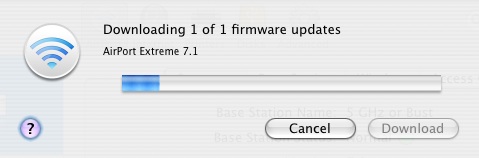
  Clicking Download starts an Internet download of any necessary files
  with a progress bar explaining the file being retrieved. With
  Firmware Update 7.1, that's the only file retrieved. After
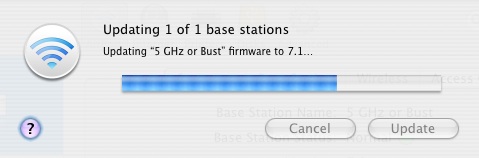
  retrieval, you click Update to install the software. The dialog
  changes to a note that firmware is being installed on a particular
  base station. It looks like the software would allow multiple
  installations in sequence of any base station that required the new
  firmware.

<http://www.tidbits.com/resources/2007-04/apn_firmware_updates.jpg>
<http://www.tidbits.com/resources/2007-04/apn_firmware_download.jpg>
<http://www.tidbits.com/resources/2007-04/apn_firmware_updating.jpg>

  Finally, when a base station has received the new firmware, it
  restarts. The LED on the front glows a solid orange while the base
  station burns the firmware into its rewritable persistent memory,
  which took about two to three minutes in my case. Then the Extreme N
  starts up normally.

  To revert to 7.0 firmware, should you have a problem, you would need
  to reinstall your original AirPort Utility software from the CD that
  comes with the Extreme N. While Apple maintains a page of firmware
  downloads, they haven't yet added the 7.0 or 7.1 release to this
  page. I cover installing older firmware releases in "Revert to Older
  Firmware" in Appendix C of "Take Control of Your 802.11n AirPort
  Extreme Network."

<http://docs.info.apple.com/article.html?artnum=75422>


Adobe Ships Creative Suite 3, Offers Video Betas
------------------------------------------------
  by Glenn Fleishman <[EMAIL PROTECTED]>
  article link: <http://db.tidbits.com/article/8951>

  Adobe's recently announced revisions to its flagship design,
  Internet, interactivity, video, and page layout software
  collectively sold as Creative Suite 3 (CS3) are now shipping (see
  "Adobe Announces Creative Suite 3 Plans, Pricing, Dates,"
  2007-04-02). The company said "April" for the first four of six
  separate editions: Design and Web available in Standard and Pro
  releases. The latter two editions, one containing all 13 Creative
  Suite 3 programs, and the other focused on video editing and
  production, will ship in the third quarter of 2007.

<http://db.tidbits.com/article/8930>
<http://www.adobe.com/products/creativesuite/>

  The revised line-up of programs now available are universal binaries
  for Mac OS X, finally exploiting the power of Intel multi-core
  processors. In a nice bit of what is perhaps not coincidental
  timing, Apple last week announced the availability of eight-core
  (two four-core processor) Mac Pro desktops (for details, see "Apple
  Introduces Eight-Core Mac Pros," 2007-04-09).

<http://db.tidbits.com/article/8941>


**Adobe Previews Video** -- Coinciding with this week's National
  Association of Broadcasters (NAB) conference, Adobe also released
  betas of its forthcoming video editing and effects applications,
  Premiere Pro CS3 and After Effects CS3 Pro. The former represents a
  return to the Mac for Adobe's video editing application, which has
  been Windows-only since 2003.

<http://nabshow.com/>
<http://labs.adobe.com/technologies/premierecs3/>
<http://labs.adobe.com/technologies/aftereffectscs3/>

  At NAB, Adobe also showed off Adobe Media Player, software that
  might be to video, Flash, and Web pages what the Acrobat Portable
  Document Format (PDF) and Acrobat Reader have become to the printed
  and previewed page. The Adobe Media Player will let designers create
  offline media for later playback using formats typically designed to
  be embedded in Web pages.

<http://www.adobe.com/aboutadobe/pressroom/pressreleases/200704/041607AMP.html>

  Adobe Media Player will allow subscriptions to video feeds, feedback
  ratings of viewed videos, and other tools clearly designed for
  narrowcasting and broadcasting video content - especially when you
  read about the variety of advertising and branding features
  available to content producers in the player. The free player will
  be available later in 2007 as a beta and will ship before the end of
  the year.


**Adobe vs. Microsoft** -- The Wall Street Journal is trying to stir
  up a little action about competition between Adobe and Microsoft via
  last weekend's article, "Microsoft, Adobe Set a Collision Course."
  Of course, it's really Microsoft trying to challenge Adobe's
  entrenched position with Flash and its creative applications, and
  Adobe trying to counter Windows Media Player by leveraging Flash's
  dominance for embedded video playback at YouTube and elsewhere.

<http://www.emailthis.clickability.com/et/emailThis?clickMap=viewThis&etMailToID=1306133125&pt=Y>

  The article notes that Microsoft's Silverlight will work much like
  Flash, and will work with Mac OS X and multiple browsers. Years of
  experience in getting Windows Media Player to play nicely with
  others isn't encouraging. Plus, Microsoft's Expression Studio is
  hardly a CS3 competitor, lacking critical pieces, including a
  Photoshop competitor, and the fact that some components of the suite
  have been in beta for years gives one pause too.

<http://www.microsoft.com/expression/expression-studio/overview.aspx>

  Microsoft has tried to beat Adobe before in areas that Adobe
  dominates. The operating system and business suite giant wanted to
  replace PDF with its own readers and interchange documents that
  wouldn't require owning a copy of the creating application to view.
  Needless to say, attempts made multiple times over several years by
  Microsoft have resulted in no change in Acrobat's near-total
  ownership of this task.

  There are three reasons for this: Adobe has published its PDF
  specification, allowing third parties (including Apple) to roll
  their own compatible writers and readers; with the help of the
  prepress industry, Adobe turned PDF into a final format for prepping
  files to go on a printing press, rather than just a method to proof
  a job; and Adobe doesn't particularly care what program creates a
  PDF file, just that every program can create such files.

  We don't see this as a fair fight: Adobe has won the hearts and
  minds of graphic designers over more than two decades. Microsoft
  doesn't stand a chance unless it delivers superior tools, not just
  those that achieve parity in limited areas.


Nisus Writer Pro Released to Public Beta
----------------------------------------
  by Adam C. Engst <[EMAIL PROTECTED]>
  article link: <http://db.tidbits.com/article/8955>

  I used to be a huge fan of Nisus Software's Nisus Writer in the
  classic Mac OS days. In fact, producing TidBITS each week relied on
  a collection of Nisus Writer macros I'd written. But the program
  never made the leap to Mac OS X, and when we moved to our new
  issue-generation approach last year (see "Behind the TidBITS
  Curtain," 2006-09-11), I no longer needed to run Nisus Writer in
  Classic mode. Nisus had of course released Nisus Writer Express some
  years before, but it was a pale shadow of the original Nisus Writer,
  and all that makes me even happier to hear that they've now released
  a public beta of Nisus Writer Pro for Mac OS X, the application
  that's supposed to replace the original Nisus Writer.

<http://db.tidbits.com/article/8673>
<http://www.nisus.com/Express/>
<http://www.nisus.com/pro/>

  Features new to Nisus Writer Pro from the Express version upon which
  it's based include style-based table of contents generation;
  indexing; bookmarks to locations within the document; cross
  references to bookmarks, footnotes, and list items;
  attribute-sensitive search and replace; floating images with text
  wrapped around them; customized line numbering; widow and orphan
  control; enhancements to the Nisus Macro Language; and greater
  flexibility in footnote and endnote styling, along with footnotes
  that can span multiple pages.

<http://www.nisus.com/pro/gallery2.php>

  With the first release of Nisus Writer Pro, Nisus Software is
  focusing on bringing back the much-missed functionality of the
  classic Nisus Writer, which means that most of these features are
  aimed at increasing the core word processing power of the
  application. However, conversations I've had with the company over
  the last few years lead me to believe that they're open to adding
  features that will set Nisus Writer Pro apart from other current
  word processors, such as built-in collaborative editing
  capabilities. I'd also like to see Nisus Writer Pro support common
  markup languages and be able to act as a front-end to blogs and
  other Web publishing systems - it's essential that a modern word
  processor be able to "print to the Web" as well as it can lay words
  on paper. Similarly, another area Nisus Writer Pro could stand out
  would be in generating truly good PDFs, complete with tables of
  contents, PDF bookmarks, hot-linked references, and more.

  Neither pricing nor release date has been determined, although Nisus
  Software is aiming to release in "Spring 2007," which probably means
  "before July." The Nisus Writer Pro public beta requires Mac OS
  10.3.9 or later, with 10.4 or later required for full right-to-left
  text support; it's a 40 MB download. Needless to say, there's no
  tech support beyond a discussion forum, and this is beta software,
  so you could lose data by using it (although it can auto-save every
  minute, making it unlikely that you'd lose much work).

<http://www.nisus.com/pro/beta/>
<http://www.nisus.com/forum/viewforum.php?f=16>


FutureBITS: Sweet Batteries, Faster P2P, Nanofiber Displays
-----------------------------------------------------------
  by Adam C. Engst <[EMAIL PROTECTED]>
  article link: <http://db.tidbits.com/article/8947>

  Predicting the future is a tricky thing, but as the late Macintosh
  writer Cary Lu once noted, all the technology we'll see in products
  in the next five years is being worked on in research labs today.
  With Cary's remark in mind, I'm going to keep an eye out for news of
  research projects that could affect our technological world. No
  promises here - if I could identify those projects that will survive
  to produce a paradigm-shifting product, I'd be a venture capitalist,
  not a writer. But it's always fun to imagine what products could be
  like if only they used...


**Sugar-Based Batteries** -- Bothered by batteries? Led by
  electrochemist Shelley Minteer, researchers at Saint Louis
  University have demonstrated a fuel cell battery that relies on
  enzymes that convert sugar to energy, leaving behind water as the
  main byproduct. Being the source of energy for most living
  organisms, sugar is cheap and widely available, and although the
  best source tested so far was normal table sugar (sucrose) dissolved
  in water, glucose, flat soda, sweetened drink mixes, and even tree
  sap have all been used successfully. Others have developed similar
  sugar-based fuel cells, but Minteer claims hers is the most powerful
  and longest lasting so far, and since power and longevity are the
  key weaknesses of alternative power sources, the question will be if
  both can be improved to the point where the sugar-based fuel cell
  can power a cell phone, iPod, laptop, or other portable electronic
  device. Just think, you could mix up a sugar solution, give half to
  your iPod, and put the other half in a hummingbird feeder.

<http://www.slu.edu/x14605.xml>


**Faster P2P Downloading** -- Peer-to-peer file sharing is for more
  than just copyright infringement - the technology is interesting for
  how it distributes massive bandwidth loads widely among a large
  population of users. Bandwidth may be cheap, but it's not free, and
  sharing the load helps all users in the system. According to a news
  release from Carnegie Mellon University, David G. Andersen of
  Carnegie Mellon and Michael Kaminsky of Intel Research Pittsburgh
  have developed a technique called "handprinting" that enables P2P
  clients to locate similar, but not identical, chunks of data, and
  they've used it in a new system called Similarity-Enhanced Transfer
  (SET) that significantly outperforms the popular BitTorrent P2P
  approach. Technology such as this could significantly ease Apple's
  bandwidth bills for distributing massive software updates, such as
  the 300+ MB 10.4.9 combo updater, or HD-quality video from the
  iTunes Store. I could even imagine an approach where contributing
  your bandwidth to help others download purchased content from the
  iTunes Store would give you credits that you could apply toward
  future purchases.

<http://www.cmu.edu/news/archive/2007/April/april10_set.shtml>
<http://www.cs.cmu.edu/~dga/papers/nsdi2007-set/>


**Flexible Nanofiber Displays** -- One of the limitations of modern
  electronics is having a rigid, often highly breakable, display. Much
  research is going into various ways to create flexible displays, but
  the latest promising research comes from an interdisciplinary group
  at Cornell University in the form of tiny - really tiny -
  "nanolamps," or light-emitting nanofibers. The 200 nanometer-wide
  fibers are actually smaller than the wavelength of the light they
  emit, enabling extremely localized light sources. Hurdles abound:
  getting the nanofibers to emit sufficiently bright light in the
  necessary colors, being able to control the light emitting
  properties of either individual nanofibers or sufficiently small
  clumps to create addressable on-screen pixels, and ensuring that the
  nanofibers offer sufficient durability and longevity. Fabrication is
  always a concern as well, although the nanofibers were created
  relatively simply using a technique called electrospinning. I
  suspect Cornell's research is years from being used in a commercial
  product, but we can still dream of having large screens attached to
  the walls like tapestries, or small displays woven into clothing.

<http://www.news.cornell.edu/stories/April07/electrospun.fibers.aj.html>


The Mystery of the Leopard Ship Date: Solved
--------------------------------------------
  by Ace MacKenzie <[EMAIL PROTECTED]>
  article link: <http://db.tidbits.com/article/8952>

  [The scene fades in on a dark street. A man is slumped against a
  streetlight, its yellow glow illuminating his rumpled suit and
  battered fedora. He straightens, and as he walks off down the
  sidewalk, subtly taking in his surroundings, he speaks in a low,
  rough voice, hardened with frustration.]

  Thursday night, and I had failed. I'd been working for a regular
  client, a petite redhead who called me every so often. Sometimes
  when she needed information. This job sounded easy - find out when
  Apple Computer was going to release Leopard, the latest version of
  their operating system. But getting sources to sing about Apple was
  always hard. They lived scared - scared of losing jobs, contracts,
  or more. I didn't blame them, since Apple kept its secrets better
  than any company in the city and dealt harshly with anyone who
  talked. Or rather, that was the word on the street. No one knew what
  really happened to those who were caught squealing - they just went
  away.

  Apple was good, you had to give them that. Leopard itself wasn't a
  secret, everyone knew it was coming, and Apple had even said, "in
  the spring." But those in the know were saying it couldn't possibly
  be spring, that Leopard just wasn't ready. Timing is everything in
  this world, and my client wanted that inside information so she
  could be first to market with a stable of books about Leopard. Smart
  girl, and I hated to disappoint her. Word had just filtered out that
  Apple had delayed Leopard until October, and everyone on the street
  knew. I wasn't looking forward to breaking the news to her.

  On my way to her office, I stopped for a whiskey at a bar I
  frequent. It's near the university, but it's too dark and seedy for
  the students. Frat boys sometimes come in loud groups, but they
  don't stay long. It's not that sort of bar. I pulled up a barstool
  next to a stranger who immediately introduced himself with the
  friendly bravado of the Midwesterner. "Bruce Carter, Senior Systems
  Engineer at the Center for Creative Computing at the University of
  Notre Dame," he said.

<http://creativecomputing.nd.edu/>

  "Nice to meet you, Bruce. You've heard about Leopard?" I was
  fishing, but perhaps I could take something else back to my client.

  "Yup. It doesn't affect us much, since when we were thinking it
  would be a June release timeframe for Leopard, we were really on the
  extreme far edge of our summer testing and deployment schedule. So
  we had strategically decided to stay with Tiger for another year, on
  existing equipment, for the studios and public computing areas."

  He paused for a long drink of beer, and a regular customer sat down
  on my other side. Andrew Laurence is a Systems Analyst at the
  University of California, Irvine, and he occasionally helps me out
  on jobs. He'd been listening to Bruce too and chimed in.

  "Bruce is right. For those of us doing the managed deployments such
  as staff desktops and labs, this is probably a relief more than
  anything else. Such installations should be plotted out according to
  budget schedules and are predicated more by the age of the old
  equipment than something as ephemeral as an OS ship date. In these
  cases, admins don't like to use the .0 release, but to wait for the
  inevitable .n release that puts the ship back on an even keel. These
  coordinated refreshes are usually done during summer, so the
  procurement process takes place between April and June; you can
  nudge it a bit, perhaps to take advantage of a software release, but
  then you're committed to that release. A lab refresh might be
  spurred by the requirements for a specific application, sometimes at
  the faculty's insistence. In this case, that'd probably mean
  something like Final Cut or CS3 - so if or when either of those
  require Leopard, then a lab will refresh to follow."

  I bought them both another beer, and settled back to listen as they
  continued to explain. Academic computing guys like to talk.

  Andrew continued. "So the delay means that Leopard won't upset the
  labs, won't dislodge the desktop refresh plans, and that only the
  eager beaver individual users will fall on the .0 sword. Sounds good
  to me."

  Bruce agreed, "This is actually better for most education calendars.
  I doubt that very many, if any, educational customers were planning
  to go to Leopard if it had shipped in June, and I equally assume
  that there were many sighs of relief that we are not going to see an
  equipment change in the middle of the summer that would require a
  shift, at least of new machines, to 10.5. We really hate doing split
  OS level deployments. We did it once with Tiger when new G5s came
  with Tiger, and while doable, we don't like to manage that if we
  don't have to. Now when I was using PLATO..."

  I cut him off. Once guys like him get started on old computer
  systems they've used, they don't stop. Don't get me wrong, I like
  listening, and sometimes I even pick up details that help in cases.
  But I didn't have that kind of time tonight. "So why's Apple doing
  this?" I asked. "I mean, I know the statement said it was because
  the iPhone project took resources needed for Leopard, but was that
  wise?"

  Andrew nodded. "Yes. Given Apple's newfound financial diversity with
  the iPod and iTunes, I doubt it'll impact them much." He paused for
  a quick drink, and Bruce jumped in.

  "There is a lot of ranting about the iPhone getting preferential
  treatment at the expense of Leopard, but delaying Leopard would seem
  to make sense. Apple already has a solid OS out in Tiger, and
  Leopard is likely to be evolutionary rather than revolutionary. It's
  not like the delay is really leaving a void, at least from my
  perspective of not knowing Apple's hardware rollout plans, whereas
  delaying the iPhone would leave not only a large void, but would be
  an even bigger PR crash."

  I thanked them for the scuttlebutt and headed for the men's room. As
  I was coming out, I bumped into a cheerful developer I know, Ken
  Case of The Omni Group. Developers are careful about what they say,
  since they know more and worry about Apple's wrath. But I asked him
  if Leopard's delay was frustrating anyway.

<http://www.omnigroup.com/>

  "Yes and no," he replied. "Leopard has a lot of great features that
  we're really looking forward to taking advantage of in our products,
  so it's hard to be patient for it to ship, and then, once it does
  ship, it will be hard to be patient while our customers upgrade to
  it."

  I interrupted. "So how will you know when people have upgraded?"

  He beamed at me. "We'll be keeping a close eye on
  update.omnigroup.com, which tracks what version of Mac OS X our
  customers are using among other things. If they choose to tell us,
  of course." He looked pleased with himself, and continued. "But as
  much as we're looking forward to Leopard, writing good software
  takes time, and we're glad that Apple is taking the time to deliver
  a quality product rather than rushing it out the door before it's
  ready. I'm also glad that we'll get a chance to see a
  feature-complete version of Leopard before it ships, so that we can
  test our software with it before our customers start using it."

<http://update.omnigroup.com/>

  Taking my leave, I headed back out into the night. Everyone I'd
  spoken with so far was happy about the delay. I wondered if my
  client would be equally happy. Or if she'd call again, given that I
  hadn't produced the goods.

  Walking toward her office in the business district, well away from
  the rougher blocks where I spend most of my time, I passed Tekserve,
  one of the few independent Mac stores left in the old part of town.
  They were closed, but a dark figure was perched on the steps. I kept
  him in the corner of my eye as I walked past. In my line of work,
  you can't be too careful.

<http://www.tekserve.com/>

  As I passed, the figure spoke my name. I turned quickly, sliding my
  finger around the trigger of the warm steel in my pocket. It's not
  always good when people identify me on the street. But my hand
  relaxed as I recognized his silhouette. David Lerner, Tekserve's
  owner. I sat down next to him. "What do you think?" I asked, knowing
  that he'd understand instantly.

  "I'm personally disappointed, because I was looking forward to Time
  Machine." This wasn't surprising from a man who signs his email,
  'May You have 1000 Backups and Never Need One.'

  "From a business standpoint, the delay may actually be helpful,
  because it separates the Adobe CS3 release from the OS update, and
  removes the vagueness over when Leopard will ship. The upside is
  that people who've been holding off buying new machines will
  probably stop waiting, but the downside is that the expected sales
  boost from Leopard will come in what's already our busiest time of
  year instead of our traditionally slower summer months. It should
  also mean that developers will really be ready with updates to their
  applications that are fully compatible with Leopard, and even take
  advantage of its new features. Like Time Machine."

  I grunted agreement. We sat companionably on the step for a few more
  minutes, staring at the darkness. "You need better lights out here,"
  I said. He grunted back, and I said goodbye.

  One more stop before I could go home and drown my sorrows. The light
  was still on in my client's office, as I knew it would be. I
  knocked, and let myself in. I could see instantly that she knew
  everything, but if anything, she looked relaxed. I shrugged, and
  told her what I'd learned about the responses from the education
  market and from a developer, and how a retailer thought users would
  react. She listened intently, her eyes locked on mine as I spoke.
  When I finished, I said, "I expect you won't be needing my services
  any more," and turned to go.

  She stopped me at the door. "Wait. Sure, the cat's out of the bag,
  or rather, it's still in the bag until October. And sure, like David
  Lerner, I'm a little concerned about the cash flow during the
  summer, since we were anticipating strong sales of our Leopard
  titles." She paused, and I watched the decision about what to say
  next flit across her pretty face.

  "But honestly, I'm relieved," she went on. "We've got other projects
  in the works, and the delay means I can take a summer vacation. I
  haven't had a proper summer vacation in years." She looked up at me.
  "Do you ever take vacations?"

  I said that I didn't generally make a practice of it, but that I
  wasn't opposed to the concept. She swallowed hard, and looking down
  at the carpet, said that she might have some more work for me in a
  few months.

  "In the summer?" I asked.

  "Yes," she said, straightening and again looking me in the face. "In
  the summer."


TidBITS Turns 17
----------------
  by Adam C. Engst <[EMAIL PROTECTED]>
  article link: <http://db.tidbits.com/article/8949>

  Today marks the 17th anniversary of TidBITS, which we've published
  continuously since 1990. On previous anniversaries, I've written
  about our accomplishments, our goals, lessons we've learned, and
  more. I had hoped this year to roll out some flashy new services and
  approaches to publishing, but as is so often the case, development
  has taken longer than expected, so the public face of TidBITS hasn't
  changed much in the last year. As Apple said when delaying Leopard,
  "We think it will be well worth the wait."

<http://db.tidbits.com/series/1166>

  But like a 17-year-old in his or her senior year of high school,
  preparing for graduation and subsequent passage to college, there's
  a great deal of upheaval happening beneath the surface. College is
  where it becomes possible to reinvent oneself, and we've been doing
  a lot of thinking and working behind the scenes to make that
  reinvention happen in the next year for TidBITS. We've always tried
  to be transparent about what's happening at TidBITS; here's a look
  at our current efforts.


**Site Improvements** -- In preparation for a major redesign, we've
  been quietly implementing a few new features on our Web site.

* Inline images in articles. For the last few months, articles that
  contained image links in the email editions of TidBITS have actually
  displayed those images inline on the Web (for an example, see "Add a
  DJ to iTunes with SpotDJ," 2007-03-26). That's right, after 16 years
  of TidBITS being text-only, graphics have finally crept in.
  Cutting-edge, I know, but with tools like Plasq's Skitch on the
  horizon for making screenshots even snazzier, we're pretty sure that
  mixing graphics and text isn't just a short-lived fad.

<http://db.tidbits.com/article/8915>
<http://plasq.com/skitch>

* Bookmarks for sharing articles. At the bottom of every article on
  our Web site and in the HTML edition of TidBITS in email, you'll now
  see a line of links to major social bookmarking sites, including
  del.ico.us, digg, reddit, Slashdot, and Yahoo's MyWeb (let us know
  if you'd like to see other sites included). If you're unfamiliar
  with the idea of social bookmarking, it's a way to recommend an
  article to other users of a particular service. The more people who
  vote for an article, the more it rises in the rankings and the more
  people are likely to go read it. We implemented social bookmarking
  links because it became apparent from our recent reader survey that
  we have a long-standing, loyal readership. The flip side of that,
  however, is that we need to work harder on introducing new readers
  to our content, and we're hoping that social bookmarking links will
  help. You can help by using them to recommend articles or to vote
  for already recommended articles - thanks!

* TidBITS Talk usability redesign. Our TidBITS Talk discussion list
  has nearly 1,700 email subscribers, but I'm noticing an increasing
  number of people finding discussions via Web searches and asking
  questions (sometimes even years later, which feels odd from the
  email perspective, but is perfectly understandable from a Web
  viewpoint). In an effort to improve the usability of TidBITS Talk,
  I've fiddled with the CSS styles to clean up the design, reworded a
  lot of the boilerplate text that Web Crossing supplies in order to
  improve clarity, and made it possible for registered users to give
  usefulness ratings to individual messages.

<http://emperor.tidbits.com/TidBITS/Talk/>

* Connecting articles and discussions. We've also started down the
  path of connecting articles and their discussions directly, so if
  you look at articles from last week that have generated discussion,
  the "Discuss This Article" link at the top takes you directly to the
  appropriate TidBITS Talk thread. If no discussion has been started,
  that link merely creates an email message to TidBITS Talk;
  engineering a Web-based solution that's invulnerable to spambots
  proved more difficult than we anticipated, so we're still working on
  the final approach.

* Mailing list subscription management. I've mentioned this feature
  before, but it has been and will continue to be an important part of
  our infrastructure moving forward, since it lets everyone manage
  their own email subscriptions easily. As an added bonus, when you
  log in to manage your email subscriptions, you'll remain logged in
  for easy addition and rating of TidBITS Talk messages.

<http://www.tidbits.com/list/>


**TidBITS Editing System** -- A year ago, in "Wanted: Better Document
  Collaboration System" (2006-04-03), I discussed what we needed in a
  document collaboration system. Although at least one project is in a
  very early stage to provide such a system, we needed something that
  worked today. Luckily, Bare Bones Software came to the rescue with
  BBEdit 8.6, which added word-level diff, so we can compare two
  revisions of a document and see exactly which text has changed (most
  diff implementations for displaying the differences between two
  documents work at the paragraph level, not the word or character
  level). Then contributing editor Matt Neuburg set up the Subversion
  version control system for us to provide versioning, a centralized
  repository, and a transfer mechanism.

<http://db.tidbits.com/article/8489>
<http://subversion.tigris.org/>
<http://www.barebones.com/products/bbedit/>

  BBEdit can act as a Subversion client, which lets us avoid using the
  Subversion client programs available for the Mac, none of which
  worked well for those of us who aren't programmers. But even BBEdit
  doesn't offer a particularly helpful interface to Subversion. After
  putting up with our griping for a while, Matt wrote a utility for us
  that significantly improves the Subversion workflow from within
  BBEdit by handling locking and unlocking of articles; it also
  simplifies status checks, commit messages, and file management.

  Now, between Matt's utility and BBEdit's built-in features, I can
  easily add a new file to the central repository, making it available
  for other staff members to edit. When I want to edit again, I can
  check to see if anyone has it locked, and if not, lock it myself to
  ensure that no one else will make changes simultaneously. Once I
  have the file open, I can check the version history to see who has
  made changes, and read any notes made about each version. I can also
  compare the current version of the file to the last version I saw
  before diving into new edits. When I'm done, it's trivial to write a
  commit message describing my changes, unlock the file, and send my
  changes back to the master copy in the central repository. The file
  is available for editing offline, and can be sent to outside
  contributors for edit checks.

  There's still room for interface and process improvement, but this
  system has made our collaborative writing and editing far faster,
  easier, and more confident. The next step for the collaborative
  editing system is to integrate it with our other major piece of
  infrastructure, the TidBITS Publishing System.


**TidBITS Publishing System** -- It's a testament to the work of
  technical editor Glenn Fleishman on the TidBITS Publishing System
  that no one has seemingly noticed changes in TidBITS since our
  26-Feb-07 issue, when our entire behind-the-scenes publishing
  approach changed. For many years, we would manually assemble each
  issue in a single file, and then send out that file.

  Now we add articles to the TidBITS Publishing System throughout the
  week, and if an article is ready for public consumption, we merely
  set a status that makes it available on our home page under the
  ExtraBITS section. This approach is part of our overall goal to move
  away from thinking of TidBITS in issue-centric terms. In the TidBITS
  Publishing System, we create articles and combine them to create an
  issue, whereas in the past, we created an issue and then broke it
  apart into articles for our Web archive.

  On Monday, to generate an issue, we simply go through all the
  available articles we've published or staged but not previously
  included in an issue, set an order for those we want to publish, add
  a summary, and push a button. Actually, we still take a number of
  publication-day editing passes to improve the quality of the
  writing, but the effort to release an issue has dropped tremendously
  from just a few months ago.

  Largely that decrease in effort is because previously we all tended
  to put off writing and editing until the last minute, whereas now
  it's easier to get something written and posted to the Web or to a
  staged area sooner. Plus, we can all take edit passes whenever it's
  convenient, rather than putting off the work until it's necessary.
  Since none of us like to see typos creep through even on the Web
  version that precedes the issue, it's all the more likely that
  articles will get an early edit pass.


**Looking Forward** -- All these efforts lay a foundation upon which
  we'll be building in the upcoming year, and we hope you find the
  improvements useful. Rest assured that changes to the email editions
  of TidBITS will be minimal, since there's no reason to mess with a
  successful formula. But as we've been learning from our reader
  survey, the ways in which people get their information on the
  Internet are changing, and we need to change with the times as well.
  That's fine - like a high school student contemplating college,
  we're both excited and a little scared by all the possibilities.


Hot Topics in TidBITS Talk/16-Apr-07
------------------------------------
  by TidBITS Staff <[EMAIL PROTECTED]>
  article link: <http://db.tidbits.com/article/8956>

**Leopard delayed until October** -- What are people's thoughts about
  Apple's delay in getting Leopard out the door? (35 messages)

<http://emperor.tidbits.com/TidBITS/Talk/1241/>


**Google calendar/OSX contextual menu** -- An update to Google's Gmail
  Notifier adds a contextual menu item for Google Calendar. How does
  one get rid of it, and does Google's quiet inclusion demonstrate
  that the company is actually capable of evil? (2 messages)

<http://emperor.tidbits.com/TidBITS/Talk/1237/>


**Spotlight enhancements** -- You can access Spotlight search queries
  via the command line that don't appear in Spotlight's interface;
  Matt Neuburg's NotLight utility makes them easier to use. (4
  messages)

<http://emperor.tidbits.com/TidBITS/Talk/1238/>


**Google "Driving" Directions** -- Google's maps demonstrate that the
  shortest distance between two points is a straight line; don't let
  that little ocean dissuade you from driving from New York to Paris.
  (10 messages)

<http://emperor.tidbits.com/TidBITS/Talk/1239/>


**Online Backup Options Expand** -- Following Joe Kissell's article on
  the current field of online backup services, readers note a few
  other services that they like. (5 messages)

<http://emperor.tidbits.com/TidBITS/Talk/1240/>


$$

This is TidBITS, a free weekly technology newsletter providing timely
news, insightful analysis, and in-depth reviews to the Macintosh and
Internet communities. Feel free to forward to friends; better still,
please ask them to subscribe!

Non-profit, non-commercial publications and Web sites may reprint or
link to articles if full credit is given. Others please contact us. We
do not guarantee accuracy of articles. Caveat lector. Publication,
product, and company names may be registered trademarks of their
companies. TidBITS ISSN 1090-7017.

Copyright 2007 TidBITS: Reuse governed by Creative Commons license.

Contact us at:    <[EMAIL PROTECTED]>
TidBITS Web site: <http://www.tidbits.com/>
License terms:    <http://www.tidbits.com/terms/>
Full text search: <http://www.tidbits.com/search/>
Subscriptions:    <http://www.tidbits.com/about/list.html>
Account help:     <http://www.tidbits.com/about/account-help.html>


--
If you want to unsubscribe or change your address, use this link
http://emperor.tidbits.com/webx?unsub@@.3c557dc4!u=306a67f9