TidBITS#937/21-Jul-08
=====================
  Issue link: <http://db.tidbits.com/issue/937>
  As everyone takes a breather after last week's iPhone 3G launch
  coverage, we dip back into a wide variety of topics, including
  Apple's public apology for messing up the MobileMe launch and a look
  at how Apple's market share is increasing. Glenn Fleishman also
  looks at Microsoft's backtracking on the MSN Music debacle, the new
  GoBoingo application for the Mac, Nokia's buyout of the Symbian
  mobile phone operating system, and how a few hundred thousand
  dollars can buy you a new top-level domain. Adam looks at
  Precipitate, which brings Spotlight searching to Google Docs files,
  and Rick Fay evaluates hands-free options for the iPhone. In the
  TidBITS Watchlist, we look at the iPod touch 1.1.5 update, the HP
  Printer Driver 1.1, and three updates from Rogue Amoeba: Airfoil
  3.2.1, Audio Hijack Pro 2.8.2, and Nicecast 1.9.3.

Articles
    Apple Gains Larger Slice of Computer Sales
    MobileMea Culpa: Apple Apologizes and Explains Tiger Situation
    MSN Music Doesn't Kill Future Playability of Purchased Tracks
    Go, Go, Boingo Gadget Hotspot Application!
    Precipitate Shines Mac Spotlight into Google's Cloud
    Vanity Spreads to Top-Level Domain Names
    Hands-Free iPhone Options for the Car
    Symbian Smartphone Platform Goes Free, Partly Open Source
    TidBITS Watchlist: Notable Software Updates for 21-Jul-08
    Hot Topics in TidBITS Talk/21-Jul-08


------------ This issue of TidBITS sponsored in part by: --------------

* READERS LIKE YOU! Support TidBITS with a contribution today!
  <http://www.tidbits.com/about/support/contributors.html>
  Special thanks this week to Michael O'Connell, Hugh Marsh,
  Geoffrey Meissner, and Richard Healey for their generous support!

* Fetch Softworks: Fetch 5.3 has a new look for Leopard,
  and new support for Leopard technologies. And you can
  upload with the oldest technology of all, Copy and Paste!
  Download your free trial version! <http://fetchsoftworks.com/>

* WebCrossing Neighbors Creates Private Social Networks
  Create a complete social network with your company or group's
  own look. Scalable, extensible and extremely customizable.
  Take a guided tour today <http://www.webcrossing.com/tour>

* MARK/SPACE, INC: Take it with you! The Missing Sync makes
  it easy to synchronize contacts, calendars, notes, photos
  and more from your Mac to your BlackBerry, Palm OS, or
  Windows Mobile phone. <http://www.markspace.com/bits>

* VMware Fusion. The most seamless way to run Windows on your Mac.
  Backed by nearly a decade of proven virtualization technology.
  Try VMware Fusion today for free, or order online for only $79.
  Visit: <http://www.tidbits.com/about/support/vmware-fusion.html>

* Microsoft's MacBU: Supporting Mac users with Office 2008.
  Is your Office up-to-date? Make sure you're running the latest
  versions of Word, Excel, PowerPoint, and Entourage by choosing
  Check for Updates from the Help menu of any Office application!

---------- Help support TidBITS by supporting our sponsors ------------


Apple Gains Larger Slice of Computer Sales
-------------------------------------------
  by Glenn Fleishman <[EMAIL PROTECTED]>
  article link: <http://db.tidbits.com/article/9699>

  Two research firms say that Apple's share of U.S. computer sales
  shot up by 30 to 40 percent in the second quarter of 2008 over the
  same quarter in 2007. IDC and Gartner say PC sales worldwide rose
  from 62 to 71 million systems year over year, and Apple's sales
  increased in every market, even as the overall price-per-computer
  dropped.

<http://bits.blogs.nytimes.com/2008/07/18/economy-down-pc-sales-up/>

  The research firms said Apple sold 38 percent (Gartner) or 32
  percent (IDC) more computers compared year over year, pushing it
  either into a clear third place after Dell and HP (Gartner), or tied
  for third with Acer (IDC), which acquired Gateway and Packard Bell
  in the intervening period. Worldwide, HP takes the top spot in
  overall market share, followed by Dell, Acer, Lenovo, and Toshiba.

  Given that Apple typically keeps its price points about the same,
  improving features or reducing the cost of high-end add-ons - like
  the MacBook Air's solid-state drive, now $500 cheaper than at its
  introduction - this likely means Apple's revenue is higher than
  indicated by its roughly 8 percent estimated market share in the
  United States. According to Gartner, other firms are cutting prices
  steeply, trading market share for revenues.


MobileMea Culpa: Apple Apologizes and Explains Tiger Situation
--------------------------------------------------------------
  by Glenn Fleishman <[EMAIL PROTECTED]>
  article link: <http://db.tidbits.com/article/9695>

  I accept your apology, but I'm speaking only for myself. Last week,
  Apple's MobileMe team sent an email to all subscribers of the
  $99-per-year service, admitting that the transition from .Mac was
  rocky, and that they're sorry about it. So sorry, in fact, that
  they're tacking 30 days onto all current subscribers' expiration
  dates. (I wrote about the botched .Mac-to-MobileMe transition in
  "MobileMe Fails to Launch Well, But Finally Launches," 2008-07-12.)

<http://db.tidbits.com/article/9689>

  Also, I received details from Apple on how Mac OS X 10.4 Tiger users
  will be able to use MobileMe services.


**Here's $8.25 for Your Troubles** -- The extension of a MobileMe
  subscription by 30 days - an $8.25 value - is a nice gesture of
  goodwill, even though it hardly covers the lost time I spent coping
  with sync problems. I like that Apple 'fessed up and said sorry. It
  would have been more meaningful if they'd used standard English
  rather than marketing-ese, but you can't have everything.

  The 30-day extension is described in an extensive FAQ, the details
  of which show that Apple is trying quite hard to show their
  contrition. Anyone with an existing .Mac account as of 09-Jul-08 or
  who signed up for a new MobileMe account before 7 PM on 15-Jul-08
  qualifies, even if your account expired (they've reactivated it), is
  about to expire, or you have a trial subscription. The new
  expiration date won't appear in your account details for "a few
  weeks," Apple writes.

<http://support.apple.com/kb/HT2408>

  Apple also said in the letter that they have been using the term
  "push" too broadly to describe MobileMe's technology. In the context
  of events, contacts, and mail, push generally means that as soon as
  a change is made, a given device or computer is notified to receive
  the update if that device or computer is connected to a network.

  With MobileMe, Apple had already received some criticism about
  labeling its desktop synchronization as push because changes lagged
  for up to 15 minutes. The iPhone and me.com Web applications receive
  changes immediately, or, if the iPhone is off all networks, as soon
  as it resumes its access. Apple says it won't use the term "push"
  for its desktop software until the software provides that actual
  feature.


**In Tiger, It's Still .Mac, Same Features** -- After I wrote about
  how to get updated MobileMe software under Mac OS X Leopard (you
  must first go to the .Mac preference pane before the Mac OS X for
  MobileMe 1.1 update will appear in Software Update), several readers
  asked whether this update would eventually be available for Tiger,
  too. The answer: no.

  An Apple spokesperson forwarded several details to me about the
  Tiger transition. First, the 10.4.11 release is required; I
  discovered this earlier today when, during a power outage at my
  office, I attempted to use an old iBook that still sported 10.4.10.
  To use the MobileMe Web applications, you also need to download
  either Safari 3 for Tiger, or use either Mozilla Firefox 2 or 3.
  Tiger's last bundled release was Safari 2.

<http://www.apple.com/support/downloads/safari312fortiger.html>
<http://www.mozilla.com/en-US/firefox/>

  All previously supported .Mac features that worked in Tiger will
  continue to work with MobileMe. Unlike the within-15-minutes
  synchronization noted above for Leopard, Tiger will sync only as
  frequently as every hour.

  Apple posted a KnowledgeBase article with information for Tiger and
  Leopard users about how to set up or change email programs to work
  with me.com addresses. To continue using old mac.com email
  addresses, which will work indefinitely, leave settings alone. To
  use a new MobileMe account or the me.com address that .Mac users
  were also assigned, follow the instructions in the article.

<http://support.apple.com/kb/HT2296>

  Apple confirmed that Tiger will continue to show .Mac throughout;
  they plan no update to change the operating system's terminology to
  read MobileMe.

  MobileMe's launch spelled an end of Apple-coordinated
  synchronization in Mac OS X 10.3 Panther, but, really, did it ever
  work well enough that someone is relying on it three years after
  Tiger was released? I hope not.


MSN Music Doesn't Kill Future Playability of Purchased Tracks
-------------------------------------------------------------
  by Glenn Fleishman <[EMAIL PROTECTED]>
  article link: <http://db.tidbits.com/article/9684>

  Microsoft blinked on its way to terminating the future capability to
  play music purchased from the defunct MSN Music store. On 31-Aug-08,
  The company had planned to pull the plug on its authorization
  servers, the back-end systems that are required for music owners to
  change the set of machines on which their purchased music is allowed
  to play. Computers that were already authorized to play music would
  still be able to play the music, however; Microsoft wasn't planning
  to use what's called "self-help" and disable existing rights and
  authorizations. (See "Thank You for Not Playing: Microsoft Expires
  DRMed Music," 2008-04-30.)

<http://db.tidbits.com/article/9595>

  The company backpedaled a few weeks ago and said that it will keep
  its authorization systems running until at least the end of 2011.
  Microsoft faced a storm of media and user criticism over the move,
  which was nearly the worst-case scenario for those who oppose
  restrictive digital rights management. (The worst case is when all
  music playing rights would expire, not just the right of transfer
  and authorization.)

<http://www.eff.org/deeplinks/2008/06/microsoft-msn-music>

  It was clear to observers that Microsoft could also have faced
  class-action lawsuits, given the large number of purchasers, the
  lack of alternatives (excepting ripping and burning discs, degrading
  the music quality), and the unilateral action.

  Judges are increasingly handing down negative judgments and fines
  against the music industry trade group RIAA. Microsoft had to view
  the downside to its move to save most likely a few hundred thousand
  dollars a year against millions in defending itself and tens of
  millions if they lost a multi-year lawsuit.


Go, Go, Boingo Gadget Hotspot Application!
------------------------------------------
  by Glenn Fleishman <[EMAIL PROTECTED]>
  article link: <http://db.tidbits.com/article/9685>

  The folks at Boingo Wireless play their own game of Katamari Damacy,
  rolling up hundreds of disparate Wi-Fi hotspot networks and tens of
  thousands of hotspots around the world into one flat-priced
  footprint. They have now enhanced support for Mac users with a
  lightweight application - GoBoingo - that's designed to make it
  easier to connect to hotspots that are part of their network.

<http://en.wikipedia.org/wiki/Katamari_Damacy>
<http://www.boingo.com/download.html>

  Before the GoBoingo client was released officially, you could sign
  up for a Boingo account and at most hotspots in the company's
  network enter your credentials manually. I have subscribed to Boingo
  most recently since January 2008, and have used dozens of hotspots
  in that more tedious method. (Typically, you have to look for a
  partner link on the main gateway page for a hotspot, select Boingo,
  and then enter your user name and password.)

  GoBoingo has no user interface as such. Once installed, it runs in
  the background, and alerts you when a Boingo partner network is in
  the vicinity. You then enter your login details - if you haven't
  connected before - and you're informed about cost if your plan
  requires a payment.

  Boingo has two recurring unlimited service options: $22 per month
  for about 60,000 hotspots in the United States, or $39 per month for
  about 100,000 hotspots worldwide. The company requires no contract.
  With a Boingo account, you can also purchase 24-hour passes to the
  network for $8, and have it billed to whatever credit card is
  associated with your Boingo account.

  Readers with long memories will recall that Boingo had a slightly
  more complicated Macintosh client a few years ago (see "Boingo for
  Macintosh Launches," 2005-01-10). That software apparently continued
  to work through Mac OS X 10.4 Tiger, but didn't function under 10.5
  Leopard.

<http://db.tidbits.com/article/7946>


Precipitate Shines Mac Spotlight into Google's Cloud
----------------------------------------------------
  by Adam C. Engst <[EMAIL PROTECTED]>
  article link: <http://db.tidbits.com/article/9682>

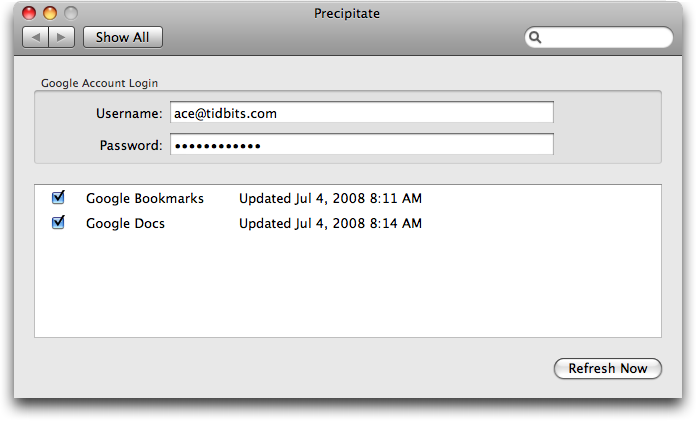
  Stuart Morgan of Google has released a free Mac OS X preference pane
  called Precipitate that enables Spotlight and Google Desktop to
  search documents stored in your Google Docs account, along with your
  Google Bookmarks.

<http://www.tidbits.com/resources/2008-07/Precipitate-pane.png>
<http://code.google.com/p/precipitate/>

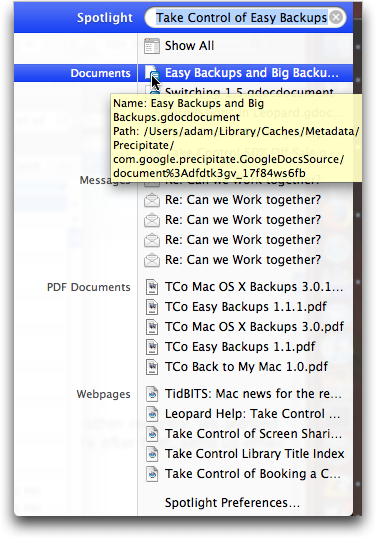
  We've been using Google Docs an increasing amount, and Precipitate
  worked fine in my initial Spotlight search tests for finding
  documents that exist only online. Clicking a found Google Docs
  document in the Spotlight search results opened it in my default
  browser, just as you'd expect. If you use either Google Docs or
  Google Bookmarks and Spotlight or Google Desktop, give Precipitate a
  try.

<http://www.tidbits.com/resources/2008-07/Precipitate-search.png>

  Future updates of Precipitate will likely support multiple Google
  accounts and some sort of automatic update functionality (so in the
  meantime, you'll need to check for updates manually at the
  Precipitate page). It's a 904K download and works in Mac OS X 10.5
  Leopard; I haven't yet confirmed Tiger compatibility.


Vanity Spreads to Top-Level Domain Names
----------------------------------------
  by Glenn Fleishman <[EMAIL PROTECTED]>
  article link: <http://db.tidbits.com/article/9669>

  We all know about _vanity_ domain names - www dot yourname here dot
  com, org, net, info, or otherwise. The Internet authority that
  oversees domain names is about to let you get a little more
  top-heavy with your vanity, if you have deep enough pockets.

  ICANN (Internet Corporation for Assigned Names and Numbers) has
  voted to move forward on allowing new top-level domains (TLDs),
  which form the right-most part of a domain name, like .com, .uk, or
  .aero. The original TLDs included .gov, .com, and .org, and expanded
  to include all two-letter country codes, such as .au for Australia
  and .nu for the island nation of Niue. (If you look at
  "www.tidbits.com", .com is the TLD, tidbits is the domain name
  registered in the .com hierarchy, and www is the local host name
  that defines a real or virtual server.)

<http://ap.google.com/article/ALeqM5gvve1Yb-5RVLc0GTkIwFT6flYwvAD91HR4N80>

  For $100,000 to $500,000, a company or an individual could apply for
  a TLD. Many years ago, when I worked at Amazon.com, I saw that TLD
  proposals were underway, and I suggested Amazon sponsor .book so
  that an ISBN number plus .book would result in a search result on
  the site. That wasn't possible then, it turned out, but would be
  possible under this new regime.

  Names could be turned down in a first-pass review if they were
  offensive, violated trademarks, or were too similar to an existing
  TLD (.con for grifters, perhaps? :-)). There's little information
  now about how two companies that want the same generic TLD, like
  .book, would work that out. Bidding? First-come, first-serve? Shared
  delegated authority? These details are expected to be worked out
  between now and about April 2009. The ICANN page on the topic is
  unfortunately quite bureaucratic and technical in discussing this
  issue.

<http://www.icann.org/topics/new-gtld-program.htm>

  Is this change necessary? Hard to say. It can be quite difficult to
  find the appropriate domain name for your business, non-profit
  organization, social site, or personal domain because of the
  exhaustion of generic words, and the vast growth in the use of sites
  to pull in advertising dollars through Google AdSense and affiliate
  program referrals. Opening up new TLDs could allow ISPs and other
  organizations to build a little more wiggle room.

  For instance, a soccer organization could register .soccer, and then
  work with a registrar to allow both fans and teams to have domains
  underneath that. The related problem, though, is that companies
  controlling TLDs that have a relationship to their product might be
  more ready to yank domain names that have content or engage in
  behavior they disagree with. That might run counter to the rules
  that ICANN requires for domain name handling.

  I could also see some interesting cooperative work emerge. Say 5,000
  Mac users wanted to register .fanboy - to take back the pejorative -
  and were willing to pony up $20 each, if the TLD cost were $100,000.
  That's certainly do-able.

  The proposal will also allow the creation of TLDs that don't use
  English. Domain names and TLDs currently are limited to a through z,
  and 0 through 9; domain names can also include one or more hyphens.
  An obscure system currently allows a kind of mapping for non-English
  characters and letters, and ICANN has been working on a way to allow
  a more straightforward encoding method. They started testing this in
  October 2007. (See "ICANN Tests Non-Roman Characters in Domain
  Names," 2007-10-12.)

<http://db.tidbits.com/article/9235>

  Part of the new TLD proposal would allow countries to request their
  two-letter code in characters from their native language or
  languages. The final report on that proposal was presented at an
  ICANN meeting. A draft report on the non-Roman character test was
  released on 24-Jun-08.

<http://www.ccnso.icann.org/workinggroups/idn-time-table-19dec07.htm>
<http://icann.org/en/announcements/announcement-24jun08-en.htm>

  The real question, of course, is how long it takes our fearless
  leader here at TidBITS to put together enough pennies for .bits.


Hands-Free iPhone Options for the Car
-------------------------------------
  by Rick Fay <[EMAIL PROTECTED]>
  article link: <http://db.tidbits.com/article/9697>

  On 01-Jul-08, the state of California made it mandatory to use
  hands-free technology for cell calls for all drivers 18 and over who
  want to talk while driving. If you're under 18, the restrictions are
  even more severe: drivers may not talk on a cell phone through any
  means, nor may they type instant messages. This under-18 ban strikes
  me as a good idea, as driving accidents are the leading cause of
  death for that age group.

  This move isn't limited to California, or nearby Washington, which
  implemented a similar ban the same day: 20 other states and a number
  of countries are looking into or planning similar restrictions on
  using cell phones while you're driving, and 10 states and countries
  require that cell phones be used with hands-free equipment while
  driving. (In Washington state, where two TidBITS editors are
  located, text messaging while driving is explicitly banned; in
  California, 18-and-up drivers can be pulled over if a police officer
  decides the driver is distracted and unsafe.)

<http://www.ghsa.org/html/stateinfo/laws/cellphone_laws.html>

  I live over the hill from Silicon Valley and travel there frequently
  via a winding two-lane highway. Commuters from both the local
  university town and Silicon Valley have driven me nuts for years
  with their horrible driving habits while talking on cell phones.
  Scariest of all are ladies in big SUVs driving in the mall parking
  lot.

  Once I knew the hands-on ban was on the way, I bought and tried four
  different options for hands-free iPhone use. I didn't plan on
  getting four different solutions, but that's how many it took to
  find one that met my needs. Prices vary from free to $129; you may
  find a solution I discarded works for you.


**Apple iPhone Headset** -- The original headset that comes with an
  iPhone (free with iPhone, or $29 purchased separately) is a good,
  workable solution. A microphone is embedded in the wire leading to
  one earbud, about 6 inches (15 cm) down the wire. This square block
  also contains an integrated multi-purpose press button. When a call
  comes in, squeezing the button answers the call; squeezing it again
  at the end of the call hangs up. When you're driving, you don't need
  to pick up the phone at all - simply pinch the microphone switch. If
  a call comes in while you're listening to music or a podcast, the
  audio is paused in favor of your ringtone and then the call itself.
  The audio resumes automatically when you hang up.

  No one I called reported any interference when I was driving the car
  with the window up. Thanks to a windscreen built into the
  microphone, they could also hear me over the wind noise with the
  window down. I find the earbuds to be comfortable (some people do
  not), and the overall wire length is sufficient to lay the iPhone on
  the console or car seat.

  I don't use the iPhone headset as my main solution (as you'll read
  below), but because it came with the iPhone and takes up hardly any
  space, I keep it in my car as a backup.

  One flaw with the earbuds, however, is that you typically have both
  left and right buds in at the same time, which might qualify under
  the laws of some states and countries as wearing illegal headphones.
  (See "Handsfree iPhone Call Leads to Ticket," 2007-09-13.)

<http://db.tidbits.com/article/9180>


**Plantronics Voyager 520 Bluetooth Headset** -- The Voyager 520 ($99)
  fits over one ear and communicates with the iPhone via Bluetooth.
  Performance was excellent, with good noise cancelation, and setup
  (pairing with the iPhone) was simple. It even comes with a small
  desktop charger.

  In fact, I loved everything about this headset except for the
  discomfort of the piece that sits in the ear canal. I must have a
  weird ear canal layout, because wearing it even for a short drive
  made me constantly conscious of the headset; there was also enough
  irritation to make the inside of my ear sore. And, I must admit, I'm
  bothered by people who walk around with Bluetooth headsets
  permanently affixed to their ears: you try to ask someone a question
  only to find they're talking to someone. Leave the headset in the
  car or office.

<http://plantronics.com/north_america/en_US/products/mobile/bluetooth-headsets/voyager-520>


**Belkin TuneCast Auto** -- Belkin's iPhone-to-FM car radio adapter
  ($79.99) is a clever one-cable system. One end of the cable plugs
  into the iPhone (or iPod) and the other end plugs into your car's
  cigarette lighter to provide power, which also charges the iPhone.
  An FM radio adapter module sits in the middle. When connected and
  with your car radio tuned to the FM band, you press the button on
  the adapter. It searches for a clear FM channel and then indicates
  the specific channel (for example, 89.7) on a built-in LCD. Select
  that channel on your car radio, and voila! Your music plays from the
  iPhone, but more important for our discussion here, if a phone call
  comes in, you hear the other party through that FM channel on your
  radio.

<http://catalog.belkin.com/IWCatProductPage.process?Product_Id=404646>

  But that's all it does. You still have to answer and hang up the
  iPhone manually, a momentary distraction when driving unless you
  also use the Apple iPhone earbuds. There's no microphone, so I used
  the iPhone's built-in mic. Plus, when driving around our hilly urban
  community or driving some distance along one of the major freeways
  in the Bay Area, the FM station reception would change at least once
  every few minutes, requiring the unit to search for a clearer FM
  channel - at which time you would have to change the radio to that
  channel.

  Admittedly, the TuneCast Auto wasn't designed as a hands-free
  telephone system, but when I could maintain a constant frequency it
  served the purpose.


**Monster iCarPlay Cassette Adapter for iPod and iPhone** -- A
  similarly unusual but effective approach is to play the iPhone's
  audio through your car stereo without relying on the FM band. The
  iCarPlay ($24.95) is a cassette adapter and cable that plugs into
  the radio's cassette tape slot. (That is, if your car stereo
  includes one; many newer cars no longer include a cassette deck,
  although some have a stereo mini-jack input on the front.) The sound
  quality was excellent, since it wasn't relying on radio reception,
  even though a wire runs between the adapter and the iPhone.

<http://www.monstercable.com/productdisplay.asp?pin=4933>

  To make the setup hands-free, I also bought the Monster iSoniTalk
  Headphone Adapter for iPhone, a small microphone ($19.95) that plugs
  into the iPhone and clips to your shirt or, in my case, a small
  adhesive hook on the dashboard; the iSoniTalk sits between the
  iPhone and iCarPlay. The iPhone then stays in the carrying case I
  use in the console of the car. When I get in, I make one connection
  to the top of the iPhone and everything is ready to go - no
  settings, no fiddling, and no distractions at any time. Hearing
  everything (car radio, satellite radio and iPhone music/podcasts)
  through the car's speakers is fabulous and cell phone callers have
  no sense of my unusual setup through the car stereo.

<http://www.monstercable.com/productdisplay.asp?pin=4571>

  This combination turns out to be my favorite, and the one I use all
  of the time now as it allows me to handle everything through the car
  stereo. It's also the cheapest solution of the ones I tried.


**Parrot Bluetooth Car Kits** -- If you spend a lot of time in the car
  and want something more sophisticated, Parrot sells a number of
  Bluetooth hands-free speakerphone kits that clip onto the dashboard
  or visor. I didn't try any of them, which range in price from
  $129.99 to $299.99, since the iCarPlay and iSoniTalk combination
  turned out to be the solution for me.

<http://www.driveblue.com/>


**Hands Off** -- With ever more localities moving toward a hands-free
  requirement when talking while in motion, I anticipate we'll see
  other solutions appear, and the overall cost drop.

  [Rick Fay is a 22-year Mac user, writer, wireless video networking
  professional, and serious evaluator of technology. He has also used
  an iPhone  throughout the United States and Mexico since 30-Jun-07.]


Symbian Smartphone Platform Goes Free, Partly Open Source
---------------------------------------------------------
  by Glenn Fleishman <[EMAIL PROTECTED]>
  article link: <http://db.tidbits.com/article/9666>

  Nokia will buy out the other owners of Symbian, a firm that develops
  the same-named smartphone operating system that dominates the
  worldwide market for phones that double as palmtop portable
  computers. Nokia will sign the software over to a new foundation,
  and gradually release parts of the platform under an open-source
  license. This move challenges Google's Android platform, developed
  as part of a large consortium called the Open Handset Alliance, and
  Apple's worldwide push for the iPhone (see "Google's View of Our
  Cell Phone Future Is an Android, Not a GPhone," 2007-11-12).

<http://ap.google.com/article/ALeqM5jyW4sR1zdLoZb2u-COOWIrMIRTlwD91GHF001>
<http://www.openhandsetalliance.com/>
<http://db.tidbits.com/article/9291>


**Nokia Builds a Unified Platform** -- Nokia plans to form the
  non-profit Symbian Foundation in 2009 that will include some of the
  other current minority owners - notably Sony Ericsson and Samsung -
  and add massive telcos like Japan's NTT DoCoMo, worldwide carrier
  Vodafone (in Europe, India, Australia, and New Zealand), and AT&T in
  America. They'll also pick up handset makers LG and Motorola and
  chipmaker Texas Instruments (TI). LG, Motorola, NTT DoCoMo, Samsung,
  and TI are also members of the Open Handset Alliance, and the three
  carriers offer and will offer competing smartphone platforms. AT&T
  and Vodafone sell the iPhone 3G.

<http://www.symbianfoundation.org/>
<http://www.symbian.com/about/overview/ownership/ownership.html>
<http://en.wikipedia.org/wiki/Vodafone_market_share>
<http://www.openhandsetalliance.com/oha_members.html>

  As part of Nokia's acquisition, a few other smartphone platforms and
  variants will be folded into the main Symbian arm, reducing overlap
  as well as choices, and ostensibly providing a more robust system by
  choosing superior components from each to build into Symbian. This
  includes Nokia's internal S60 platform, DoCoMo's MOAP, and UIQ,
  owned by Sony Ericsson and Motorola.

  A fully revised platform incorporating elements from S60, MOAP, and
  UIQ won't ship until 2010, but components will start being released
  in 2009, and all future platform development for Symbian and S60
  will be forward compatible. One such component slated for 2009 is
  the S60WebKit, an already open-sourced component of the S60 platform
  that itself relies on the same underlying open-source components in
  WebKit used by Apple for its Safari browser and anything in Mac OS X
  that renders Web pages and widgets in other programs. WebKit is not
  identical to Safari: it acts as the foundation for JavaScript
  interpretation and rendering.

<http://opensource.nokia.com/projects/S60browser/>
<http://webkit.org/>


**Symbian Everywhere Except U.S.** -- While we don't know much about
  Symbian in the United States, that's an aberration, in part due to
  Nokia's lack of interest in creating CDMA phones for Verizon and
  Sprint back when CDMA ruled the roost before T-Mobile, Cingular, and
  AT&T Wireless built a complementary robust national GSM market.
  (Cingular and AT&T Wireless merged and then were folded into the new
  AT&T.)

  The Symbian platform powered 67 percent of smartphones sold
  worldwide in 2007, according to research firm Canalys. In contrast,
  Windows Mobile hit 13 percent and Research in Motion's BlackBerry OS
  10 percent. In the fourth quarter of 2007, Apple showed up with 7
  percent of worldwide sales by platform, while Symbian dropped to 65
  percent, Windows Mobile dipped very slightly to 12 percent, and RIM
  increased a tad to 11 percent. Linux filled in the remaining 5
  percent.

<http://www.canalys.com/pr/2008/r2008021.htm>

  In the United States, the BlackBerry OS dominates with 42 percent of
  sales last quarter, Apple has 27 percent, and Microsoft 21 percent.
  In the Asian-Pacific region, Symbian owns 85 percent of new
  smartphone sales, and it has 80 percent in the combined markets of
  Europe, the Middle East, and Africa.


**Conserving Costs, and Reducing Fees** -- Nokia says all members of
  the new Symbian Foundation will receive royalty-free licenses to use
  the system. In contrast, Nokia paid $250 million to Symbian for
  licenses in 2007, even though they were the 48-percent minority
  owner. The $410 million buyout seems to make perfect sense for all
  the partners, and it's a way to compete more effectively against
  upstarts by reducing reasons _not_ to use Symbian. (Symbian is
  privately held, and releases limited financial data, the most recent
  being in 2006. While the company booked a large profit in a variety
  of categories, it's unclear how much was rebated to shareholders,
  and it's also apparent that Nokia will continue to need to fund the
  foundation along with its new partners.)

<http://www.symbian.com/about/financial/financial.html>

  The Google-backed Android platform has no royalty or license fees.
  The alliance behind it has started by releasing application
  components under an open-source license, and plans "over time" to
  release "more of the code that makes up Android" as open source. The
  first Android-based phones are expected to be offered on T-Mobile's
  network in late 2008.

<http://code.google.com/android/kb/licensingandoss.html>

  Apple, Microsoft, and RIM have software developer kits for
  developing software on their platforms, but don't have open-source
  policies for their operating systems. (Apple has to release certain
  improvements they make to open-source and other code that they
  modify and distribute as part of the iPhone's OS, but they aren't
  required to release the entire platform, just as with Mac OS X.)

  Apple and RIM find themselves in the same camp now, as hardware
  makers that also control a platform, compared with Android, Windows
  Mobile, and Symbian, which are platforms that can be licensed by any
  qualifying handset maker. Neither Apple nor RIM has any conceivable
  motivation to license their platforms.

  This could put pressure on Microsoft to change the terms and nature
  of Windows Mobile royalties and licensing - it charges $14 per phone
  today - although it's hard to see what that gains them, as Windows
  Mobile phones are designed for tight enterprise integration. With
  many of those integration features now in the iPhone, along with
  RIM's U.S. market share, the Redmond giant may need to shake up its
  plans.


**One Master, One Recipe** -- Nokia has shifted the sands somewhat.
  While I'm reminded of Fake Steve Jobs's classic post last year on
  the Open Handset Alliance, it seems like this move reduces the
  number of cooks involved in Symbian, turning a company with many
  masters into a foundation with a single purpose.

<http://fakesteve.blogspot.com/2007/11/its-not-phone-its-alliance.html>


TidBITS Watchlist: Notable Software Updates for 21-Jul-08
---------------------------------------------------------
  by TidBITS Staff <[EMAIL PROTECTED]>
  article link: <http://db.tidbits.com/article/9694>

* HP Printer Driver 1.1 from Apple "includes the latest drivers for
  printers you have used on your system." Unfortunately, it's unclear
  from that description if it merely includes drivers for new HP
  printers, or if drivers for existing HP printers have been improved.
  (Free, 405.1 MB)

<http://www.apple.com/support/downloads/hpprinterdriver11.html>

* iPod touch 1.1.5 from Apple applies unspecified improvements to the
  iPod touch, most likely security and performance fixes found in the
  iPod touch 2.0 software released last week. If you've decided not to
  spend the $9.95 to upgrade to version 2.0 - or more likely you're
  waiting for Apple to shake out any bugs from this first dot-zero
  release - the 1.1.5 update sounds like a good bet. As with other
  iPod touch updates, this one is available only through iTunes:
  connect your iPod touch, select it in the Devices list, then click
  the Check for Update button. (Free, 165 MB)

<http://www.apple.com/ipodtouch/>

* Airfoil 3.2.1, Nicecast 1.9.3, and Audio Hijack Pro 2.8.2 from Rogue
  Amoeba now all include the Instant Hijack 2.1 update for grabbing
  sound from any active application; this update fully supports 64-bit
  systems, the company says. Airfoil 3.2.1 has other minor bug fixes,
  while Nicecast 1.9.3 and Audio Hijack Pro 2.8.2 update the LAME
  encoder for producing MP3 files. Audio Hijack Pro also improves the
  MegaMix mode that Rogue Amoeba developed to record sound from Skype
  conversations.

<http://www.rogueamoeba.com/airfoil/mac/>
<http://www.rogueamoeba.com/nicecast/>
<http://www.rogueamoeba.com/audiohijackpro/>


Hot Topics in TidBITS Talk/21-Jul-08
------------------------------------
  by Jeff Carlson <[EMAIL PROTECTED]>
  article link: <http://db.tidbits.com/article/9700>

**Thesaurus in Dashboard?** One easily overlooked feature of Dashboard
  is that you can drag multiple instances of a widget onto the screen.
  (4 messages)

<http://emperor.tidbits.com/TidBITS/Talk/2092>


**MobileMe and Tiger** -- Apple's support for MobileMe is spotty under
  Mac OS X 10.4. If you're having trouble syncing, try the suggestions
  in this thread. (8 messages)

<http://emperor.tidbits.com/TidBITS/Talk/2093>


**iPhone Email Failure** -- After upgrading to the iPhone 2.0
  software, several people encounter problems receiving email. (8
  messages)

<http://emperor.tidbits.com/TidBITS/Talk/2094>


**MobileMea Culpa: Apple Apologizes, Extends, Revises; More on Tiger**
  -- Readers discuss the security aspects of MobileMe. (2 messages)

<http://emperor.tidbits.com/TidBITS/Talk/2095>


**MacBook with poor AirPort connection** -- MacBooks typically get
  better wireless reception than MacBook Pros, but one woman's
  experience suggests otherwise. What else could be going on? (1
  message)

<http://emperor.tidbits.com/TidBITS/Talk/2096>


**Duplicate messages in Mail.app** -- What could be the cause of
  duplicate messages when the network connection is unreliable? (1
  message)

<http://emperor.tidbits.com/TidBITS/Talk/2097>


**Hands Off iPhone Talking in my Car** -- Is an iPhone's headset
  illegal to use as a hands-free option? (12 messages)

<http://emperor.tidbits.com/TidBITS/Talk/2098>


**Using a GSM cell phone as a modem** -- The iPhone connects to the
  Internet, so why can't it bridge a connection to one's laptop?
  Readers discuss other options. (3 messages)

<http://emperor.tidbits.com/TidBITS/Talk/2099>


**iPhone 3G: On the Line in Seattle** -- High interest and iPhone
  shortages are resulting in long lines at Apple Stores and AT&T
  stores to get the latest iPhone 3G. (5 messages)

<http://emperor.tidbits.com/TidBITS/Talk/2100>


$$

This is TidBITS, a free weekly technology newsletter providing timely
news, insightful analysis, and in-depth reviews to the Macintosh and
Internet communities. Feel free to forward to friends; better still,
please ask them to subscribe!

Non-profit, non-commercial publications and Web sites may reprint or
link to articles if full credit is given. Others please contact us. We
do not guarantee accuracy of articles. Caveat lector. Publication,
product, and company names may be registered trademarks of their
companies. TidBITS ISSN 1090-7017.

Copyright 2008 TidBITS: Reuse governed by Creative Commons license.

Contact us at:    <[EMAIL PROTECTED]>
TidBITS Web site: <http://www.tidbits.com/>
License terms:    <http://www.tidbits.com/terms/>
Full text search: <http://www.tidbits.com/search/>
Subscriptions:    <http://www.tidbits.com/about/list.html>
Account help:     <http://www.tidbits.com/about/account-help.html>


--
If you want to unsubscribe or change your address, use this link
http://emperor.tidbits.com/webx?unsub@@.3c557dc4!u=306a67f9