Now I understand!  I was planning to reuse the case.  It didn't occur to
me to sacrifice the case and put the oscillator in another box.
Thanks for the idea, John.

Ed

> Message: 3
> Date: Mon, 19 Jan 2009 21:20:54 -0800
> From: "John Miles" <[email protected]>
> Subject: Re: [time-nuts] Wenzel Oscillator Repair
> To: "Discussion of precise time and frequency measurement"
>       <[email protected]>
> Message-ID: <[email protected]>
> Content-Type: text/plain; charset="us-ascii"
>
> I used a fiberglass-reinforced cutoff wheel.  This can open practically
> anything, but it puts a lot of vibration and dust into the innards of
> whatever you're taking apart.  My guess was that this was safer than using a
> torch.
>
> Since I wasn't going to be able to maintain the original hermeticity, I
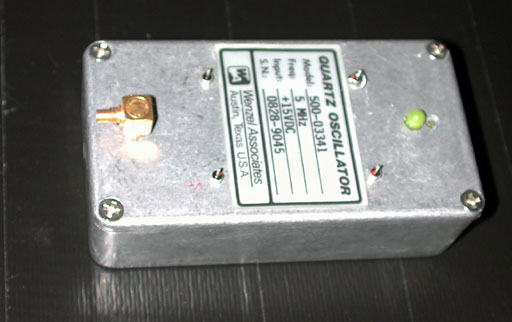
> remounted the oscillator in a Hammond box, like so:
>
> http://www.thegleam.com/ke5fx/w1.jpg
>
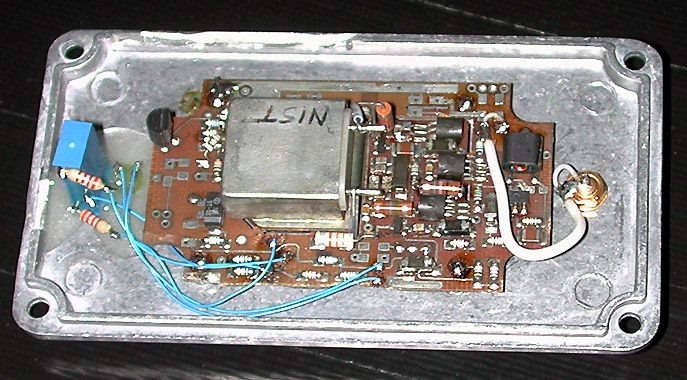
> I brought the trimmer (which was also damaged in this particular oscillator)
> and oven-status LED out to the box lid, along with the four original
> terminals.  Makes a nice package that can be easily opened for maintenance:
>
> http://www.thegleam.com/ke5fx/w2.jpg
>
> The repackaged OCXO seems to work fine.  I haven't made any hardcore
> measurements with it but I can tell just by watching the counter that its
> short-term stability is similar to my other unmolested 5 MHz ULN.
>
> -- john, KE5FX
>
>> -----Original Message-----
>> From: [email protected] [mailto:[email protected]]on
>> Behalf Of Ed Palmer
>> Sent: Monday, January 19, 2009 4:07 PM
>> To: [email protected]
>> Subject: Re: [time-nuts] Wenzel Oscillator Repair
>>
>>
>> I hadn't thought of using a Dremel.  Did you use an abrasive wheel or a
>> steel cutter?  The case on mine looks to be about 20 ga. tin-plated
>> steel (~0.04" thick).  The gap is so small it might have been a friction
>> fit to start with.
>>
>> Ed
>>
>>> From: "John Miles" <[email protected]>
>>> Subject: Re: [time-nuts] Wenzel Oscillator Repair
>>> To: "Discussion of precise time and frequency measurement"
>>>     <[email protected]>
>>> Message-ID: <[email protected]>
>>> Content-Type: text/plain; charset="us-ascii"
>>>
>>> I had a similar problem with a 5 MHz OCXO from their ULN
>>>
>> series.  There was
>>
>>> a bad solder joint on the output connection, easy enough to fix
>>>
>> once I got
>>
>>> the unit open.
>>>
>>> In my case I used a Dremel tool to cut the seam.  Suggest wearing a dust
>>> mask, obviously, and keep your cuts close to the perimeter of
>>>
>> the can, in
>>
>>> case the PC board comes right up to the edge like mine did.
>>>
>>> -- john, KE5FX
>>>
>> _______________________________________________
>> time-nuts mailing list -- [email protected]
>> To unsubscribe, go to
>> https://www.febo.com/cgi-bin/mailman/listinfo/time-nuts
>> and follow the instructions there.
>>

_______________________________________________
time-nuts mailing list -- [email protected]
To unsubscribe, go to https://www.febo.com/cgi-bin/mailman/listinfo/time-nuts
and follow the instructions there.