Hello Bjoern,

that would work well for static acceleration (tilt) but for vibration
resistance the crystal must be low-g, or complexly compensated with wide loop
bandwidths such as the FEI papers describe.

Initial Calibration would also be tricky, and having an algorithm  to
measure one result (frequency) against five inputs (aging, tempco, X, Y, Z
acceleration) and more (crystal jumps, retrace) is also quite sophisticated  :)

Also, Mems, or  other accelerometers have inherent noise, and to
compensate a crystal that has say +/-2E-09 per g sensitivity means one would
have to
add up to +/-2E-09 in offset statically. That's a lot of deviation, and
any noise from the mems would find its way into the Allan
Variance/phase-noise.

For vibration compensation, the compensation could easily go up to
+/-1.2E-08 and more (for up to +/-6G vibration to be canceled).

Very interesting topic, and I would love to hear what folks think about
this, or have come up with in terms of solutions.

At the high-end of the spectrum of the technology is the gun-barrel
launched artillery shell with crystal oscillator built-in, that has to
withstand
and operate with 10,000 to 20,000 g acceleration!

One caveat for the artillery shell: commercial GPS would likely not  work
due to the 1000 Knots verlocity limit.

bye,
Said


In a message dated 7/10/2009 16:53:23 Pacific Daylight Time,
[email protected] writes:
Hi Said  & Tom,

The below url links some "low-g"-osc papers.

http://www.freqelec.com/tech_lit.html

Said, did you contemplate  adding a cheap 3d-accelerometer and try to teach
your holdover algorithms  use the accelerometer measurements in the same
way as your temperature  measurements?

--

Björn

> Hello  Tom,
>
> this plot looks very similar to our standard double oven  units. We
> have our low-g option, which reduces the deviation to about  2-  3E-10
> per g, they work great but do cost more than standard  units..
> Coincidentally they also reduce sensitivity to vibration and  "tapping"
> by 5x to 10x... I wish we could offer them at the same  price, but they
> are very difficult to manufacture. That's why no one  uses them by
> default in their product.
>
> Bye,  Said
>
>
>
>  From iPhone
>
> On Jul  10, 2009, at 15:51, "Tom Van Baak" <[email protected]>  wrote:
>
>>> One is do crystal oscillators change frequency  when they
>>> are turned. The answer to that is yes. This  gravitational
>>> acceleration effect is rather huge, parts in ten  to the 9th
>>> or so, and anyone can see this. This is why you  never
>>> touch, bump, or move, or rotate a laboratory  frequency
>>> standard (this includes GPSDO and cesium  standards).
>>
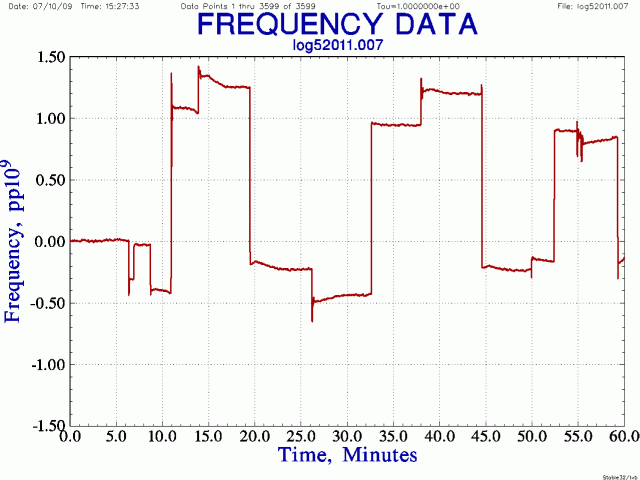
>> And to give you a *picture* instead of  just numbers... Here is
>> a plot showing frequency changes in an  OCXO (this from a
>> free-running Thunderbolt GPSDO) over the span of  one hour.
>> Every 5 minutes or so I rotated the rectangular box on  some
>> axis by 90 degrees.
>>
>>  <http://www.leapsecond.com/pages/ocxo-2g/TBolt-2g-6axis.gif>
>>
>>  You can see that the sudden frequency jumps due to change
>> in  g-force on the crystal are about -0.5e-9 to +1.5 e-9, which
>> is  100x the normal frequency noise for this oscillator (about
>> 2e-11  pk-pk or about 2e-12 adev).
>>
>> Hopefully this result  won't come as a big surprise to anyone; the
>> so-called "2g  turn-over" spec is common for quality oscillators.
>> Again, this is  why when you enter the world of precision timing
>> at 1e-10 and  below you tend not to ever touch your standards.
>>
>> Now  if one of you happened to have a fully-programmable 3-axis
>>  turntable and a couple of hours you could slowly create a most
>>  beautiful high-resolution 3D color plot showing the precise shift
>>  in frequency as a function of axis.
>>
>>  /tvb
>>
>>
>>  _______________________________________________
>> time-nuts mailing  list -- [email protected]
>> To unsubscribe, go to
>>  https://www.febo.com/cgi-bin/mailman/listinfo/time-nuts
>> and follow  the instructions there.
>
>  _______________________________________________
> time-nuts mailing list  -- [email protected]
> To unsubscribe, go to
>  https://www.febo.com/cgi-bin/mailman/listinfo/time-nuts
> and follow the  instructions  there.
>


_______________________________________________
time-nuts  mailing list -- [email protected]
To unsubscribe, go to
https://www.febo.com/cgi-bin/mailman/listinfo/time-nuts
and follow the  instructions there.

_______________________________________________
time-nuts mailing list -- [email protected]
To unsubscribe, go to https://www.febo.com/cgi-bin/mailman/listinfo/time-nuts
and follow the instructions there.