Hi Said,

What GPSDO-products do compensate for tilt?
It seem like a major error source -- if the user for some reason want to
tilt a unit in holdover. It seems to be a "low hanging fruit" to attenuate
this error substantially even with a $2 MEMS accelerometer.

Once the ambitions grow -- more complexities can be added.

Then again, is there a use-case giving some hope the engineering costs can
be regained.

--

   Björn

> Hello Bjoern,
>
> that would work well for static acceleration (tilt) but for vibration
> resistance the crystal must be low-g, or complexly compensated with wide
> loop
> bandwidths such as the FEI papers describe.
>
> Initial Calibration would also be tricky, and having an algorithm  to
> measure one result (frequency) against five inputs (aging, tempco, X, Y, Z
> acceleration) and more (crystal jumps, retrace) is also quite
> sophisticated  :)
>
> Also, Mems, or  other accelerometers have inherent noise, and to
> compensate a crystal that has say +/-2E-09 per g sensitivity means one
> would  have to
> add up to +/-2E-09 in offset statically. That's a lot of deviation, and
> any noise from the mems would find its way into the Allan
> Variance/phase-noise.
>
> For vibration compensation, the compensation could easily go up to
> +/-1.2E-08 and more (for up to +/-6G vibration to be canceled).
>
> Very interesting topic, and I would love to hear what folks think about
> this, or have come up with in terms of solutions.
>
> At the high-end of the spectrum of the technology is the gun-barrel
> launched artillery shell with crystal oscillator built-in, that has to
> withstand
> and operate with 10,000 to 20,000 g acceleration!
>
> One caveat for the artillery shell: commercial GPS would likely not  work
> due to the 1000 Knots verlocity limit.
>
> bye,
> Said
>
>
> In a message dated 7/10/2009 16:53:23 Pacific Daylight Time,
> [email protected] writes:
>
> Hi Said  & Tom,
>
> The below url links some "low-g"-osc papers.
>
> http://www.freqelec.com/tech_lit.html
>
> Said, did you contemplate  adding a cheap 3d-accelerometer and try to
> teach
> your holdover algorithms  use the accelerometer measurements in the same
> way as your temperature  measurements?
>
> --
>
> Björn
>
>> Hello  Tom,
>>
>> this plot looks very similar to our standard double oven  units. We
>> have our low-g option, which reduces the deviation to about  2-  3E-10
>> per g, they work great but do cost more than standard  units..
>> Coincidentally they also reduce sensitivity to vibration and  "tapping"
>> by 5x to 10x... I wish we could offer them at the same  price, but they
>> are very difficult to manufacture. That's why no one  uses them by
>> default in their product.
>>
>> Bye,  Said
>>
>>
>>
>>  From iPhone
>>
>> On Jul  10, 2009, at 15:51, "Tom Van Baak" <[email protected]>  wrote:
>>
>>>> One is do crystal oscillators change frequency  when they
>>>> are turned. The answer to that is yes. This  gravitational
>>>> acceleration effect is rather huge, parts in ten  to the 9th
>>>> or so, and anyone can see this. This is why you  never
>>>> touch, bump, or move, or rotate a laboratory  frequency
>>>> standard (this includes GPSDO and cesium  standards).
>>>
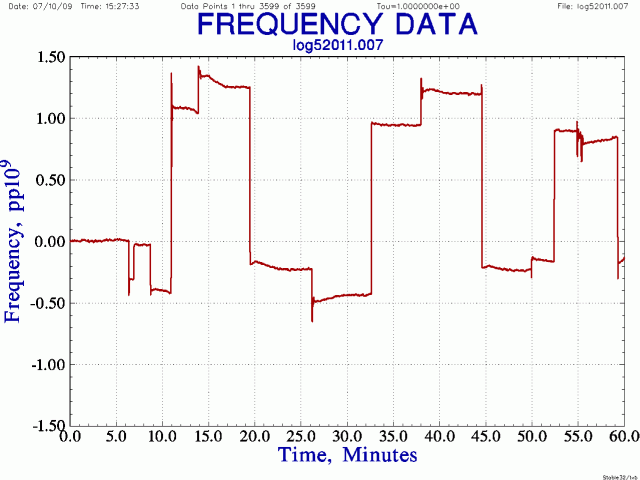
>>> And to give you a *picture* instead of  just numbers... Here is
>>> a plot showing frequency changes in an  OCXO (this from a
>>> free-running Thunderbolt GPSDO) over the span of  one hour.
>>> Every 5 minutes or so I rotated the rectangular box on  some
>>> axis by 90 degrees.
>>>
>>>  <http://www.leapsecond.com/pages/ocxo-2g/TBolt-2g-6axis.gif>
>>>
>>>  You can see that the sudden frequency jumps due to change
>>> in  g-force on the crystal are about -0.5e-9 to +1.5 e-9, which
>>> is  100x the normal frequency noise for this oscillator (about
>>> 2e-11  pk-pk or about 2e-12 adev).
>>>
>>> Hopefully this result  won't come as a big surprise to anyone; the
>>> so-called "2g  turn-over" spec is common for quality oscillators.
>>> Again, this is  why when you enter the world of precision timing
>>> at 1e-10 and  below you tend not to ever touch your standards.
>>>
>>> Now  if one of you happened to have a fully-programmable 3-axis
>>>  turntable and a couple of hours you could slowly create a most
>>>  beautiful high-resolution 3D color plot showing the precise shift
>>>  in frequency as a function of axis.
>>>
>>>  /tvb
>>>
>>>
>>>  _______________________________________________
>>> time-nuts mailing  list -- [email protected]
>>> To unsubscribe, go to
>>>  https://www.febo.com/cgi-bin/mailman/listinfo/time-nuts
>>> and follow  the instructions there.
>>
>>  _______________________________________________
>> time-nuts mailing list  -- [email protected]
>> To unsubscribe, go to
>>  https://www.febo.com/cgi-bin/mailman/listinfo/time-nuts
>> and follow the  instructions  there.
>>
>
>
>
> _______________________________________________
> time-nuts  mailing list -- [email protected]
> To unsubscribe, go to
> https://www.febo.com/cgi-bin/mailman/listinfo/time-nuts
> and follow the  instructions there.
>
> _______________________________________________
> time-nuts mailing list -- [email protected]
> To unsubscribe, go to
> https://www.febo.com/cgi-bin/mailman/listinfo/time-nuts
> and follow the instructions there.
>


_______________________________________________
time-nuts mailing list -- [email protected]
To unsubscribe, go to https://www.febo.com/cgi-bin/mailman/listinfo/time-nuts
and follow the instructions there.