27/11/2012 14:18
I bought a 18GHz EIP545A counter which the vendor said was working
fine the day before and when on overnight soak test, and also when
last used some months agao. But when he checked it on the morning of
my coming over to see it he found it had developed a fault... I bought
it off him cheaply, as seen, hoping it might be fixable.


Here's the basic tale:

It was acquired displaying just dashes. I checked the PSU voltages and
found the PSU section outputting well away from the manual figures. I
corrected these and checked supplies for ripple and they were all
good. I then decided to remove any board that was not essential to
operation. It came with a GPIB option board, so I pulled it. Luckily
this did some good and a working display appeared. There were three
tantalum caps on this board, as a matter of interest I pulled a leg on
each and tested them, all were OK. Refitting it killed the display
back to "dashes" again, so I set it aside as having an "unknown
fault", and continued. I can get it to accurately display up to
EXACTLY 188.9999 MHz. Inputting 190.0000 MHz gives zeros. It has three
frequency bands. Band one works perfectly right up and well beyond its
10Hz to 100MHz range. Band two often doesn't work at all, and just
diplays zeros, it's a 50 ohm input, compared to the 1meg 20pF Band 1
input. Sometimes by ramping the frequency up slowly from 100 MHz I can get a
seemingly random reading. Band 3, the GHz range, doesn't work at
all. Again, only zeros are displayed.

The machine has quite a good range of self diagnosis tests. Tests are
via the key pad. The first test checks the VCO and other stuff, and
should display an accurate 200.0000 MHz. It displays well over, always
in the range 253.5**** and the display isn't stable, it hovers over
several KHz. There's a tree menu to see where this issue could lie.
One limb suggests using a known good counter on the output of the VCO.
I did this and the output is miles high in frequency, about double,
and unstable. The tree menus goes on to suggest a phase lock circuitry
fault.

Further tests seem to depend in part upon using something called a
Signature Analyser, which I have never even heard of They suggest an
HP5004A, which is apparently pretty ancient. Is there a cheap way of
acquiring something to do this sort of testing? I believe given a few
pointers my scope, multi meter, sig gen and my other (working) Racal
counter could take me further.

It's a nice old thing, and I would quite like a means of counting into
the higher frequencies it offers, but don't want to spend too much
time or money on it. It works a damned sight more than when it first
landed, which has kind of given me incentive to push a bit further,
given I have a .pdf copy of the repair manual. Here's the page of the
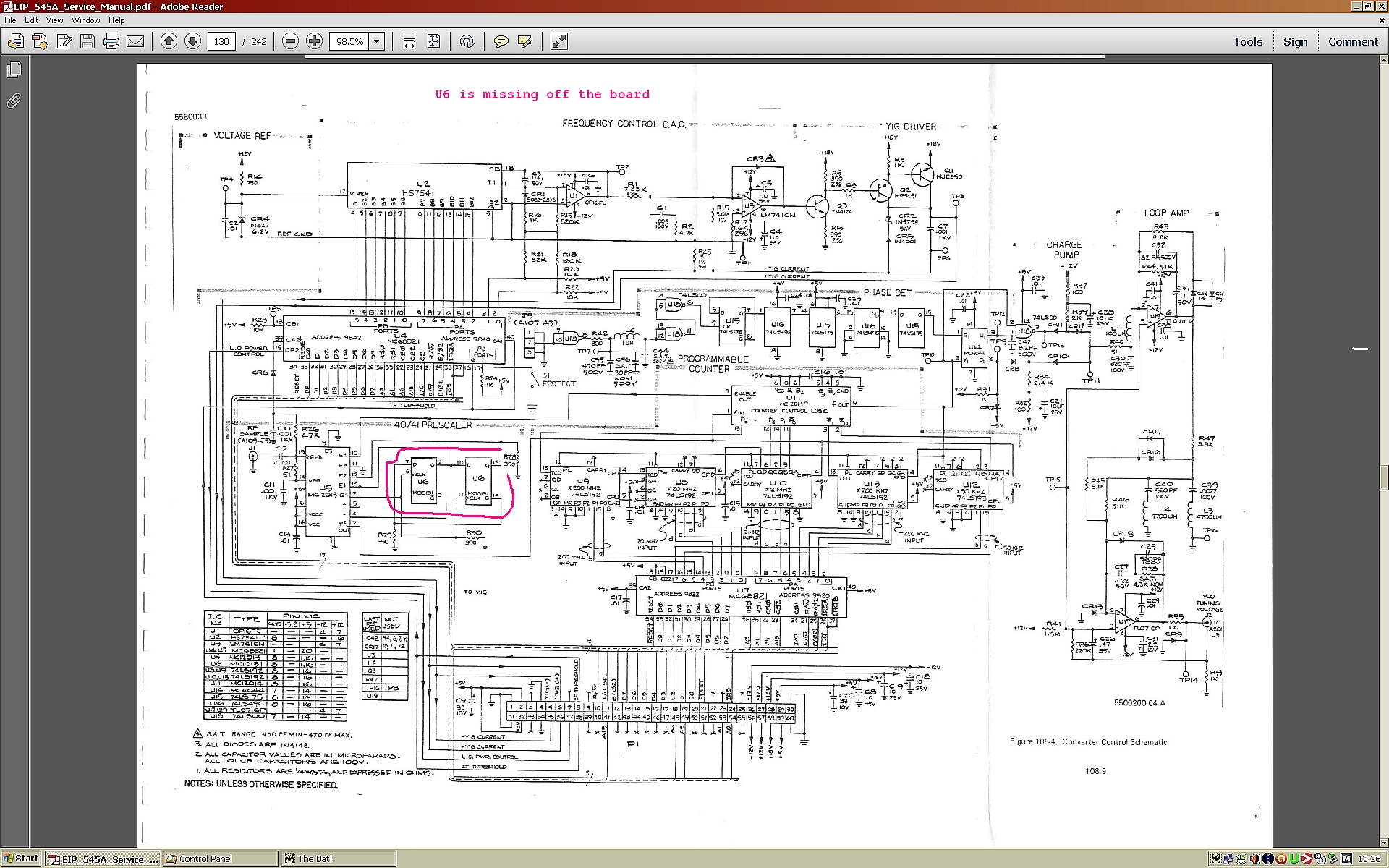
schematic I think is relevant, if it is a phase locked loop problem.

This morning I realised there's a chip missing from a socket on the
board in question. It's U6, a flip flop, part of the pre scaler I
think? I assumed it was for some option, not fitted, but I am not so
sure now. A Chinese Ebay seller is breaking one of these machines and
he lists all the boards seperately, with decent photos. His board has
this socket populated, and looking at the schematic, (linked at the
bottom of this post), I think it's probably a vital component? I am
sure the seller must have known about this, but who knows...

I have ordered a new chip and will fit it whwen it arrives tomorrow.

Now, assuming I ever get this thing up and running fully, is there a
quick and dirty way of producing a test signal in the upper limits of
its range to check it out, given my Marconi sig gen stops at 1040 MHz?
Perhaps using a diode to give some harmonics?

Diagram of the board I believe is faulty and missing the chip is at:

http://www.gatesgarth.com/phaselockloop.jpg

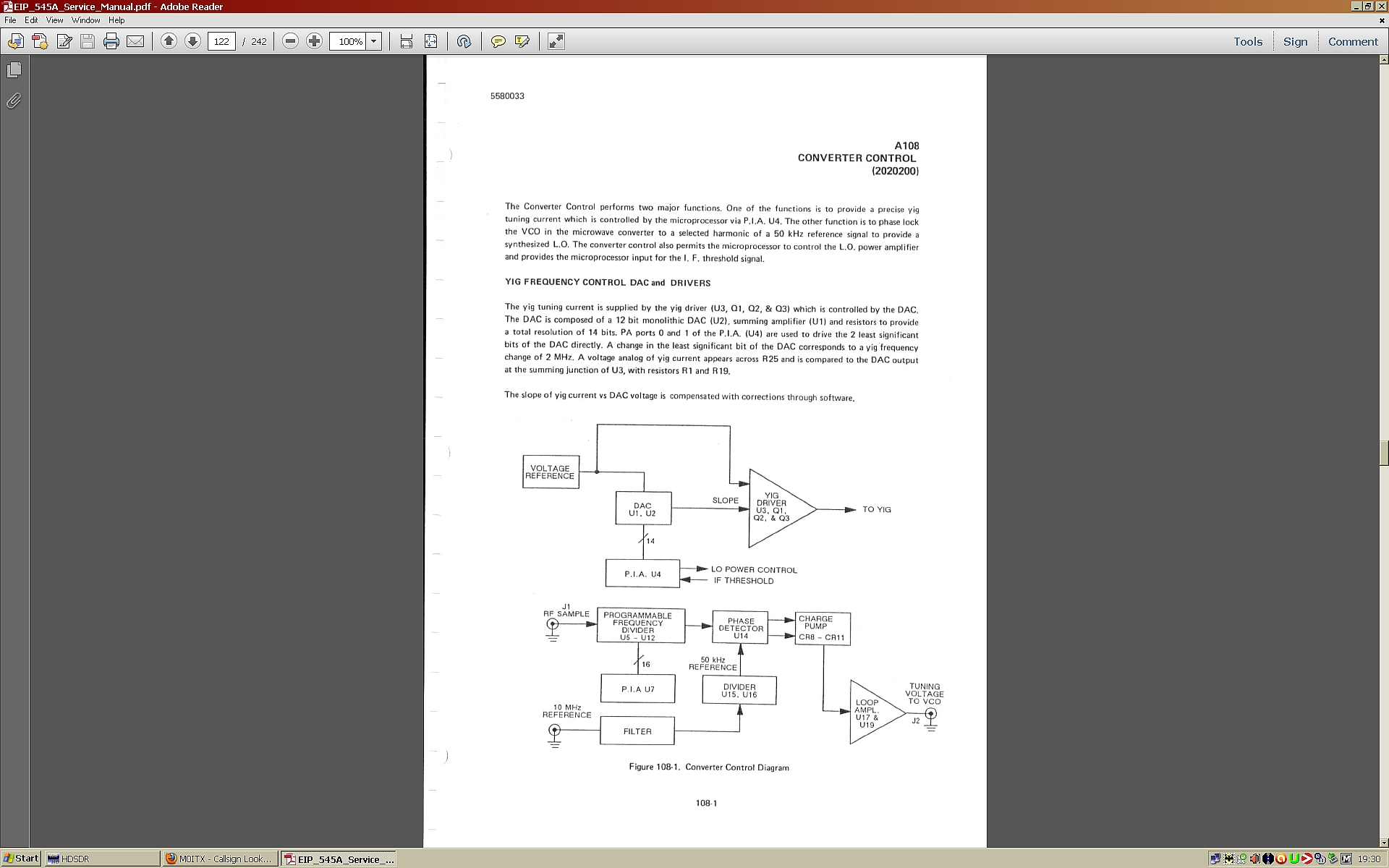
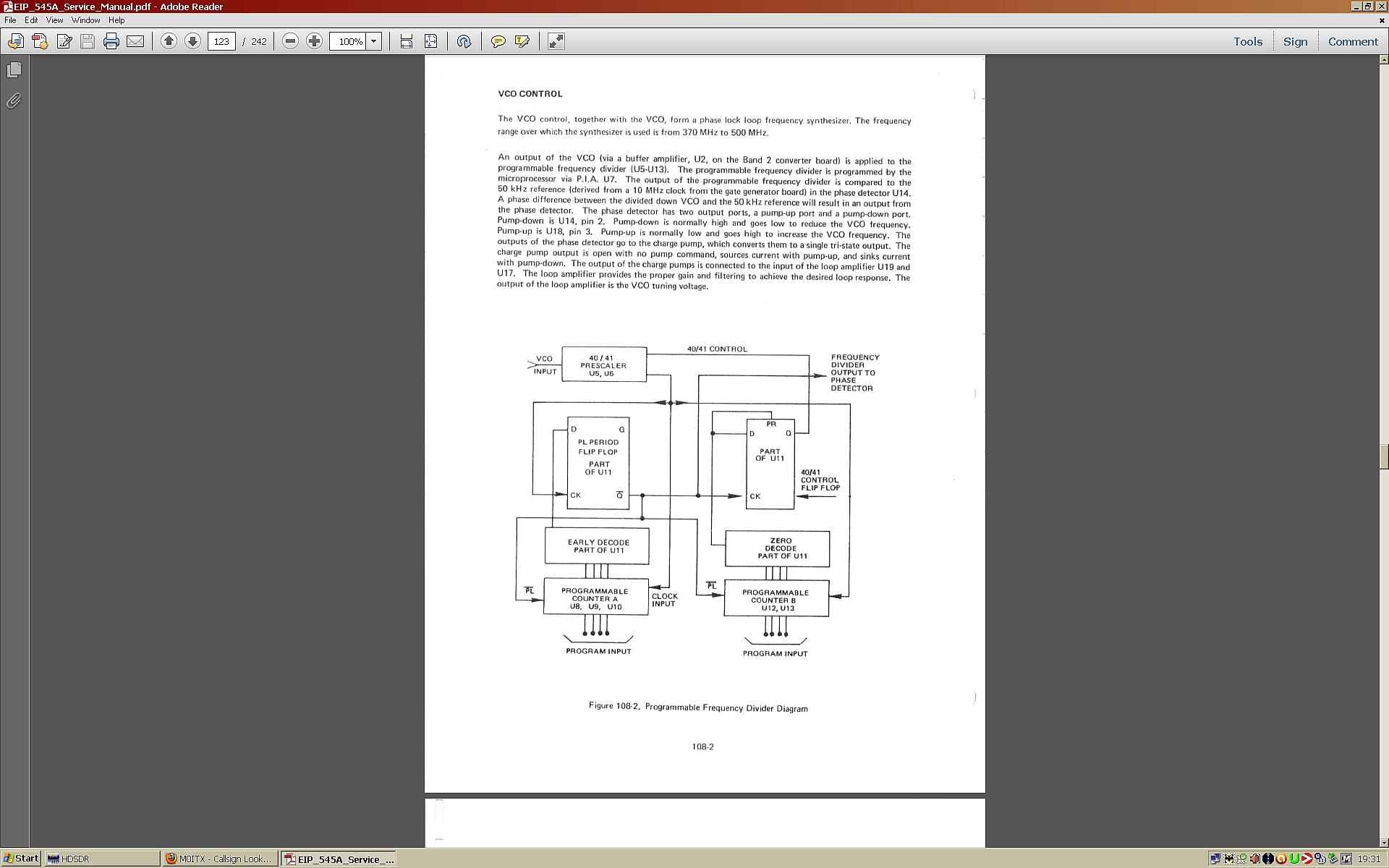
The text for this section, from the manual is at:

http://www.gatesgarth.com/phaselocklooptext1.jpg

and at

http://www.gatesgarth.com/phaselocklooptext2.jpg

Thanks for looking!


--
       Best Regards,
                   Chris Wilson.
mailto: [email protected]


_______________________________________________
time-nuts mailing list -- [email protected]
To unsubscribe, go to https://www.febo.com/cgi-bin/mailman/listinfo/time-nuts
and follow the instructions there.