Yes, I do understand I'm asking for trouble, though I kinda expected to
see more noise rather than less.
I guess its time to break out the soldering iron.

Cheers
Simon

On 14/10/2014 17:22, Robert LaJeunesse wrote:
Using 74AC parts on what I think of as a pluggable breadboard (e.g.
http://uk.farnell.com/jsp/search/productdetail.jsp?SKU=2295705&MER=bn-me-ca-r1-best-sto-5)
 is asking for trouble. The parts are RF fast and the pluggable board has not very
good contact resistance and certainly more inductance and shunt capacitance than is
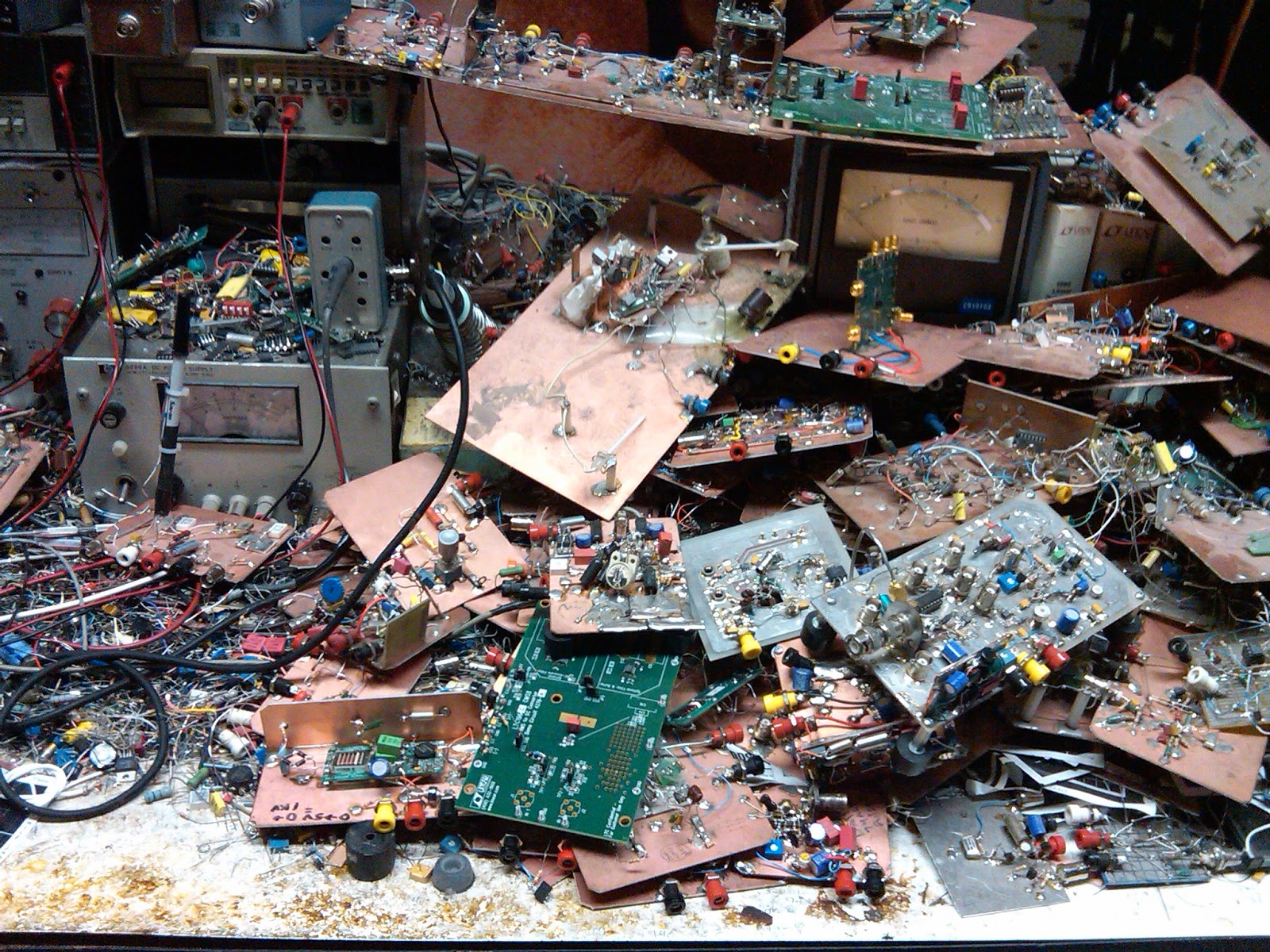
good for RF. I would highly recommend using dead-bug style on a solid copper plane,
as provided by a chunk of unetched PCB material. (Jim Williams did a few like that,
see
http://1.bp.blogspot.com/-y3xQiBHHzaQ/UP3mLk96qWI/AAAAAAAAAss/ZvPbfN8lmTQ/s1600/eep114.jpg.)
 This approach allows for extremely short lead lengths and power supply bypassing
(to the plane) with a near zero lead length capacitor.

Bob L.
Sent: Tuesday, October 14, 2014 at 11:32 AM
From: "Simon Marsh" <[email protected]>
To: "Discussion of precise time and frequency measurement" <[email protected]>
Subject: Re: [time-nuts] Digital Mixing with a BeagleBone Black and D Flip Flop

... 74AC74 ... knocked up on some pluggable breadboard
_______________________________________________
time-nuts mailing list -- [email protected]
To unsubscribe, go to https://www.febo.com/cgi-bin/mailman/listinfo/time-nuts
and follow the instructions there.
_______________________________________________
time-nuts mailing list -- [email protected]
To unsubscribe, go to https://www.febo.com/cgi-bin/mailman/listinfo/time-nuts
and follow the instructions there.