>The faster the comparator, the greater its analog bandwidth.
>Thus there is more total noise to cause jitter.  The DC to
>daylight comparator is the opposite of the John Dick (JPL)
>paper on zero crossing detectors in PTTI around 1990.  John
>teaches that you use the MINIMUM bandwidth amplifier to
>square up a sine wave.
Although you hear it a lot, I'm not so sure of the generality of this
statement.  It would make sense if you were talking about a sampling process
where noise from the entire system bandwidth is aliased irreversibly into the
output signal, but I don't see a compelling reason to think of a ZCD that way.
It's true that saturated logic is quieter than unsaturated logic, but during
the critical zero crossing time, is it really saturated?  If the device is
faster than the input signal, the answer is a definite "No," and that's where I
think the conventional wisdom about fast comparators being bad for jitter comes
from.  They aren't contributing more jitter, they're just failing to clean up
the input jitter during the transition time.

All other things being equal, it's desirable to minimize the time spent in that
region of the waveform.  It doesn't necessarily hurt to choose a faster logic
family, as long as the process noise and device gain are otherwise compatible
with the decision.  Random jitter on the 7.5 GHz ADCLK905 is specified at
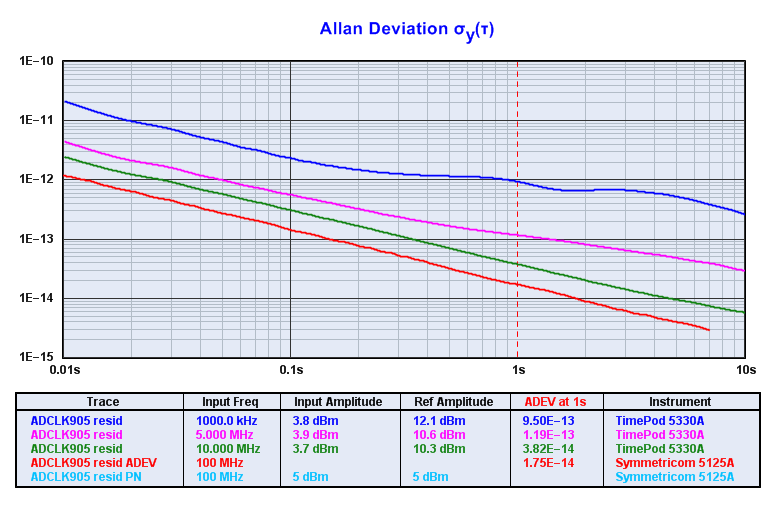
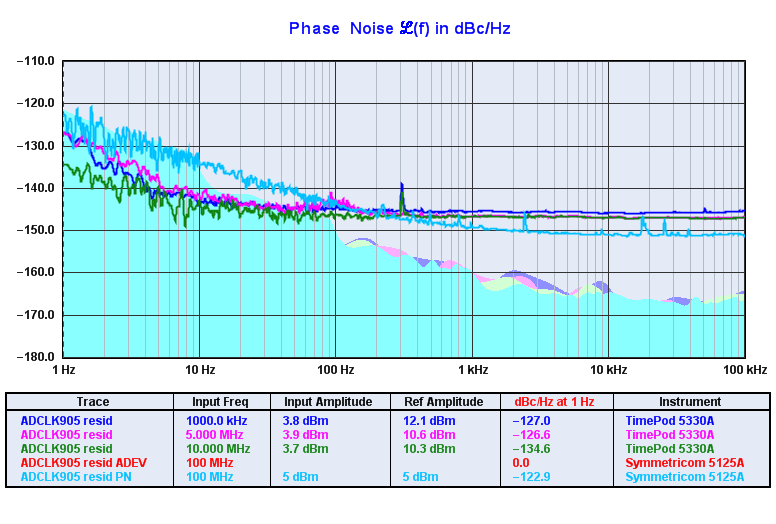
around 60 femtoseconds, after all.  A residual PN test at 10 MHz on an ADCLK905
ends up at around -135 dBc/Hz at 1 Hz just like many other slower comparators,
a figure that's good for 1s ADEVs in the E-14s (see
http://www.ke5fx.com/ADCLK905_ADEV.png and
http://www.ke5fx.com/ADCLK905_PN.png).

At lower carrier frequencies, the ADCLK905's apparent jitter is worse because
the low slew rate of the input signal gives its open-loop gain more time to
influence the outcome.  But it wouldn't be significantly better if the
ADCLK905's bandwidth were a thousand times lower.  Of course, when the input
signal is *much* slower, as in the JPL paper, a multistage shaper with
optimized bandwidth and gain allocation is helpful.  But their situation at 1
Hz is not directly applicable at 5/10 MHz.  An obsessive focus on bandwidth
here is just going to make the phase tempco worse without improving the jitter.

> BTW: If anyone here has any good text to read on oscillator design,
> please let me know. I'm collecting those :-)

In addition to the ones Rick mentioned, you might look into Enrico Rubiola and
Jeremy Everard.

-- john, KE5FX
Miles Design LLC

_______________________________________________
time-nuts mailing list -- [email protected]
To unsubscribe, go to https://www.febo.com/cgi-bin/mailman/listinfo/time-nuts
and follow the instructions there.