> I think it's worse than that. You have to hold the temperature constant, and
Hi Hal,

I concur. Here is a nice example for all of you:

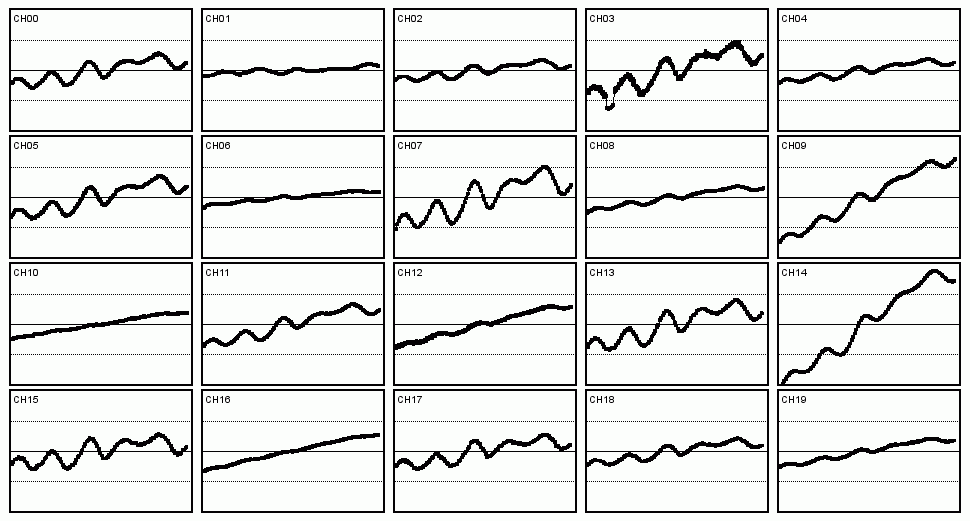
http://leapsecond.com/pages/tbolt/TBolt-20a-043.gif

The image shows 20 new Trimble Thunderbolt's being tested for aging in my
house. The daily temperature change was about 5 C. Horizontal scale is about 5
days elapsed time. Vertical scale is some ppb or ppt in frequency. The actual
numbers aren't important here.

What *is* instructive about the image is that it shows that "identical"
oscillators can have very different tempco's and that oscillators can have very
different aging rates. And to your point, it also demonstrates that in many
cases an aging rate measurement can take many days before you know if it's just
aging or if it's other effects (temperature, voltage, humidity, pressure, tilt,
retrace, etc.).

One way to speed up the process is keep the ambient measurement constant as you
suggest. Another way is to measure the temperature and then post-process the
data for a fit of both temperature and aging. This is also one reason why many
GPSDO, like the TBolt, have internal precision thermometers. It helps the user
(or optionally the disciplining algorithm) distinguish thermal effects from
aging effects.

Just a reminder -- what we usually mean by oscillator "aging" is the long-term
secular drift in frequency over time due to physical effects within the
oscillator. This systematic effect not only applies to quartz crystals, but
also to a lesser degree: rubidium vapor, rubidium & cesium CSAC, and hydrogen
maser clocks. By contrast, cesium beam and cesium fountain designs tend not to
have aging effects.

Note also that aging rates are traditionally quoted in "per day" units, even
though technically the units are seconds per second per second. For example,
the aging spec for a 10811A quartz oscillator is 5e-10/day. This does *not*
imply that it is or will be consistent day by day, nor that you are able to
measure it within one day. For some oscillators it is not uncommon to have to
collect a month of data before you have a clue what the daily aging rate is,
how consistent it is, how predictable it is, and so on.

/tvb

----- Original Message -----
From: "Hal Murray" <[email protected]>
To: "Discussion of precise time and frequency measurement" <[email protected]>
Cc: <[email protected]>
Sent: Wednesday, October 05, 2016 10:14 PM
Subject: Re: [time-nuts] Measure GPSDO stability with minimum resources?


>
> [email protected] said:
>> Unless the oscillator is still warming up, 5 minutes or even 60 is way too
>> short a time to look at aging. For aging, you will want to look at the
>> change in DAC values over several days at least.
>
> I think it's worse than that.  You have to hold the temperature constant, and
> maybe even the power supply voltage.  A probe on the crystal can might allow
> you to correct for temperature.
>
_______________________________________________
time-nuts mailing list -- [email protected]
To unsubscribe, go to https://www.febo.com/cgi-bin/mailman/listinfo/time-nuts
and follow the instructions there.