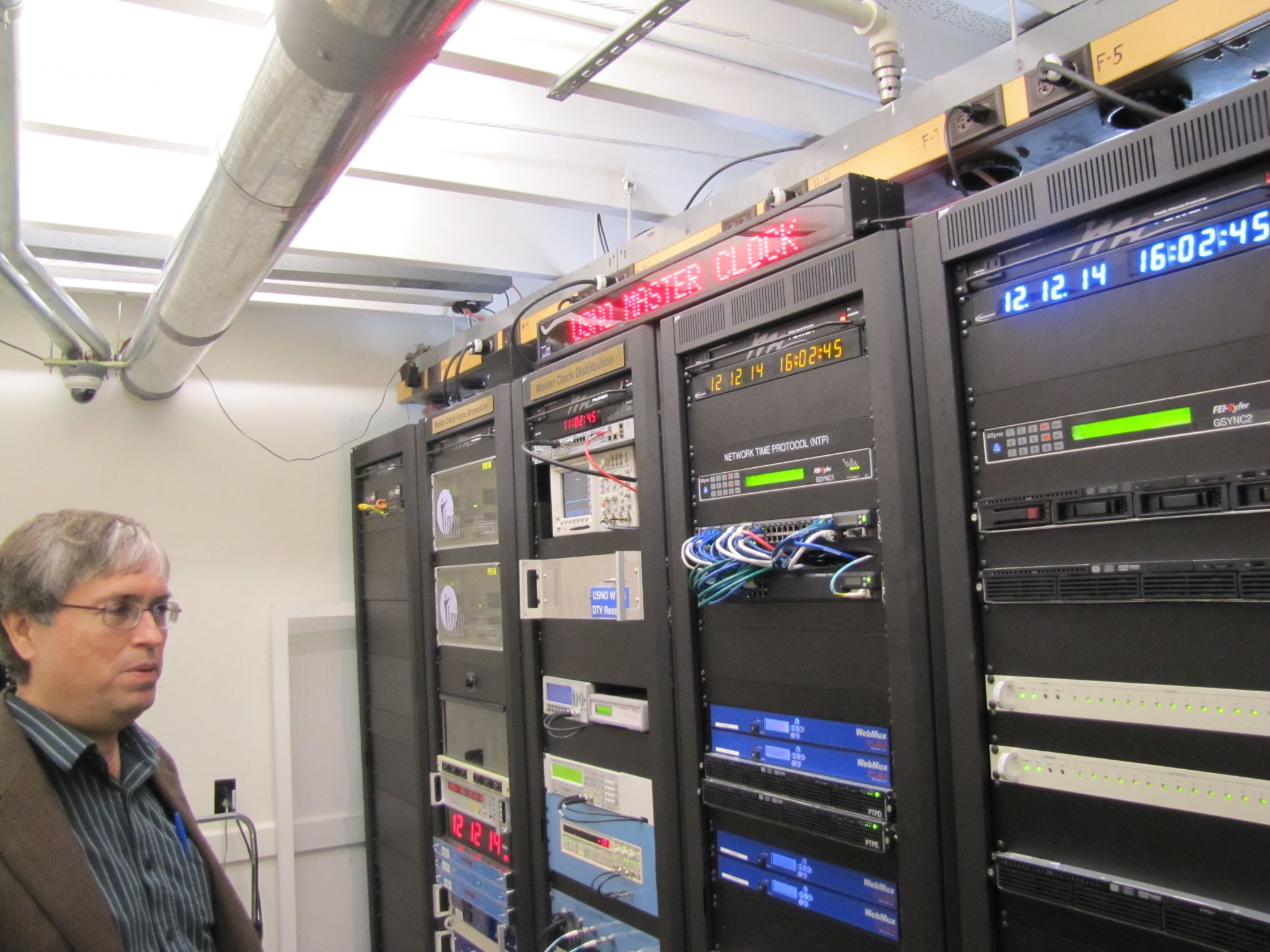
Two reasons that come to mind are:
  Displaying distributed time to distant sites from some master.
  Readability at a distance.
> Le 22 janv. 2017 à 07:31, Ruslan Nabioullin <[email protected]> a écrit :
>
> Hi, looking at pictures of various time metrology equipment setups for best
> practices and inspiration, I have commonly seen time of day display unit(s)
> installed in racks containing processing or time transfer equipment, e.g.,
> http://www.xyht.com/wp-content/uploads/2015/05/Powers_Master_Clock.jpg. All
> that these units do is merely display the time of day and sometimes the date,
> typically by means of seven segment LED displays, of the time code inputted
> to them (typically IRIG-B, I'm guessing).  Any ideas why such a unit is
> necessary when one can simply look at the time displayed by timing receivers
> and time code generators (and even some standards), and the interface of some
> fusor, defined in this context as a system which performs timing data fusion
> (by implementing a paper clock or a more primitive algorithm) and
> timekeeping, either by means of a direct shell, or via something like NTP?
>
> Thanks in advance,
> Ruslan
> _______________________________________________
> time-nuts mailing list -- [email protected]
> To unsubscribe, go to https://www.febo.com/cgi-bin/mailman/listinfo/time-nuts
> and follow the instructions there.

"The power of accurate observation is commonly called cynicism by those who
have not got it. »
George Bernard Shaw

_______________________________________________
time-nuts mailing list -- [email protected]
To unsubscribe, go to https://www.febo.com/cgi-bin/mailman/listinfo/time-nuts
and follow the instructions there.