Bob,
Several of us do long-term measurement of mains frequency. We tend to
time-stamp cycles and then compute period or frequency, rather than
measuring frequency or period directly. Traditional counters in gated
frequency or time interval mode have dead time and this will skew results.
In my case I just run a 5 VAC wall-wart through a 10k resistor directly
to the input pin of a PIC. No scaling, no filtering, no opto, no ZCD, no
nothing. If I measure every cycle I get 155 million samples per month.
If I extract one cycle each second (decimate by 60) it's only 2.5
million samples a month. Many months there is not a single glitch in the
data in spite of all the FUD about power line noise. Once in a while a
month contains an extra or missing sample but the beauty of timestamp
data is that this can be detected and repaired as part of data
processing with no loss of phase.
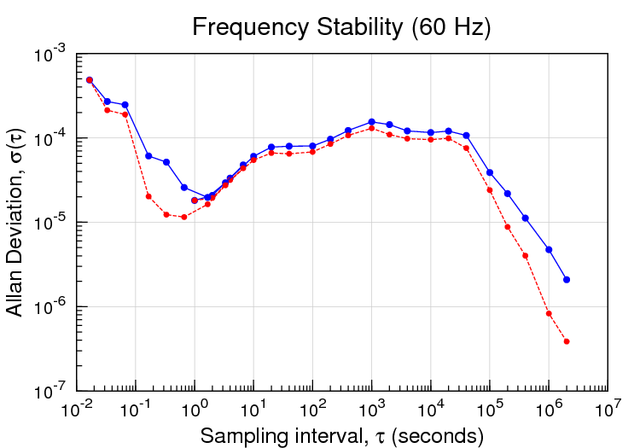
Here's a page where Kevin (in New Mexico) and I (in Seattle) both used
picPET's to measure mains for a few days and then we compared the
results. Although thousands of miles apart, we're both on the same grid
so the agreement was astonishing. It was milliseconds in time and ADEV
down to e-8 over a day:
http://leapsecond.com/pages/mains-cv/

See also: http://leapsecond.com/pic/mains-adev-mdev-gnuplot-g4.png

/tvb


On 7/2/2019 10:09 PM, Bob Albert via time-nuts wrote:
  I have tried to measure the power line frequency with spotty success.  My
best results came from a period measurement, as many periods as the counter can
accumulate.  Due to noise, one is never sure at quite what point the source is
measured.  Perhaps a brick wall filter would clean it up for a more reliable
measurement.
Of course, at 60 Hz the period is 16-2/3 milliseconds.  So the counter should
properly show a 1 followed by a row of 6s, with the last digit bouncing between
6 and 7 most of the time.
If there is a filter used, it will not only remove noise but also short term
variations.  But generatlly speaking you don't want to measure those, unless
you are trying to evaluate a rotary generator.
Getting this reading can be a challenge.
     On Tuesday, July 2, 2019, 10:01:03 PM PDT, jimlux <[email protected]>
wrote:
On 7/2/19 4:09 PM, Dana Whitlow wrote:
I've always noted that casual attempts to pick up 60 Hz with small antennas
etc see more harmonics and other trash than actual line frequency.  But if
you're in an office environment, why not plug something in?  It's quite easy
to build a simple passive diode clipper/filter that will plug into a wall
outlet and
which will provide a sort of soft (but clean) squarewave at a voltage level
convenient for lab instruments and with good protection against big spikes
and
other trash riding on the line.
Safety approvals are one obstacle (of course one could use a AC wall wart).

Actually, it's because someone asked me about a science experiment where
you'd place them in a neighborhood outdoors.


_______________________________________________
time-nuts mailing list -- [email protected]
To unsubscribe, go to
http://lists.febo.com/mailman/listinfo/time-nuts_lists.febo.com
and follow the instructions there.
_______________________________________________
time-nuts mailing list -- [email protected]
To unsubscribe, go to
http://lists.febo.com/mailman/listinfo/time-nuts_lists.febo.com
and follow the instructions there.
_______________________________________________
time-nuts mailing list -- [email protected]
To unsubscribe, go to
http://lists.febo.com/mailman/listinfo/time-nuts_lists.febo.com
and follow the instructions there.