On 7/3/19 8:56 AM, Tom Van Baak wrote:
Bob,
Several of us do long-term measurement of mains frequency. We tend to
time-stamp cycles and then compute period or frequency, rather than
measuring frequency or period directly. Traditional counters in gated
frequency or time interval mode have dead time and this will skew results.
In my case I just run a 5 VAC wall-wart through a 10k resistor directly
to the input pin of a PIC. No scaling, no filtering, no opto, no ZCD, no
nothing. If I measure every cycle I get 155 million samples per month.
If I extract one cycle each second (decimate by 60) it's only 2.5
million samples a month. Many months there is not a single glitch in the
data in spite of all the FUD about power line noise. Once in a while a
month contains an extra or missing sample but the beauty of timestamp
data is that this can be detected and repaired as part of data
processing with no loss of phase.
Here's a page where Kevin (in New Mexico) and I (in Seattle) both used
picPET's to measure mains for a few days and then we compared the
results. Although thousands of miles apart, we're both on the same grid
so the agreement was astonishing. It was milliseconds in time and ADEV
down to e-8 over a day:
http://leapsecond.com/pages/mains-cv/

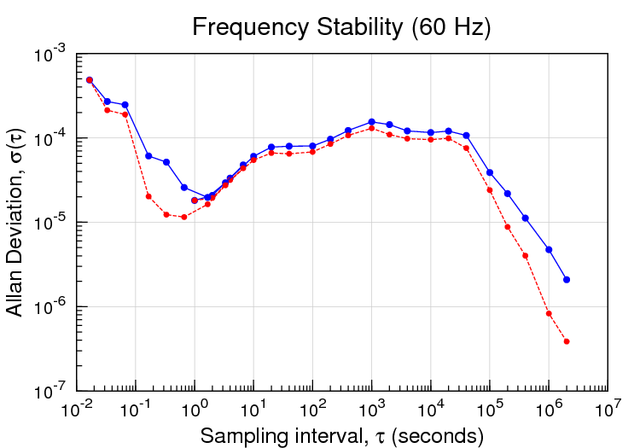
See also: http://leapsecond.com/pic/mains-adev-mdev-gnuplot-g4.png

/tvb
yes indeed
http://fnetpublic.utk.edu/anglecontour.html shows a pretty constant
phase shift of tens of degrees.
(except Texas, because, after all, they're Texas)


_______________________________________________
time-nuts mailing list -- [email protected]
To unsubscribe, go to
http://lists.febo.com/mailman/listinfo/time-nuts_lists.febo.com
and follow the instructions there.