The station at Santa Rosa, California (#853 in the Western Interconnection)
is mine. Have had their receiver for several years. Only downside is that i
can't record the data directly from the supplied receiver.
Jeremy


On Wed, Jul 3, 2019 at 12:01 PM Paul Theodoropoulos via time-nuts <
[email protected]> wrote:

> This stuff is fascinating to a time-nut-level:Novice such as myself.
> While falling down the rabbit-hole searching on all the various bits of
> the info below, I ran across this - not sure if you're aware of it, or
> if it's old news, but it seems at least peripherally interesting:
>
> http://fnetpublic.utk.edu
>
>
> On 7/3/19 08:56, Tom Van Baak wrote:
> > Bob,
> >
> > Several of us do long-term measurement of mains frequency. We tend to
> > time-stamp cycles and then compute period or frequency, rather than
> > measuring frequency or period directly. Traditional counters in gated
> > frequency or time interval mode have dead time and this will skew
> > results.
> >
> > In my case I just run a 5 VAC wall-wart through a 10k resistor
> > directly to the input pin of a PIC. No scaling, no filtering, no opto,
> > no ZCD, no nothing. If I measure every cycle I get 155 million samples
> > per month. If I extract one cycle each second (decimate by 60) it's
> > only 2.5 million samples a month. Many months there is not a single
> > glitch in the data in spite of all the FUD about power line noise.
> > Once in a while a month contains an extra or missing sample but the
> > beauty of timestamp data is that this can be detected and repaired as
> > part of data processing with no loss of phase.
> >
> > Here's a page where Kevin (in New Mexico) and I (in Seattle) both used
> > picPET's to measure mains for a few days and then we compared the
> > results. Although thousands of miles apart, we're both on the same
> > grid so the agreement was astonishing. It was milliseconds in time and
> > ADEV down to e-8 over a day:
> >
> > http://leapsecond.com/pages/mains-cv/
> >
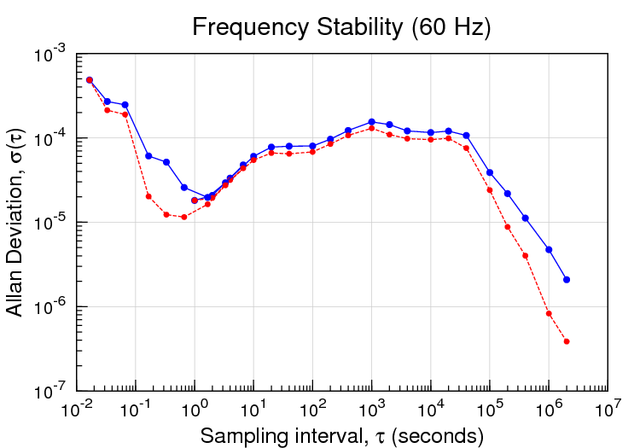
> > See also: http://leapsecond.com/pic/mains-adev-mdev-gnuplot-g4.png
> >
> > /tvb
> >
> >
> > On 7/2/2019 10:09 PM, Bob Albert via time-nuts wrote:
> >>   I have tried to measure the power line frequency with spotty
> >> success.  My best results came from a period measurement, as many
> >> periods as the counter can accumulate.  Due to noise, one is never
> >> sure at quite what point the source is measured.  Perhaps a brick
> >> wall filter would clean it up for a more reliable measurement.
> >> Of course, at 60 Hz the period is 16-2/3 milliseconds.  So the
> >> counter should properly show a 1 followed by a row of 6s, with the
> >> last digit bouncing between 6 and 7 most of the time.
> >> If there is a filter used, it will not only remove noise but also
> >> short term variations.  But generatlly speaking you don't want to
> >> measure those, unless you are trying to evaluate a rotary generator.
> >> Getting this reading can be a challenge.
> >>      On Tuesday, July 2, 2019, 10:01:03 PM PDT, jimlux
> >> <[email protected]> wrote:
> >>     On 7/2/19 4:09 PM, Dana Whitlow wrote:
> >>> I've always noted that casual attempts to pick up 60 Hz with small
> >>> antennas
> >>> etc see more harmonics and other trash than actual line frequency.
> >>> But if
> >>> you're in an office environment, why not plug something in? It's
> >>> quite easy
> >>> to build a simple passive diode clipper/filter that will plug into a
> >>> wall
> >>> outlet and
> >>> which will provide a sort of soft (but clean) squarewave at a
> >>> voltage level
> >>> convenient for lab instruments and with good protection against big
> >>> spikes
> >>> and
> >>> other trash riding on the line.
> >>
> >> Safety approvals are one obstacle (of course one could use a AC wall
> >> wart).
> >>
> >> Actually, it's because someone asked me about a science experiment where
> >> you'd place them in a neighborhood outdoors.
> >>
> >>
> >>
> >> _______________________________________________
> >> time-nuts mailing list -- [email protected]
> >> To unsubscribe, go to
> >> http://lists.febo.com/mailman/listinfo/time-nuts_lists.febo.com
> >> and follow the instructions there.
> >>    _______________________________________________
> >> time-nuts mailing list -- [email protected]
> >> To unsubscribe, go to
> >> http://lists.febo.com/mailman/listinfo/time-nuts_lists.febo.com
> >> and follow the instructions there.
> >
> >
> > _______________________________________________
> > time-nuts mailing list -- [email protected]
> > To unsubscribe, go to
> > http://lists.febo.com/mailman/listinfo/time-nuts_lists.febo.com
> > and follow the instructions there.
>
> --
> Paul Theodoropoulos
> www.anastrophe.com
>
> _______________________________________________
> time-nuts mailing list -- [email protected]
> To unsubscribe, go to
> http://lists.febo.com/mailman/listinfo/time-nuts_lists.febo.com
> and follow the instructions there.
>
_______________________________________________
time-nuts mailing list -- [email protected]
To unsubscribe, go to
http://lists.febo.com/mailman/listinfo/time-nuts_lists.febo.com
and follow the instructions there.