I think this is a very good candidate for encoding. I would recommend
writing a proposal for UTC and including the discussion about potential
location.
On Tue, Jul 1, 2014 at 8:10 PM, James Clark <[email protected]> wrote:

> One of the most pervasive religious symbols in traditional Thailand
> culture is the "unalom" (อุณาโลม).  I was wondering whether it might be
> appropriate to encode this in Unicode.
>
> Visually, it looks like KHOMUT U+0E58, rotated 90 degrees
> counterclockwise, and then reflected about its vertical axis (so that the
> spiral is right-handed rather than left-handed).  However, the semantics
> are unrelated.  KHOMUT marks the end of a chapter or document, whereas
> unalom is a religious, auspicious symbol.
>
> More specifically, unalom represents the tuft of white hair curling from a
> mole between the eyebrows of the Buddha [1], and thus symbolises
> enlightenment. It is related to the concept of a third eye. The word
> อุณาโลม is a compound of อุณา, derived from the Sanskrit word urna, and
> Pali word unna, which literally mean wool but are also used to refer to
> auspicious marks on the forehead of the Buddha.
>
> The unalom is widespread in Thailand. For example, the Thai Red Cross
> Society was originally founded as the Red Unalom Society, and its logo was
> a red Unalom combined with a cross. It forms the main component of the seal
> of Rama I (founder of the current Thai Royal dynasty). It is even part of
> the logo for the Royal Thai Army. The unalom used in Thai Buddhist culture
> in similar ways to how a cross is used in Western Christian culture.
>
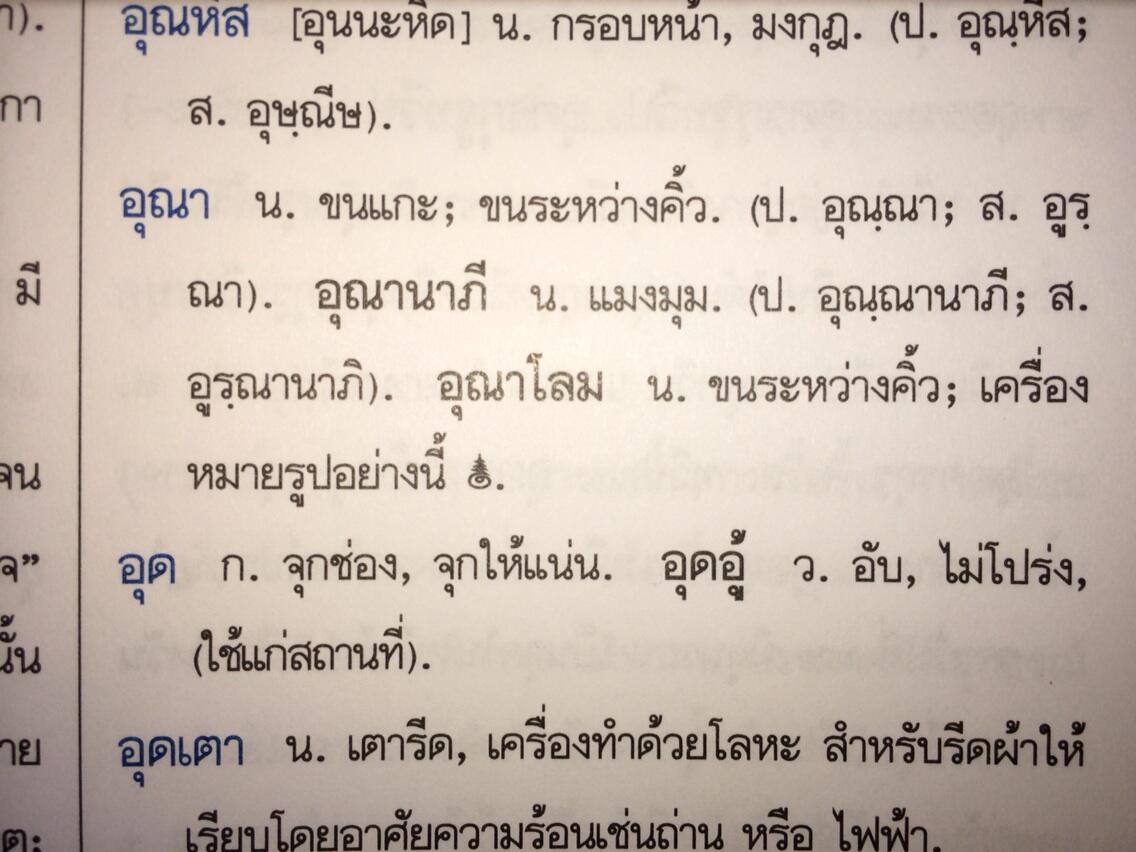
> The Royal Institute Thai Dictionary (the authoritative dictionary for the
> Thai language) has an entry for unalom showing the symbol:
>
>   https://pbs.twimg.com/media/BrdB2IsCYAAu4gP.jpg:large
>
> One issue is whether this ought to be encoded in the Thai block or as a
> non-script specific symbol. The concept of an auspicious mark on the
> forehead of the Buddha is common feature of Buddhist art and culture.
> However, the exact form of the mark varies: sometimes is a circular dot and
> sometimes a spiral.  The Thai form of the unalom is also found in other
> South-East Asian countries bordering Thailand (Laos, Myanmar, Cambodia).
>  My inclination would be to include it in the Thai block, on the basis that
> it needs to harmonize typographically with U+0E58, and that Khmer has its
> own separate version of khomut (U+17DA).  Devanagari om U+0950 is a
> precedent for encoding a religious symbol in a script block. In fact, some
> scholars consider the unalom or urna to be representation of the om sound
> [1]. Since it is not a character (in the sense of being part of the Thai
> writing system), the name should probably be "THAI UNALOM".
>
> James
>
> [1] Buddhist Sculpture of Northern Thailand, Carol Stratton
>
> http://books.google.com/books?id=EVpSSigMi4cC&lpg=PA50&ots=v8uqIcyyFX&dq=urna%20unalom&pg=PA50#v=onepage&q&f=false
>
>
>
>
> _______________________________________________
> Unicode mailing list
> [email protected]
> http://unicode.org/mailman/listinfo/unicode
>
>
_______________________________________________
Unicode mailing list
[email protected]
http://unicode.org/mailman/listinfo/unicode