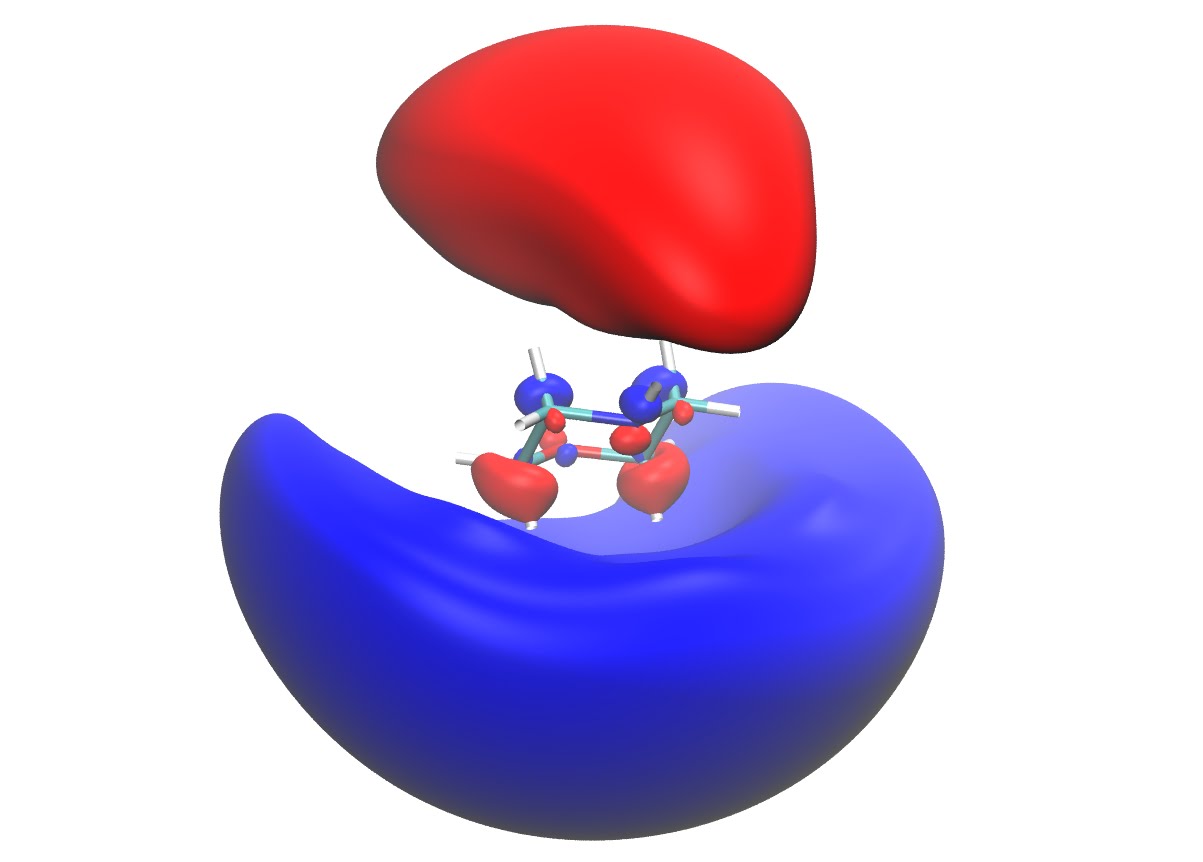
In prompto of your argument I try to get a discussion about especially the
nature of charge and that of a charge at a orbitsphere.
Maybe you'll find the argument interessting, have fun!
Hi,

Many people have fundamental issues with accepting that the law of the atom
is following a non smooth
rule e.g. that the charge is located in a very thin orbitsphere.

My questions is if it is possible to give another interpretation that
speaks more to our intuition than source
terms at the second derivative.

I would like to throw out an idea of a channel like behavior of nature. The
background is that physical laws is
very seldom nonlinear (simple) but when you stress them additional factors
turn up. The thing is that Maxwells
equation is extremely linear in empty space. So a simple nonlinear term
does not cut it (no?). Another idea is that free
space exhibits a true linearity (simplicity) up to a certain limit after
which it stops communication immediately of
the excess information e.g. transfer information up to a certain limit and
the rest bounces. I'm wondering if that could
be behind the un-regularity of GUTCP. An interesting assumption is that no
information leaves the internal photon,
else it would leak energy. Meaning that information is probably traveling
in parallel of the orbitsphere and slightly bounces
as it is kept inside the sphere. So my question is there any extreme
properties of the trapped photon's field that can shed
light of a filled channel or am I just dreaming this up. Anyway this
physics could explain or at least show how a physical
process could yield a thin shell of source terms at the second derivative -
a fact that is used by the opponents of GUTCP
to ridicule it. Also note that the sum of the bouncing e.g. the impacts
should be essentially zero in the long run if space have
a memory.


On Tue, Jan 13, 2015 at 8:14 AM, Eric Walker <[email protected]> wrote:

> On Sun, Jan 11, 2015 at 4:31 PM, Stefan Israelsson Tampe <
> [email protected]> wrote:
>
> Yep, this is exactly the problem, you have two incomplete models that same
>> the same thing. It's a mystery ...
>>
>
> Allow me to point to some additional, beautiful images of excited Rydberg
> states that one will presumably need to set aside in order to make room for
> Mills's orbitspheres in one's life:
>
> http://photon.physnet.uni-hamburg.de/typo3temp/pics/1d908a9be3.jpg
>
> http://4.bp.blogspot.com/-nk4zG5qt_nY/TtAqBojr3vI/AAAAAAAAABg/Vd5nKr7MGNw/s1600/WFs.png
>
> http://3.bp.blogspot.com/-urfIZEw5Ykw/T2Xvi98EJ8I/AAAAAAAABFc/VWk3UQ67S2o/s1600/17a%2527.persp2.bmp
> http://www.nature.com/ncomms/journal/v4/n2/images_article/ncomms2466-f4.jpg
>
> One is tempted to conclude that the makers of these images are propagating
> false teachings.
>
> In a world of orbitspheres, there are, presumably, no electrons passing
> through the nucleus, resulting in an increased probability of internal
> conversion.  We will need to set aside our current understanding of
> internal conversion and adopt one based upon infinitesimally thin electron
> currents that are miles away from the nucleus, from its own perspective.
>
> Perhaps the two descriptions are dual, in the way that George Orwell
> explained that one can develop the ability to keep in mind two
> contradictory thoughts:
>
>    - War is peace.
>    - Freedom is slavery.
>    - Ignorance is strength.
>
> Through an act of doublethink, it might be possible to reconcile
> orbitspheres and electron orbits, as they are currently understood.
>
> Eric
>
>