On Thu, Oct 29, 2015 at 11:11 PM, Bob Higgins <[email protected]>
wrote:
In Rydberg matter the electron is in a very large circular orbit (and by
> circular, I mean that the orbital is planar).
>

My understanding is that the proposed clusters of varying sizes with
sixfold symmetry rotate in a plane.  Unless Holmlid is proposing Rydberg
excitation that is fundamentally different than that seen elsewhere, the
orbitals of the electrons are those of the usual spherical harmonics (e.g.,
an s- or p-orbitals), but with large angular momentum, which leads them to
be deformed and susceptible to magnetic fields.

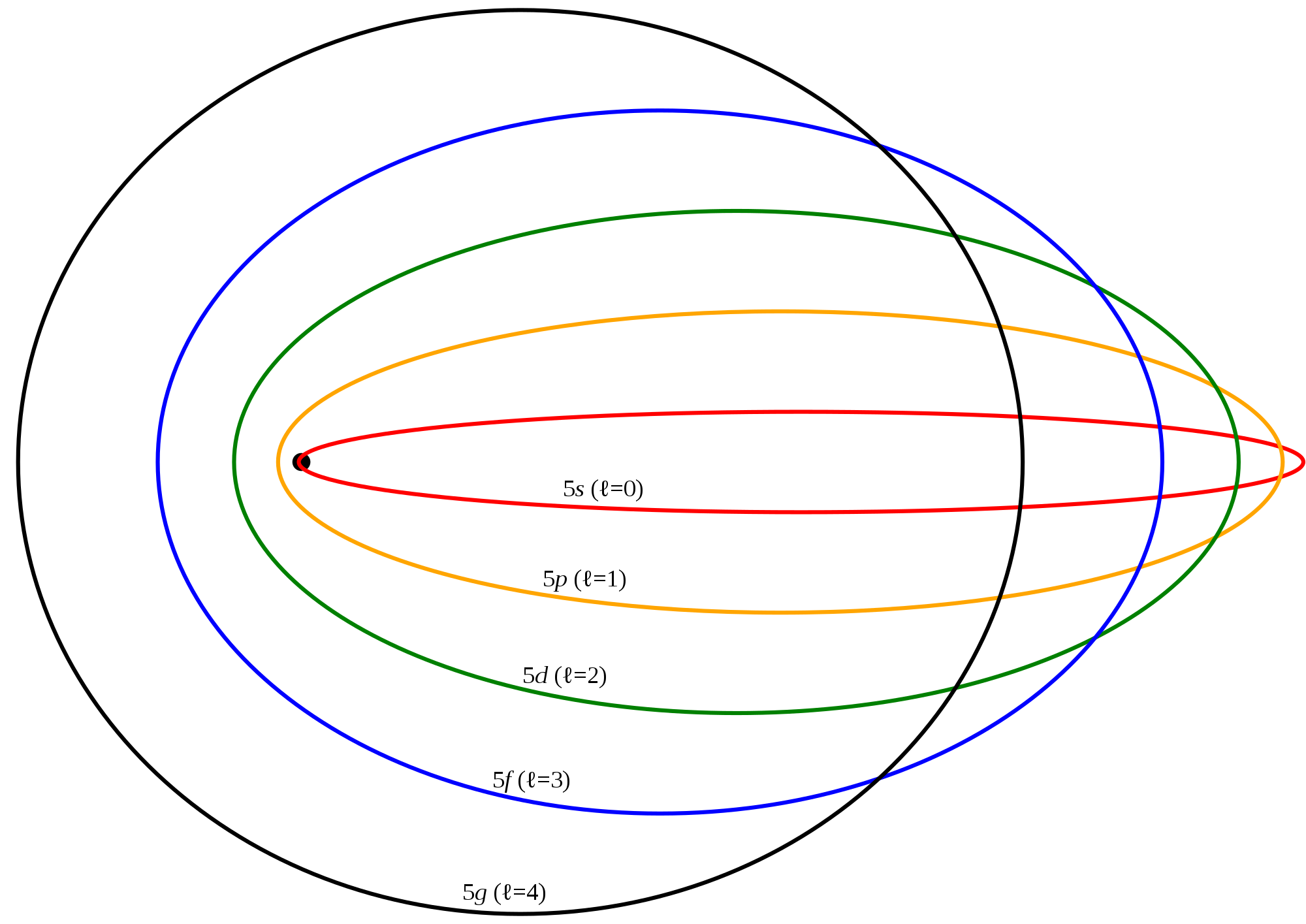
Here are orbitals deformed under successive units of orbital angular
momentum; the specific shapes of the orbitals are not represented:

https://upload.wikimedia.org/wikipedia/commons/thumb/7/75/Sommerfeld_ellipses.svg/2000px-Sommerfeld_ellipses.svg.png

I believe these orbitals are understood to have the normal 3-dimensional
probability distributions.  The image suggests that additional units of
angular momentum in all orbital types increasingly expose the charge in the
nucleus, leading to something like an ion.  (Somewhere I got the impression
that the the Rydberg matter is presumed to form ionic bonds.)

Eric