2 things stand out about this article:   The unbalanced formation of muons  in
testing the decay of B0 mesons, the team found that the decay process
produced muons with less frequency.  Something about this rings a bell with
some LENR results but I can't find it.
Secondly, the investigation of beauty was in the  Large Hardon Collider
beauty experiment <http://lhcb-public.web.cern.ch/lhcb-public/> (LHCb) .
The hardon typo is in the original article, and it's kinda funny.   ;-)

On Fri, Apr 21, 2017 at 3:24 PM, Kevin O'Malley <[email protected]> wrote:

> CERN Declares War On The Standard Model
> <https://www.universetoday.com/135091/cern-declares-war-standard-model/#>
>   Article Updated: 20 Apr , 2017by Matt Williams
> <https://www.universetoday.com/author/mwill/>
> https://www.universetoday.com/135091/cern-declares-war-standard-model/
>
> Ever since the discovery of the Higgs Boson in 2012
> <https://www.universetoday.com/96132/higgs-like-particle-discovered-at-cern/>,
> the Large Hadron Collider has been dedicated to searching for the existence
> of physics that go beyond the Standard Model. To this end, the Large
> Hardon Collider beauty experiment
> <http://lhcb-public.web.cern.ch/lhcb-public/> (LHCb) was established in
> 1995, specifically for the purpose of exploring what happened after the Big
> Bang that allowed matter to survive and create the Universe as we know it.
>
> Since that time, the LHCb has been doing some rather amazing things. This
> includes discovering five new particles
> <https://www.universetoday.com/134573/large-hadron-collider-discovers-5-new-gluelike-particles/>,
> uncovering evidence of a new manifestation of matter-antimatter asymmetry
> <http://home.cern/about/updates/2017/01/new-source-asymmetry-between-matter-and-antimatter>,
> and (most recently) discovering unusual results when monitoring beta decay.
> These findings, which CERN announced in a recent press release
> <http://lhcb-public.web.cern.ch/lhcb-public/Welcome.html#RKstar>, could
> be an indication of new physics that are not part of the Standard Model.
>
> In this latest study, the LHCb collaboration team noted how the decay of B
> 0mesons resulted in the production of an excited kaon and a pair of
> electrons or muons. Muons, for the record, are subatomic particles that are
> 200 times more massive than electrons, but whose interactions are believed
> to be the same as those of electrons (as far as the Standard Model is
> concerned).
>
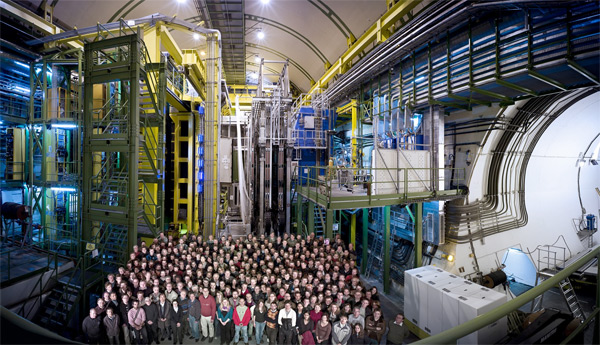
> <https://www.universetoday.com/wp-content/uploads/2017/03/lhcb_collaboration.jpg>
>
> *The LHCb collaboration team. Credit: lhcb-public.web.cern.ch
> <http://lhcb-public.web.cern.ch>*
>
> This is what is known as “lepton universality”, which not only predicts
> that electrons and muons behave the same, but should be produced with the
> same probability – with some constraints arising from their differences in
> mass. However, in testing the decay of B0 mesons, the team found that the
> decay process produced muons with less frequency. These results were
> collected during Run 1 of the LHC, which ran from 2009 to 2013.
>
> The results of these decay tests were presented on Tuesday, April 18th, at
> a CERN seminar
> <https://indico.cern.ch/event/580620/attachments/1442409/2226501/cern_2017_04_18.pdf>,
> where members of the LHCb collaboration team shared their latest findings.
> As they indicated during the course of the seminar, these findings are
> significant in that they appear to confirm results obtained by the LHCb
> team during previous decay studies.
>
> This is certainly exciting news, as it hints at the possibility that new
> physics are being observed. With the confirmation of the Standard Model
> (made possible with the discovery of the Higgs boson in 2012),
> investigating theories that go beyond this (i.e. Supersymmetry
> <https://indico.cern.ch/event/580620/attachments/1442409/2226501/cern_2017_04_18.pdf>)
> has been a major goal of the LHC. And with its upgrades completed in 2015,
> it has been one of the chief aims of Run 2 (which will last until 2018).
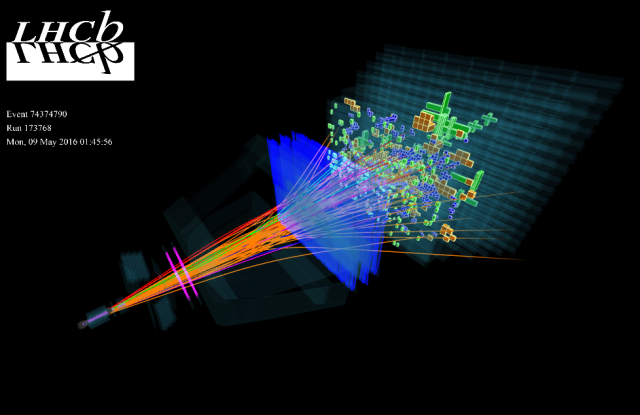
> <https://www.universetoday.com/wp-content/uploads/2017/03/lhcb7.png>
>
> *A typical LHCb event fully reconstructed. Particles identified as pions,
> kaon, etc. are shown in different colours. Credit: LHCb collaboration*
>
> Naturally, the LHCb team indicated that further studies will be needed
> before any conclusions can be drawn. For one, the discrepancy they noted
> between the creation of muons and electrons carries a low probability value
> (aka. p-value) of between 2.2. to 2.5 sigma. To put that in perspective,
> the first detection of the Higgs Boson occurred at a level of 5 sigma.
>
> In addition, these results are inconsistent with previous measurements
> which indicated that there is indeed symmetry between electrons and muons.
> As a result, more decay tests will have to be conducted and more data
> collected before the LHCb collaboration team can say definitively whether
> this was a sign of new particles, or merely a statistical fluctuation in
> their data.
>
> The results of this study will be soon released in a LHCb research paper.
> And for more information, check out the PDF version of the seminar
> <https://indico.cern.ch/event/580620/attachments/1442409/2226501/cern_2017_04_18.pdf>
> .
>