One of the key things about the decay path is the role of neutrinos.
What tends to be ignored is that the experiment is not being conducted
in a neutral background, but is being conduced in the background of a
sea of solar and cosmic neutrinos. The cosmic neutrinos that are a left
over from the big bang are at such low energies that they will almost
certainly play no role. However the solar neutrinos are at a flux and
an energy that I had recently begun to wonder whether they may
occasionally catalyse/interact with reactions involving the weak nuclear
force, which would result in decay probabilities that are slightly
different from the SM predictions. So perhaps its not that the SM is
wrong, its just that they have to add another reaction pathway.
Nigel
On 22/04/2017 04:37, John Berry wrote:
Oh wow,everyone get excited, there is a tiny deviation in the
production of muons over electrons even though there should be due to
their energy but it's a bit larger than that!
And as Muons die quickly, they aren't even useful.
This piece gives the view that physics is pretty much complete and the
most interesting thing that billions of dollars can do is find
bulls#!+ like that!
The huge gaps in understanding are ignored, but I'm glad they are
tracking down tiny details.
They are blind to so much!  The standard model can eat our dust!

John Berry
On Sat, Apr 22, 2017 at 10:24 AM, Kevin O'Malley <[email protected]
<mailto:[email protected]>> wrote:
        CERN Declares War On The Standard Model

<https://www.universetoday.com/135091/cern-declares-war-standard-model/#>

     Article Updated: 20 Apr , 2017
    by Matt Williams <https://www.universetoday.com/author/mwill/>


    https://www.universetoday.com/135091/cern-declares-war-standard-model/
    <https://www.universetoday.com/135091/cern-declares-war-standard-model/>

    Ever since the discovery of the Higgs Boson in 2012

<https://www.universetoday.com/96132/higgs-like-particle-discovered-at-cern/>,
    the Large Hadron Collider has been dedicated to searching for the
    existence of physics that go beyond the Standard Model. To this
    end, the Large Hardon Collider beauty experiment
    <http://lhcb-public.web.cern.ch/lhcb-public/> (LHCb) was
    established in 1995, specifically for the purpose of exploring
    what happened after the Big Bang that allowed matter to survive
    and create the Universe as we know it.

    Since that time, the LHCb has been doing some rather amazing
    things. This includes discovering five new particles

<https://www.universetoday.com/134573/large-hadron-collider-discovers-5-new-gluelike-particles/>,
    uncovering evidence of a new manifestation of matter-antimatter
    asymmetry

<http://home.cern/about/updates/2017/01/new-source-asymmetry-between-matter-and-antimatter>,
    and (most recently) discovering unusual results when monitoring
    beta decay. These findings, which CERN announced in a recent press
    release
    <http://lhcb-public.web.cern.ch/lhcb-public/Welcome.html#RKstar>,
    could be an indication of new physics that are not part of the
    Standard Model.

    In this latest study, the LHCb collaboration team noted how the
    decay of B0mesons resulted in the production of an excited kaon
    and a pair of electrons or muons. Muons, for the record, are
    subatomic particles that are 200 times more massive than
    electrons, but whose interactions are believed to be the same as
    those of electrons (as far as the Standard Model is concerned).


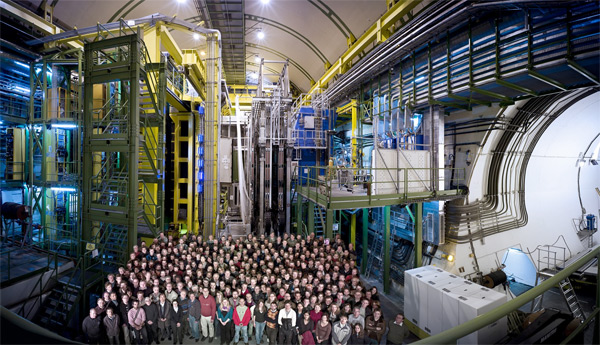
<https://www.universetoday.com/wp-content/uploads/2017/03/lhcb_collaboration.jpg>


    /The LHCb collaboration team. Credit: lhcb-public.web.cern.ch
    <http://lhcb-public.web.cern.ch>/

    This is what is known as “lepton universality”, which not only
    predicts that electrons and muons behave the same, but should be
    produced with the same probability – with some constraints arising
    from their differences in mass. However, in testing the decay of
    B0 mesons, the team found that the decay process produced muons
    with less frequency. These results were collected during Run 1 of
    the LHC, which ran from 2009 to 2013.

    The results of these decay tests were presented on Tuesday, April
    18th, at a CERN seminar

<https://indico.cern.ch/event/580620/attachments/1442409/2226501/cern_2017_04_18.pdf>,
    where members of the LHCb collaboration team shared their latest
    findings. As they indicated during the course of the seminar,
    these findings are significant in that they appear to confirm
    results obtained by the LHCb team during previous decay studies.

    This is certainly exciting news, as it hints at the possibility
    that new physics are being observed. With the confirmation of the
    Standard Model (made possible with the discovery of the Higgs
    boson in 2012), investigating theories that go beyond this (i.e.
    Supersymmetry

<https://indico.cern.ch/event/580620/attachments/1442409/2226501/cern_2017_04_18.pdf>)
    has been a major goal of the LHC. And with its upgrades completed
    in 2015, it has been one of the chief aims of Run 2 (which will
    last until 2018).

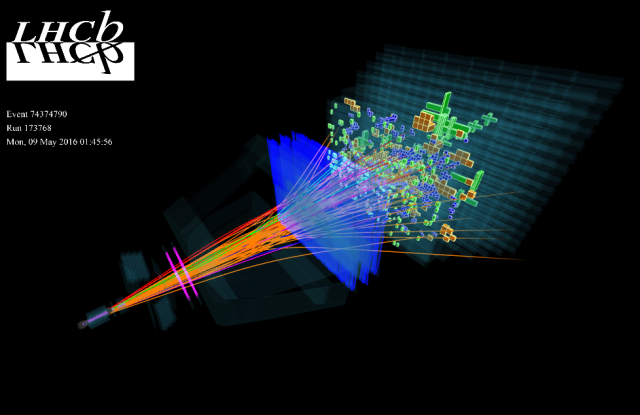
    <https://www.universetoday.com/wp-content/uploads/2017/03/lhcb7.png>

    /A typical LHCb event fully reconstructed. Particles identified as
    pions, kaon, etc. are shown in different colours. Credit: LHCb
    collaboration/

    Naturally, the LHCb team indicated that further studies will be
    needed before any conclusions can be drawn. For one, the
    discrepancy they noted between the creation of muons and electrons
    carries a low probability value (aka. p-value) of between 2.2. to
    2.5 sigma. To put that in perspective, the first detection of the
    Higgs Boson occurred at a level of 5 sigma.

    In addition, these results are inconsistent with previous
    measurements which indicated that there is indeed symmetry between
    electrons and muons. As a result, more decay tests will have to be
    conducted and more data collected before the LHCb collaboration
    team can say definitively whether this was a sign of new
    particles, or merely a statistical fluctuation in their data.

    The results of this study will be soon released in a LHCb research
    paper. And for more information, check out the PDF version of the
    seminar

<https://indico.cern.ch/event/580620/attachments/1442409/2226501/cern_2017_04_18.pdf>.