DN(0) →···→···→ K± → π± → μ± → e±
Nx4x938MeV →···→···→ 493MeV → 139MeV → 105MeV → 0. 511MeV
Holmlid's meson particle decay chain.

"The origin of the particle signals observed here is clearly laser-induced
nuclear processes in H(0). The first step is the laser-induced transfer of
the H2(0) pairs in the ultra-dense material H(0) from excitation state *s* =
2 (with 2.3 pm H-H distance) to *s* = 1 (at 0.56 pm H-H distance) [2
<http://journals.plos.org/plosone/article?id=10.1371/journal.pone.0169895#pone.0169895.ref002>].
The state *s* = 1 may lead to a fast nuclear reaction. It is suggested that
this involves two nucleons, probably two protons. The first particles
formed and observed [16
<http://journals.plos.org/plosone/article?id=10.1371/journal.pone.0169895#pone.0169895.ref016>
,17
<http://journals.plos.org/plosone/article?id=10.1371/journal.pone.0169895#pone.0169895.ref017>]
are kaons, both neutral and charged, and also pions. From the six quarks in
the two protons, three kaons can be formed in the interaction. Two protons
correspond to a mass of 1.88 GeV while three kaons correspond to 1.49 GeV.
Thus, the transition 2 p → 3 K is downhill in internal energy and releases
390 MeV. If pions are formed directly, the energy release may be even
larger. The kaons formed decay normally in various processes to charged
pions and muons. In the present experiments, the decay of kaons and pions
is observed directly normally through their decay to muons, while the muons
leave the chamber before they decay due to their easier penetration and
much longer lifetime."


On Fri, Apr 21, 2017 at 6:30 PM, Kevin O'Malley <[email protected]> wrote:

> 2 things stand out about this article:   The unbalanced formation of muons
>  in testing the decay of B0 mesons, the team found that the decay process
> produced muons with less frequency.  Something about this rings a bell with
> some LENR results but I can't find it.
>
> Secondly, the investigation of beauty was in the  Large Hardon Collider
> beauty experiment <http://lhcb-public.web.cern.ch/lhcb-public/> (LHCb) .
>   The hardon typo is in the original article, and it's kinda funny.   ;-)
>
> On Fri, Apr 21, 2017 at 3:24 PM, Kevin O'Malley <[email protected]>
> wrote:
>
>> CERN Declares War On The Standard Model
>> <https://www.universetoday.com/135091/cern-declares-war-standard-model/#>
>>   Article Updated: 20 Apr , 2017by Matt Williams
>> <https://www.universetoday.com/author/mwill/>
>> https://www.universetoday.com/135091/cern-declares-war-standard-model/
>>
>> Ever since the discovery of the Higgs Boson in 2012
>> <https://www.universetoday.com/96132/higgs-like-particle-discovered-at-cern/>,
>> the Large Hadron Collider has been dedicated to searching for the existence
>> of physics that go beyond the Standard Model. To this end, the Large
>> Hardon Collider beauty experiment
>> <http://lhcb-public.web.cern.ch/lhcb-public/> (LHCb) was established in
>> 1995, specifically for the purpose of exploring what happened after the Big
>> Bang that allowed matter to survive and create the Universe as we know it.
>>
>> Since that time, the LHCb has been doing some rather amazing things. This
>> includes discovering five new particles
>> <https://www.universetoday.com/134573/large-hadron-collider-discovers-5-new-gluelike-particles/>,
>> uncovering evidence of a new manifestation of matter-antimatter asymmetry
>> <http://home.cern/about/updates/2017/01/new-source-asymmetry-between-matter-and-antimatter>,
>> and (most recently) discovering unusual results when monitoring beta decay.
>> These findings, which CERN announced in a recent press release
>> <http://lhcb-public.web.cern.ch/lhcb-public/Welcome.html#RKstar>, could
>> be an indication of new physics that are not part of the Standard Model.
>>
>> In this latest study, the LHCb collaboration team noted how the decay of B
>> 0mesons resulted in the production of an excited kaon and a pair of
>> electrons or muons. Muons, for the record, are subatomic particles that are
>> 200 times more massive than electrons, but whose interactions are believed
>> to be the same as those of electrons (as far as the Standard Model is
>> concerned).
>>
>> <https://www.universetoday.com/wp-content/uploads/2017/03/lhcb_collaboration.jpg>
>>
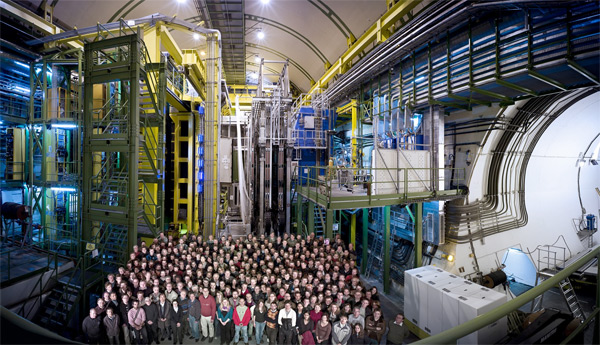
>> *The LHCb collaboration team. Credit: lhcb-public.web.cern.ch
>> <http://lhcb-public.web.cern.ch>*
>>
>> This is what is known as “lepton universality”, which not only predicts
>> that electrons and muons behave the same, but should be produced with the
>> same probability – with some constraints arising from their differences in
>> mass. However, in testing the decay of B0 mesons, the team found that
>> the decay process produced muons with less frequency. These results were
>> collected during Run 1 of the LHC, which ran from 2009 to 2013.
>>
>> The results of these decay tests were presented on Tuesday, April 18th,
>> at a CERN seminar
>> <https://indico.cern.ch/event/580620/attachments/1442409/2226501/cern_2017_04_18.pdf>,
>> where members of the LHCb collaboration team shared their latest findings.
>> As they indicated during the course of the seminar, these findings are
>> significant in that they appear to confirm results obtained by the LHCb
>> team during previous decay studies.
>>
>> This is certainly exciting news, as it hints at the possibility that new
>> physics are being observed. With the confirmation of the Standard Model
>> (made possible with the discovery of the Higgs boson in 2012),
>> investigating theories that go beyond this (i.e. Supersymmetry
>> <https://indico.cern.ch/event/580620/attachments/1442409/2226501/cern_2017_04_18.pdf>)
>> has been a major goal of the LHC. And with its upgrades completed in 2015,
>> it has been one of the chief aims of Run 2 (which will last until 2018).
>> <https://www.universetoday.com/wp-content/uploads/2017/03/lhcb7.png>
>>
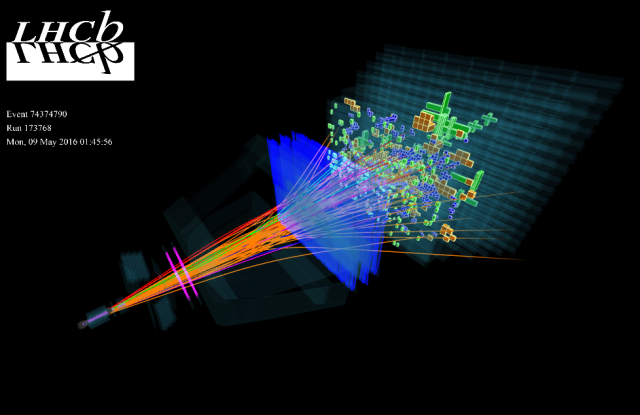
>> *A typical LHCb event fully reconstructed. Particles identified as pions,
>> kaon, etc. are shown in different colours. Credit: LHCb collaboration*
>>
>> Naturally, the LHCb team indicated that further studies will be needed
>> before any conclusions can be drawn. For one, the discrepancy they noted
>> between the creation of muons and electrons carries a low probability value
>> (aka. p-value) of between 2.2. to 2.5 sigma. To put that in perspective,
>> the first detection of the Higgs Boson occurred at a level of 5 sigma.
>>
>> In addition, these results are inconsistent with previous measurements
>> which indicated that there is indeed symmetry between electrons and muons.
>> As a result, more decay tests will have to be conducted and more data
>> collected before the LHCb collaboration team can say definitively whether
>> this was a sign of new particles, or merely a statistical fluctuation in
>> their data.
>>
>> The results of this study will be soon released in a LHCb research paper.
>> And for more information, check out the PDF version of the seminar
>> <https://indico.cern.ch/event/580620/attachments/1442409/2226501/cern_2017_04_18.pdf>
>> .
>>
>
>