On Sun, 10 May 2009, Horace Heffner wrote:

> On May 9, 2009, at 12:45 PM, Kyle Mcallister wrote:
> All it takes is a bolt (core) wrapped with a small sense coil and a
> larger energizing coil.  You hook the sensor coil to a transistor
> gate and the the power coil to emitter and battery.   As a magnet
I finally heard the secret history of this device when I was working at
Boston science museum.  Its original inventor was at the U. of Mass.

The coils/transistor motor is used all over the place in those animated
swinging pendulum paperweight toys.  It's also an easy way to build a
brushless motor with a spinning magnet.  The inventor, the infamous
engineer Harry E. Stockman, never made a cent off it.  I guess it didn't
get popular until his 1961 patent ran out.

His original design was a "Dipping Bird" toy with a glass of water.  But
the glass was empty, and had coils wrapped around the rim, with a magnet
in the bird's beak.

Here's the original article from 1961 (also text below.)

  Secret of the Dunking Duck
  American Journal of Physics -- June 1961 -- Volume 29, Issue 6, pp. 374-375
  Am. J. Phys. / Volume 29 / Issue 6 / LETTERS TO THE EDITOR

  Dunking Duck without Liquid  (just a teaser article, gives only hints)
  American Journal of Physics -- May 1961 -- Volume 29, Issue 5, pp. 335-336
  Am. J. Phys. / Volume 29 / Issue 5 / LETTERS TO THE EDITOR

Here's the PDF file, but you have to be subscribed to the service:
http://scitation.aip.org/getpdf/servlet/GetPDFServlet?filetype=pdf&id=AJPIAS000029000006000374000002&idtype=cvips&prog=normal


 LETTERS TO THE EDITOR   vol29 #6
 Secret of the Dunking Duck

 "In the description of a dunking duck without liquid, it was stated that
 the creature did not need a glass of water, but now, when the day of
 reckoning is here, it must be admitted that the duck needs a glass, or
 some kind of "water hole," although it does not contain any water(1).
 Around the edge of the cavity into which the duck sinks his magnetic
 beak, is mounted a tiny inductor with many thousands of turns of fine
 wire.  the inductor has a tap, which provides the common-emitter
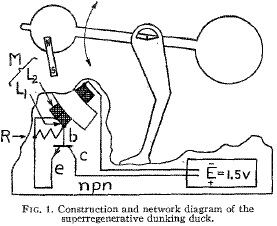
 connection of a switching transistor; see Fig. 1 (2)(3)  The bottom part
 L1 of the inductor is connected to the base electrode b, and the upper
 part L2 is connected through the battery E to the collector c.  The
 transistor and the small flashlight cell used as battery are hidden in
 the molded base upon which the duck gracefully stands.  Owing to the
 large value of the mutual inductance M, the system oscillates at
 ultrasonic frequency, so that a direct collector current of several mA
 results, although only 1.5v is available as driving voltage.  The
 ultrasonic oscillation is then damped out then the ducks body rests
 comfortably in nearly horizontal position, and this is done by means of
 the damping resistor R.  If now the duck is tipped over in drinking
 position, the value of M suddenly increases, so that beta-A of the
 oscillatory system exceeds 1.  Oscillations thus commence, with a short
 rise-time collector current pulse as a result, which violently drives the
 duck's beak all the way down.  The emf in the inductor L1 then ceases,
 the collector current pulse vanishes, and the duck proceeds to raise its
 beak at a rate determined by the natural frequency of the mechanical
 oscillatory system, which frequency may be as low as 1cps.  Since the
 mechanical oscillation represents the signal, the ultrasonic oscillation
 represents a superregenerative action, which on an oscilloscope closely
 resembles that from the conventional tube or transistor superregenerative
 detector.

  Fig 1 diagram  http://amasci.com/graphics/dbird.gif

 "The components are not critical, and the duck dunks merrily away for
 several months, even on a small flashlight cell.  As far as the ancient
 history of this duck is concerned, its originator cannot quite overcome
 the suspicion that it migrated from the land of the Scots; for once it is
 through with its last "dunk," it leaves the battery so thoroughly emptied
 of electricity that it might just as well have been short-circuited.
 This high utilization ability of the device may be largely attributed to
 the superregenrative action, since the current "spikes" in the collector
 circuit represent a fairly low value of average current.

 HARRY E. STOCKMAN
 Lowell Technological Institute

  (1)H. E. Stockman, Am J Phys 29, 335 (1961)
  (2)Patent App Jan 19, 1961 USPTO Washington 25 DC
  (3) Made by SER Co., Waltham Mass


(((((((((((((((((( ( (  (   (    (O)    )   )  ) ) )))))))))))))))))))
William J. Beaty                            SCIENCE HOBBYIST website
billb at amasci com                         http://amasci.com
EE/programmer/sci-exhibits   amateur science, hobby projects, sci fair
Seattle, WA  206-762-3818    unusual phenomena, tesla coils, weird sci