This distance cannot be determined. Because of quantum mechanics, an
entangled pair can be next to each other of across the solar system.
Before the fact of entanglement, the hydrogen atoms are in the lattice
structure of Rydberg matter.
In an excited state, the protons are confined at the center of the particle
and the electrons orbit on the outside.

http://newenergytimes.com/v2/news/2010/35/SR35906insights.shtml

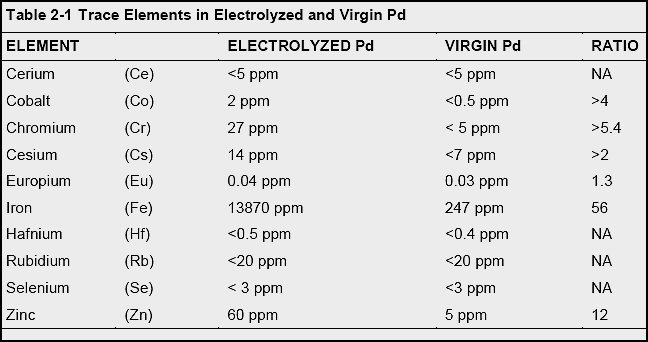
This study shows transmutation to iron as highly favored by LENR in
deuterium/palladium.


http://newenergytimes.com/v2/news/2010/35/35img/1999Bush-TraceElementsAdded-648.jpg


Without the production a many light precursor elements, it is hard to
believe that so much iron and other heavy elements could have been produced
not by a gradual buildup of elements with increasing atomic weight but by
the wholesale fusion of hundreds of protons in one shot.


On Mon, Dec 23, 2013 at 4:08 PM, <[email protected]> wrote:

> In reply to  Axil Axil's message of Sat, 21 Dec 2013 22:23:03 -0500:
> Hi,
> [snip]
> >At this juncture, there are important undefined parameters that need to be
> >resolved before a reliable estimate of proton cooper pair density can be
> >calculated.
>
> Can you at least give a rough estimate of the separation distance between
> two
> protons in a pair?
>
> >
> >First, the strength of the magnetic field that can reduce or eliminate
> >charge through screening. Next, the speed or duration of the magnetic
> field
> >to allow the protons to move toward each other, and finally the number of
> >hydrogen atoms that comprise the hydrogen nano-particle before the
> magnetic
> >field reaches full intensity when screening is the most powerful.
> [snip]
> Regards,
>
> Robin van Spaandonk
>
> http://rvanspaa.freehostia.com/project.html
>
>