Hello Jones

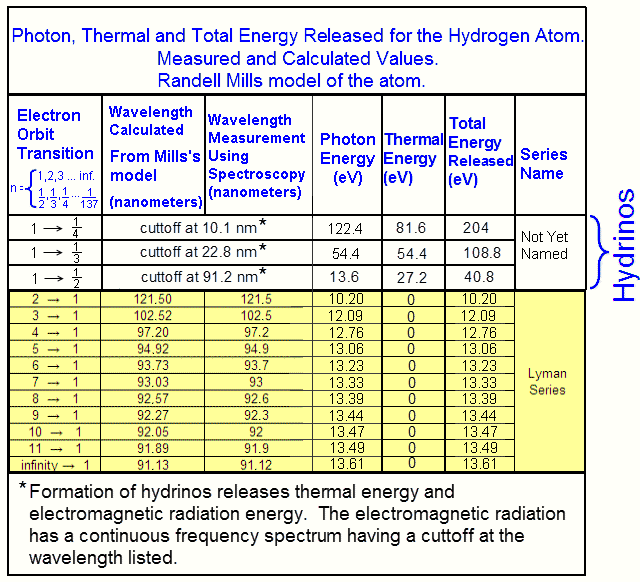
I have talked to plasmaphysicists and they say that the continuumspectrum (
which was reproduced)  proves that there is a until now unknown physical proces
going on when hydrogen atoms collide (probably during 3 body reactions).
Peter v Noorden


----- Original Message -----
  From: Jones Beene
  To: [email protected]
  Sent: Monday, January 20, 2014 5:39 PM
  Subject: RE: [Vo]:BLP's announcement


  Your spiel is a complete cop out.


  The Lehigh chart, which I have seen, shows a distinct signature.


  A so-called "continuum with a cutoff" is NOT a signature. It is a subterfuge.


  Mills has been frustrated over the years in being unable to show a distinct
signature for the first level of redundancy (27.2) and this crap about a
"continuum with a cutoff" is his feeble attempt to show what he cannot show
otherwise - which is a real signature.


  He can show line broadening in the visible range - which is somewhat helpful
- but you have "drunk to kool-aid" on this "continuum with a cutoff" BS as
being anything other than a generalization, meaning nothing.


  If it were not for the fine study by Thermacore, Mills could probably get
away with this kind of intellectual dishonesty. He is looking more and more
like a charlatan and this upcoming demo will be an insult.


  Jones


  From: Jeff Driscoll


  As far as I know, Mills's theory does not predict a continuum radiation
having a cuttoff at a frequency that corresponds to a 27.2 eV for transitions
that start from n = 1 (maybe fractional to fractional transition does, I don't
know)
  see here:
  http://zhydrogen.com/wp-content/uploads/2011/04/19pn.gif

  And, Mills theory only has continuum radiation with a cuttoff frequency.
There are no photons emitted that have a specific frequency that shows up
sharply on a graph.  That's why it is hard to detect hydrino photon emission
during hydrino creation.

  I try to explain it all here on pages 52-55:
  http://zhydrogen.com/wp-content/uploads/2013/04/BLP-presentation.pdf

  Jeff


  On Mon, Jan 20, 2014 at 11:13 AM, Jones Beene <[email protected]> wrote:


                  From: David Roberson

                  A thought just occurred to me.  Is it not possible to ionize
  a hydrino with high temperatures, gamma radiation, or other energetic
  processes?  This should be able to return the hydrino back into hydrogen
  again which should be detected.  I suppose that if these processes can
  impact the hydrinos then they should not be considered dark manner by
  definition.

  Dave,

  Yes, this procedure you mention is rather obvious - and it has in fact been
  done; but one reason that you do not hear about this particular finding on a
  regular basis could be that the results are open to interpretation.

  I am going to present the interpretation which Mills does not want you to
  hear. You can make your own judgment on what is really happening.

  The most convincing paper on hydrinos which is available to view - was not
  performed by Mills but by Thermacore. Long term excess heat was found as was
  a time delayed signature.

  https://www.google.com/url?q=http://www.lenr-canr.org/acrobat/GernertNnascen
  thyd.pdf&sa=U&ei=e0DdUq3AIsTgyQHUyoGIAg&ved=0CAYQFjAA&client=internal-uds-cs
  e&usg=AFQjCNG_00ZwiWP5nfDF2NVjs0l9AOKQmQ

  .and in that paper the nickel capillary tubing, after the very long
  successful run, gives up the best evidence ever for the existence of the
  hydrino - since it was tested by ESCA analysis at Lehigh University. There
  is no doubt the tests were accurate - it is the interpretation that can
  vary.

  ESCA is now known as X-ray photoelectron spectroscopy (XPS) and is
  accomplished by capturing spectra obtained by irradiating a material with a
  monochromatic beam of relatively soft X-rays. In this case, the results seem
  to support some of Mills theory but not all of it.

  The Lehigh University testing in fact finds NO 27.2 eV signature, as Mills
  theory suggests.

  However, XPS does find the a 55 eV signal/signature, which is close to
  Mills' theoretical signature for the hydrino, which is supposed to be 54.4
  eV but not exact. However, the XPS device is in fact capable of showing an
  exact signature, but none is found.

  Mike Carrel has also mentioned that Mills has lately dropped efforts to find
  the lower Rydberg signature in favor of the H(1/4). What Mike failed to
  mention is that the reason for this change in strategy is that BLP HAS NEVER
  BEEN ABEL TO SHOW THE 27.2 SIGNATURE. and if one is mildly skeptical of
  Mills, this can be viewed as a disaster since the higher energy signal is
  itself off target.

  In fact, it is clear to me that the Mills theory cannot be accurate, given
  the independent testing, and that there is no signal at the all-important
  level of 27.2 eV and in fact the higher level signal is itself NOT at the
  exact Rydberg level but is off by up to 8 percent.

  The bottom line is that nickel has been proven to not only produce excess
  energy, but to capture hydrogen in such a way that when irradiated by soft
  x-rays, it will emit a signature at 55 eV . and although this is close to
  the Rydberg multiple at 54.4 eV it is not exact, and thus the source for
  this signal is open to interpretation.

  In fact, I've been working on an alternative explanation for the 55 eV
  signal - involving the diproton reaction, (Reversible Proton Fusion) which
  will be presented at some point.

  It explains why this signature is NOT a precise Rydberg value, even though
  it is close - and why the signal derives from the XPS device itself (in its
  interaction with retained protons) - but the conclusion is that this signal
  is not derived from retained hydrinos being "reinflated."

  Jones


  --
  Jeff Driscoll
  617-290-1998