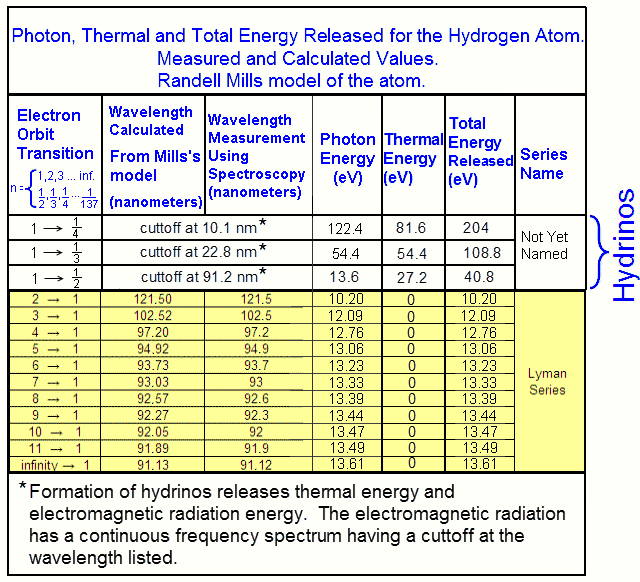
As far as I know, Mills's theory does not predict a continuum radiation
having a cuttoff at a frequency that corresponds to a 27.2 eV for
transitions that start from n = 1 (maybe fractional to fractional
transition does, I don't know)
see here:
http://zhydrogen.com/wp-content/uploads/2011/04/19pn.gif
And, Mills theory only has continuum radiation with a cuttoff frequency.
There are no photons emitted that have a specific frequency that shows up
sharply on a graph.  That's why it is hard to detect hydrino photon
emission during hydrino creation.

I try to explain it all here on pages 52-55:
http://zhydrogen.com/wp-content/uploads/2013/04/BLP-presentation.pdf

Jeff


On Mon, Jan 20, 2014 at 11:13 AM, Jones Beene <[email protected]> wrote:

>
>
>                 From: David Roberson
>
>                 A thought just occurred to me.  Is it not possible to
> ionize
> a hydrino with high temperatures, gamma radiation, or other energetic
> processes?  This should be able to return the hydrino back into hydrogen
> again which should be detected.  I suppose that if these processes can
> impact the hydrinos then they should not be considered dark manner by
> definition.
>
> Dave,
>
> Yes, this procedure you mention is rather obvious - and it has in fact been
> done; but one reason that you do not hear about this particular finding on
> a
> regular basis could be that the results are open to interpretation.
>
> I am going to present the interpretation which Mills does not want you to
> hear. You can make your own judgment on what is really happening.
>
> The most convincing paper on hydrinos which is available to view - was not
> performed by Mills but by Thermacore. Long term excess heat was found as
> was
> a time delayed signature.
>
>
> https://www.google.com/url?q=http://www.lenr-canr.org/acrobat/GernertNnascen
>
> thyd.pdf&sa=U&ei=e0DdUq3AIsTgyQHUyoGIAg&ved=0CAYQFjAA&client=internal-uds-cs
> e&usg=AFQjCNG_00ZwiWP5nfDF2NVjs0l9AOKQmQ
>
> …and in that paper the nickel capillary tubing, after the very long
> successful run, gives up the best evidence ever for the existence of the
> hydrino – since it was tested by ESCA analysis at Lehigh University. There
> is no doubt the tests were accurate – it is the interpretation that can
> vary.
>
> ESCA is now known as X-ray photoelectron spectroscopy (XPS) and is
> accomplished by capturing spectra obtained by irradiating a material with a
> monochromatic beam of relatively soft X-rays. In this case, the results
> seem
> to support some of Mills theory but not all of it.
>
> The Lehigh University testing in fact finds NO 27.2 eV signature, as Mills
> theory suggests.
>
> However, XPS does find the a 55 eV signal/signature, which is close to
> Mills’ theoretical signature for the hydrino, which is supposed to be 54.4
> eV but not exact. However, the XPS device is in fact capable of showing an
> exact signature, but none is found.
>
> Mike Carrel has also mentioned that Mills has lately dropped efforts to
> find
> the lower Rydberg signature in favor of the H(1/4). What Mike failed to
> mention is that the reason for this change in strategy is that BLP HAS
> NEVER
> BEEN ABEL TO SHOW THE 27.2 SIGNATURE… and if one is mildly skeptical of
> Mills, this can be viewed as a disaster since the higher energy signal is
> itself off target.
>
> In fact, it is clear to me that the Mills theory cannot be accurate, given
> the independent testing, and that there is no signal at the all-important
> level of 27.2 eV and in fact the higher level signal is itself NOT at the
> exact Rydberg level but is off by up to 8 percent.
>
> The bottom line is that nickel has been proven to not only produce excess
> energy, but to capture hydrogen in such a way that when irradiated by soft
> x-rays, it will emit a signature at 55 eV … and although this is close to
> the Rydberg multiple at 54.4 eV it is not exact, and thus the source for
> this signal is open to interpretation.
>
> In fact, I’ve been working on an alternative explanation for the 55 eV
> signal - involving the diproton reaction, (Reversible Proton Fusion) which
> will be presented at some point.
>
> It explains why this signature is NOT a precise Rydberg value, even though
> it is close - and why the signal derives from the XPS device itself (in its
> interaction with retained protons) – but the conclusion is that this signal
> is not derived from retained hydrinos being “reinflated.”
>
> Jones
>
>
>
>


--
Jeff Driscoll
617-290-1998