I suspect that the release of methane within coastal waters and tundra, etc.
has been going on for a long time and remained undetected.  It is possible that
this is a new phenomena impacting the oceans and atmosphere, but there is no
solid reason to suspect that it is.

Unless someone is actively looking for a problem they are not likely to find
it, and new science is based to a great extent upon the discovery of unexpected
events.
As I have stated on numerous occasions, there are most likely many variables
that have a significant impact upon the predictions of the climate models that
remain unknown at this time.   Of course no one can point these out before they
are discovered, but the track record of the model constructors strongly
suggests that they will appear.  Once a significant period elapses during which
their predictions match the future climate it will be time to begin to trust
these guys.  That time is certainly not today.

Everyone of us should be intelligent enough to be skeptical of politically
charged science and we must not fall into the trap of trusting experts that
continue to make major blunders.   This issue is not unlike asking you to trust
the main line physics experts who will tell you that LENR is pure rubbish.  Why
should they not deserve the same level of trust as the climate scientists?

Dave


-----Original Message-----
From: CB Sites <[email protected]>
To: vortex-l <[email protected]>
Sent: Thu, Aug 28, 2014 11:08 pm
Subject: Re: EXTERNAL: Re: [Vo]:global warming?


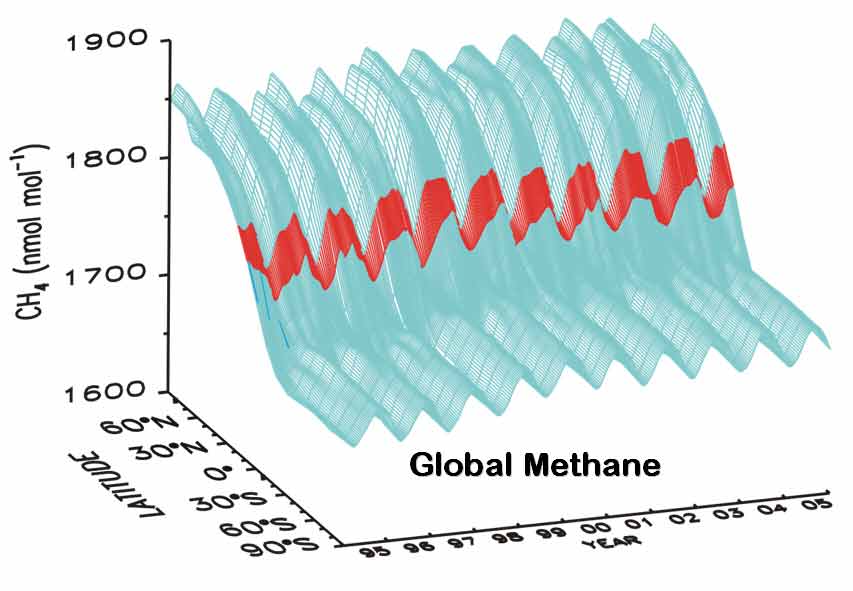
This hasn't been occurring very long.  Otherwise we would have noticed.  The
methane measurements from satellite will be interesting to watch over the next
few years. Here is one report
http://www.esrl.noaa.gov/gmd/obop/mlo/programs/esrl/methane/img/img_global_methane.jpg


On Thu, Aug 28, 2014 at 10:29 AM, David Roberson <[email protected]> wrote:

One might also question how long the bubbling has been occurring.  Perhaps the
earlier bubbling of a know very powerful warming gas has obscured our
contribution.  This is just one of the many questions that appear to be left
unanswered and not included in the models.   Once most of the variables are
quantified and properly included in the models we will then have a reasonable
model and hopefully its predictions become more accurate.   Even then there is
no guarantee that the uncertainty due to random events does not overwhelm the
predictions beyond a few years.

Dave


-----Original Message-----
From: Roarty, Francis X <[email protected]>
To: vortex-l <[email protected]>
Sent: Thu, Aug 28, 2014 7:47 am
Subject: RE: EXTERNAL: Re: [Vo]:global warming?


Also makes me wonder what strange effects massive hydrocarbon loading could
have on silicon grains as it bubbles up through the sea floor, perhaps the
Bermuda Triangle is the result of hydrino bubbles :_)

From: Axil Axil [mailto:[email protected]]
Sent: Thursday, August 28, 2014 1:13 AM
To: vortex-l
Subject: EXTERNAL: Re: [Vo]:global warming?


http://www.bbc.com/news/science-environment-28898223


'Widespread methane leakage' from ocean floor off US coast


This could be bad news...


On Wed, Aug 27, 2014 at 9:32 AM, Chris Zell <[email protected]> wrote:

http://news.nationalgeographic.com/news/2014/08/140821-global-warming-hiatus-climate-change-ocean-science/


So, the mainstream now says no global warming for 10 - 15 years?