On 07.10.2010 14:56, Nick Sabalausky wrote:
"Stephan Soller"<[email protected]>  wrote in message
news:[email protected]...
On 07.10.2010 11:02, Nick Sabalausky wrote:
Not explicitly as far as I'm aware, but then neither does HTML aside from
URLs. And the PDF format does have provisions for files/data of arbitrary
types to be embedded into it. So that could be used to embed HTTP URLs,
or
any other form of network-oriented links, or any other
application-related
information/instructions/data you want. Then you could build
CSS/JS/CGI-like
stuff on top of all that. And all of a sudden "PDF-readers" become a
really
shitty application platform just like what happened with HTML and web
browsers.
Interesting point of view. So PDF basically equals to HTML in that regard.
Never thought about it that way but you're probably right. :)
Well, they were both created as document formats ;)
I usually like to minimize bitmapped stuff on pages too, just because
it's
simpler, it can still get acceptable results, and I'm no artist ;)  But
then
when the client has a design they want it to look like and it includes
things that can only be done as images, well, then I just don't have the
energy or patience to try to talk them out of it - I'll just toss in
whatever I need to to make it work, even if that means tables, and be
done
with it.
If I get a design from a client I do that to. I don't use tables but most
often a combination of floats and relative/absolute positioning but
usually with quite a lot of images in it. Even if they don't have a
finished design arguing about it often is a lost cause anyway. However for
my own personal project (or in case I have to do the design myself) these
new CSS techniques come in quite handy (if the environment allows it...).

I used it for my [personal website][1] and it was quite handy. The only
images are the header image, icons and the background gradient. The
gradient only because I was to lazy to look up the proper properties and
do some cross browser testing (not sure if Opera support gradient yet
though).

[1]: http://arkanis.de/
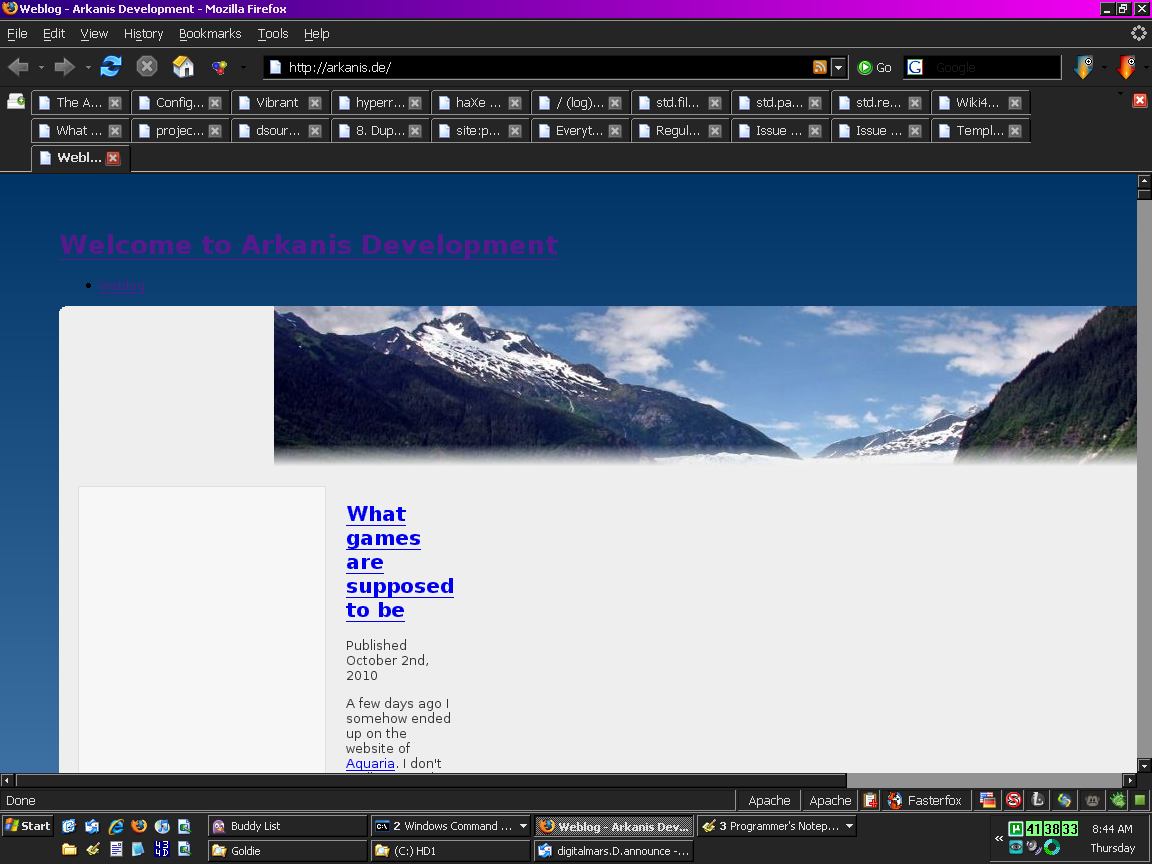
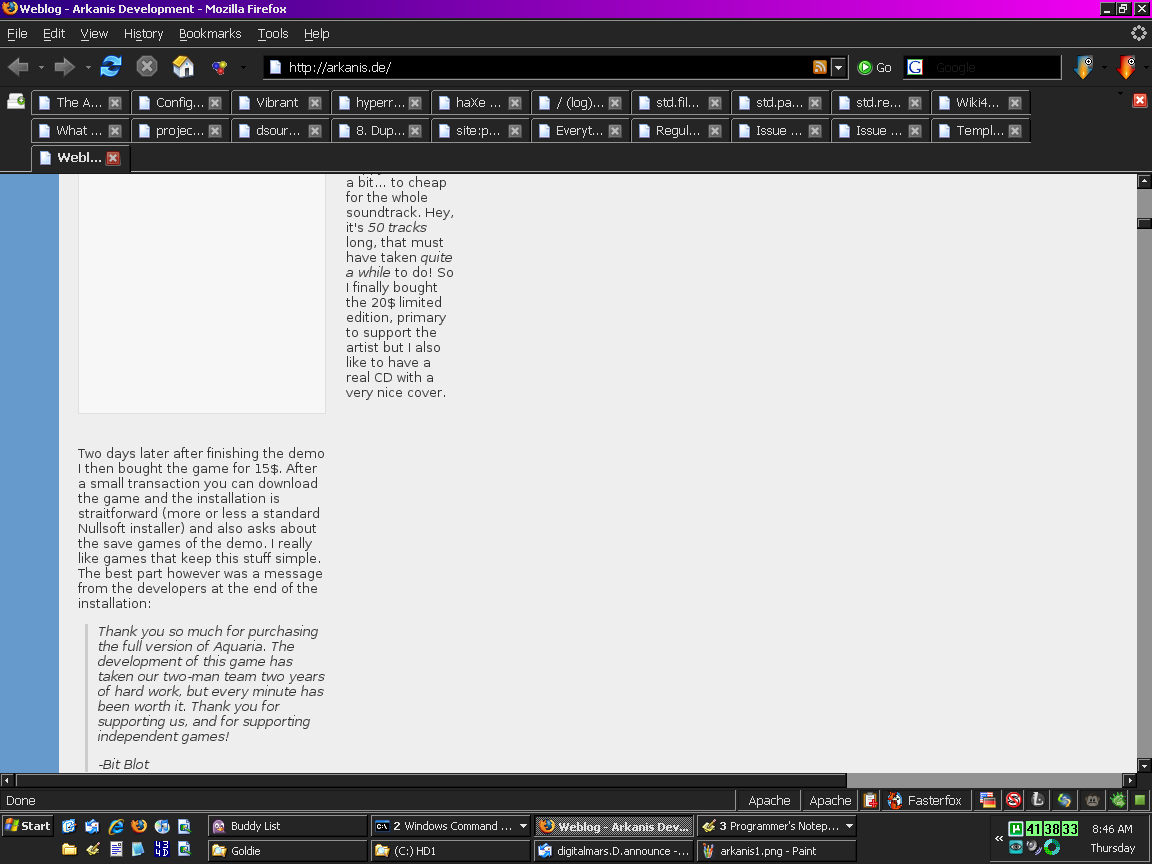
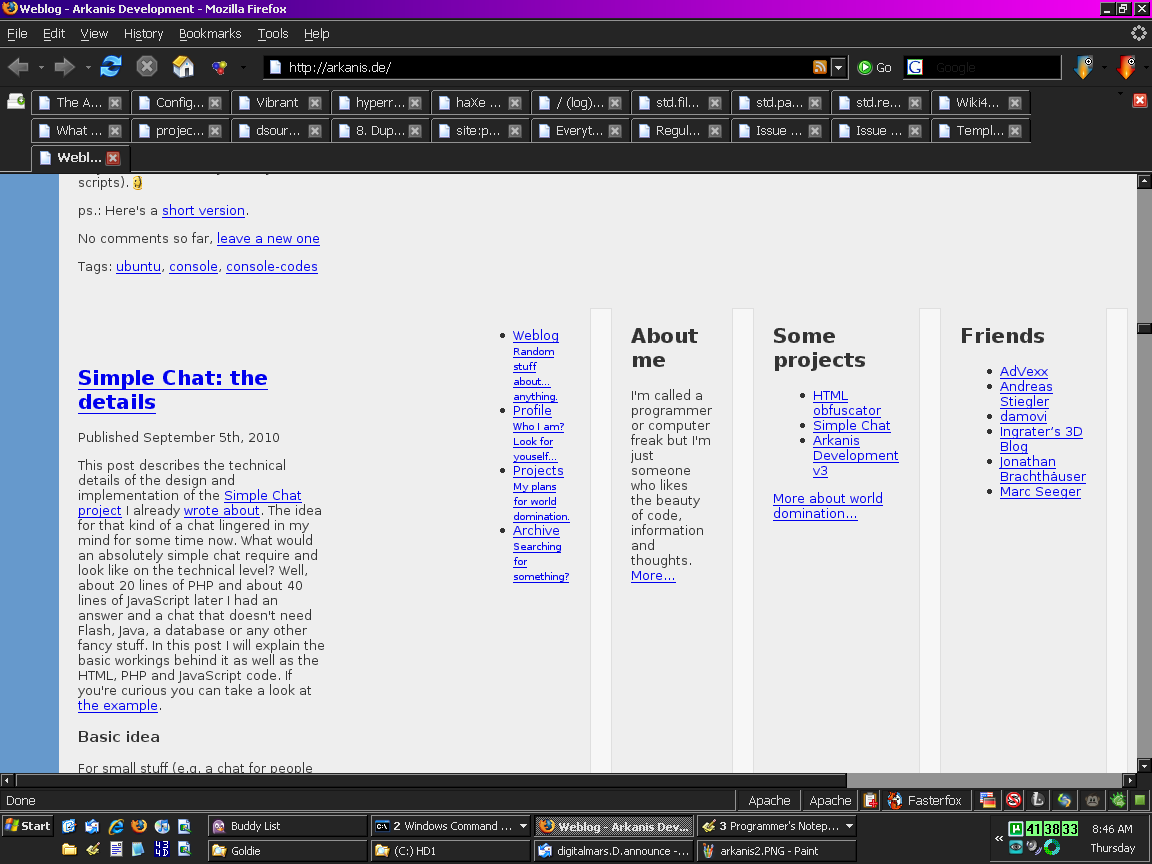
Not to complain, just FYI, this is what that page looks like for me:

http://www.semitwist.com/download/arkanis1.png
http://www.semitwist.com/download/arkanis2.png
http://www.semitwist.com/download/arkanis3.png

Interestingly, if I turn JS on, than it'll look a lot better *until* it
finishes loading, at which point it goes back to looking just like those
screenshots.
Thanks for the screenshots. May I ask which version of Firefox (if I see
that correctly) your're using? The JS stuff is quite interesting since
the page actually does not use JS at all. The only situation where JS
should actually be involved is for IE (because you need to introduce
unknown elements to IE before using them). I'm not aware that any
version of Firefox interprets IE conditional comments (although there
was talk about it once) so this behavior is somewhat concerning.
However this page uses quite new and still in progress browser stuff
(HTML5, CSS3) so it'll give old browsers a very hard time. It's more
like a showcase for the new stuff. Take a look at [this screenshot][1]
to see how it's supposed to look like. It was made with font
antialiasing on a standard TFT but the text might look a bit awkward on
CRTs or TFTs with a different subpixel layout (usually the OS takes care
of that when rendering text). There's also the [design prototype][2]
which does not use the "new" techniques. It should work on your browser
(at least most stuff, I never IEified it nor did extensive cross browser
testing since it's only a prototype).
[1]: http://arkanis.de/projects/arkanis-development-v3/ubuntu.png
[2]: http://arkanis.de/weblog/2008-05-25-modern-ambience-design-prototype/
And finally there's also the [old design][3] which works in IE 5.5, 6
and 7 (ditched 4, 5, and 5.01 and I'm not sure about 8). It took about
two weeks to make it work in IE 5.5 and 6 if I remember correctly.
[3]: http://arkanis.de/projects/arkanis-development-v2/photo-ambience/

Happy programming
Stephan