From: Brian Olson <[EMAIL PROTECTED]>
Date: Sat, 22 May 2004 23:49:13 -0700
...
(2) Apply an additive shift to each voter's CR profile so that the sum
of the absolute values is minimized.
...
With the exception of step 2, I've simulated this.
Step 2 is an obvious zero-info strategy that smart voters will do
anyway, so I think it would make sense to make it automatic.
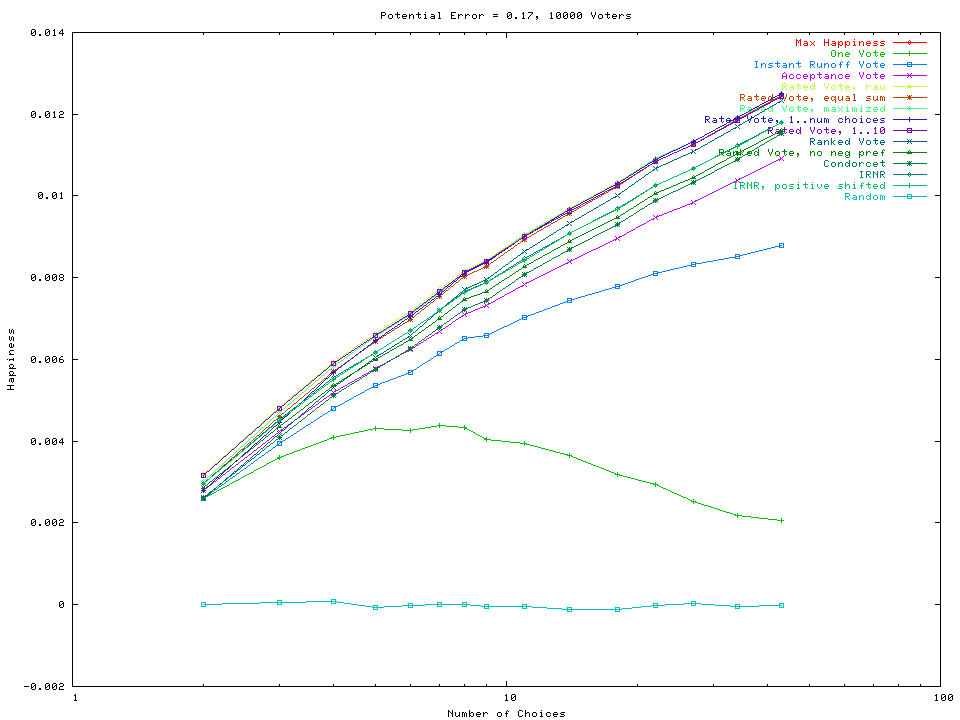
On this graph it's labeled "Rated Vote, equal sum":
http://bolson.org/voting/graph/v10000/e0_17.png
It doesn't stand out on the graph, but it's in with the cluster of
things at the top which are very near to maximizing social utility.
But, that's with simulations of voters casting honest ballots.
Does "honest" really mean honest? - no zero-info strategy? For example,
under Approval, might a voter approve (or disapprove) all candidates?
As Mike O is fond of saying: given honest ballots, straight CR is
perfect. So we take steps away from that in order to have a system that
is more "fair" or is harder or impossible to cheat. I have a mode in my
simulator that runs a few basic strategies against the election
methods, but I'm working on adding an AI/ALife system to learn the best
strategy against each election method. If the AI learns that honest
votes are most likely to get it what it wants, we win.
Brian Olson
http://bolson.org/
Have you tried modeling vote correlations based on voters' views on
political issues? (e.g., some voters may vote based on the candidates'
positions on just one or a couple issues, like gun control,
right-to-life, electoral reform, etc.) I got some (unpleasantly)
surprising results when I put this into my simulations.
Ken Johnson
----
Election-methods mailing list - see http://electorama.com/em for list info