Hi Robert, thanks for the reviews and details :-)
In short I suggest to add INFOPLUS, DOSZIP and DN to default install...

>>> Once I received (TASM) source code for
>>> <http://web.archive.org/web/20070608155633/http://user.rol.ru/%7Edxover/speedsys/>
>>> under "do whatever you want this it, but don't bug me".

Seems quite "benchmark oriented" (CPU, disk, RAM, PCI bus list etc.)

> <https://www.bttr-software.de/members/robert/tp770/> for an example.

>>> MSD is really nice for early hardware and easy to use.
>> Which features does it have which COMPINFO is lacking?
> 1) It doesn't barf on Windows XP. COMPINFO always gives me RTE 205.

Internet says this is a floating point error if Turbo Pascal?
Maybe trying to detect FPU in a way which upsets the protected
mode host? How well does it behave with various (J-) EMM386?

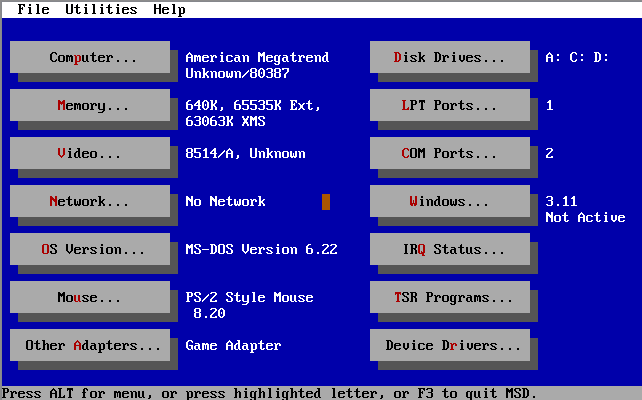
> 2) Here's a screenshot of the main window of MSD:
> https://winuxinfocenter.de/wp-content/uploads/2018/09/msd1.png

That lists: BIOS string, base/EMS/XMS size, VGA string, network,
kernel version, mouse version, joystick, drive letters, printer
and serial ports, Win 3.x, IRQ, TSR, drivers. As everything has
sub-menus, I guess it shows some BIOS-reported values, stats from
the memory drivers, strings and screen modes from VGA BIOS, some
unknown network details, mouse status details, stats about drive
letters, maybe status flags and settings for serial and printer
ports, which IRQ handler is in which area (BIOS, drivers etc.?)
and shows some nice TSR and driver overview with more status in
comparison to MEM output.

>>>> https://www.ibiblio.org/pub/micro/pc-stuff/freedos/files/util/system/compinfo/
>>> - FOSS (GNU GPL & GNU LGPL)
>>> - it's already there
>>> - no docs
>>> - C and Pascal versions avaiable
>>> - "unfree" toolchain (Turbo Pascal)

> I dunno. I also couldn't get it to work in MS Virtual PC. Same RTE 205.

See above, floating point or EMM386 issue maybe?

>>> Also "unfree" toolchain (TP+ASM):
>>> INFOPLUS by Andrew Rossmann, last updated in 1993, public domain
>>> https://ftp.sunet.se/mirror/archive/ftp.sunet.se/pub/simtelnet/msdos/sysinfo/ifp1p158.zip
>>> https://ftp.sunet.se/mirror/archive/ftp.sunet.se/pub/simtelnet/msdos/sysinfo/ifp1s158.zip
>>> (binary, sources)
> It's very complete for it's time and is very similar to MSD.
> But because of it's age, it doesn't show anything about PnP, PCI

Neither does MSD, so INFOPLUS sounds very good.
I guess it also is a lot better than COMPINFO.

> I prepared some screenshots: https://www.bttr-software.de/tmp/infoplus/

BIOS string, CPU ID, RAM ID, MEM, graphics ID, graphics modes,
keyboard and mouse, parallel and serial ports, sound, DOS info,
"multiplex programs", environment variables, device drivers,
DOS and BIOS drive info, partition table, boot drive info, CMOS
info, TSR and drivers, "alternate multiplex", memory managers.

That sounds as if it is significantly better than MSD itself :-)

>> DOSZIP sounds like something to agree upon?
> Yes. It's small, fast, FLOSS.

Nice!

>> DOS Navigator, open source variant: Pros/Cons versus DOSZIP?

Pro: Editor, text screen grabber, calculator, calendar,
ASCII table, phone book, small spreadsheet, CD player,
flexible terminal, "navigator link", Tetris...

Very nice. I guess we could include both DOSZIP and DN OSP :-)

>> https://www.ibiblio.org/pub/micro/pc-stuff/freedos/files/util/disk/
>>
>> has Ranish, XFDISK, SPFDISK and FDISK, even FIPS and file managers,
>> apparently incl. DOS Navigator (1.51, 2.14, no NDN any more?) while
>> https://www.ibiblio.org/pub/micro/pc-stuff/freedos/files/util/file/
>> is where file managers should be and DOSZIP actually is, alone, now?

Cheers, Eric


_______________________________________________
Freedos-user mailing list
[email protected]
https://lists.sourceforge.net/lists/listinfo/freedos-user