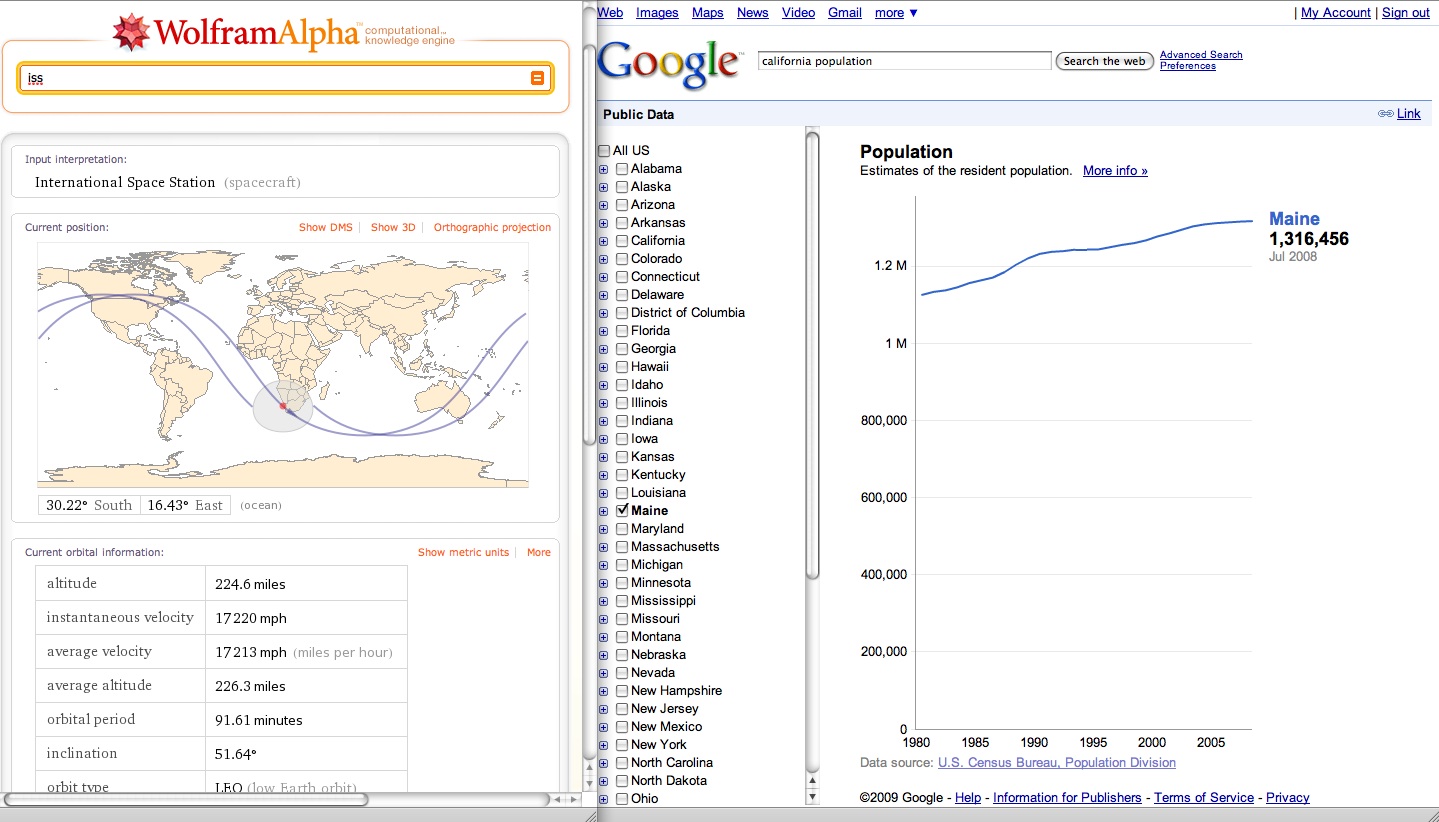
Whether Wolfram Alpa ends up being vaporware or real it is at least driving
innovation.  Fun to see the back and forth with Google and great to see what a
central role geography plays in most all the use cases:
http://www.techcrunch.com/wp-content/uploads/2009/04/alphagoogle_cropped.jpg

As many have stated the crux seems to be in making it scale without the need
for curated datasets and canned methodologies.  We've played around with
several approaches for trying to generate intelligence and context around the
data we collect in GeoCommons.  The sticky wicket for us is always getting it
to scale in a way that produces quality results.  The part that makes me most
dubious with Wolfram is that from what I've read the curation of data is done
by their internal staff and the results to date have been from a pretty large
scale effort.  Just seems it would be impossible to keep pace with a closed
system of curation.  I think it is a good case for crowdsourcing with
filtering/curation similar to what Andrew describes here (albeit with more
built in intelligence):

http://highearthorbit.com/swiftriver-and-crowd-curating-the-crowd-source/

However it turns out geography will play a big role and should give us all
plenty of opportunities for wankingly esoteric thoughts :-)

best,
sean


FortiusOne Inc,
2200 Wilson Blvd. suite 307
Arlington, VA 22201
cell - 202-321-3914

----- Original Message -----
From: "Joshua Lieberman" <[email protected]>
To: "Ed Parsons" <[email protected]>
Cc: [email protected]
Sent: Monday, May 4, 2009 12:25:16 PM GMT -05:00 US/Canada Eastern
Subject: Re: [Geowanking] Web 3.0 may be here

There is a more fundamental disconnect where Semantic is joined to
Web, that of intention. Most Web content is self-organized because it
is intended for a human viewer. The common target of data on the Web
is still completely unclear (except for Google Earth, of course). This
leaves the Semantic Web in a glass-like state: areas of short-range
order which demo well, but do not scale to longer range.

Josh

On May 4, 2009, at 11:44 AM, Ed Parsons wrote:

> The general scepticism here I think is well placed, semantic based
> systems always demo well, the key to more widespread adoption is the
> automation of the still largely manual creation of ontological
> relationships. But one day I'm sure this will work, after-all TBL is
> usually right.
>
> ed
>
> On 4 May 2009, at 06:59, R E Sieber wrote:
>
>> Because I do geospatial ontologies, I'm skeptical of anything that
>> attempts to automate semantics. However, ontologies are incredibly
>> top-heavy in design. Anything that could marshall user generated
>> content in the structuring of semantics, even if it's mostly
>> vaporware, could represent an advance.
>>
>> I also do some cyberinfrastructure stuff and ain't nothing that's
>> going to reach into private databases, particularly spatial ones,
>> without tons of standardization, web services that sit on top of
>> each, schema, etc. Still if they had something better than
>> something like D2R, I'd be very happy.
>>
>> Renee
>>
>> Andrew Johnson wrote:
>>> We'll see if this ends up being another Cuil, or another useful
>>> tool. Either way, it's certainly not going to live up to the hype
>>> or have very far-reaching effects.
>>>
>>> There's nothing new about curating a big set of data and wrapping
>>> a nice GUI around it, not even if you write the whole thing in
>>> Mathematica. The talking heads are going bonkers over it, but the
>>> tech community, the actual programmers and engineers, is a mix of
>>> wait-and-see, and outright scorn.
>>>
>>> How could a piece of vaporware called a Knowledge Computation
>>> Engine really do anything besides hiss and steam?
>>>
>>> Andrew
>>>
>>>
>>>
>>> On Sun, May 3, 2009 at 9:17 PM, R E Sieber <[email protected]
>>> <mailto:[email protected]
>>> >> wrote:
>>>
>>>   Holy @#%$^! I want the API - Renee
>>>
>>>   (Note how much of this is about semantic searches of geography.)
>>>
>>>   May 3, 2009
>>>
>>> http://www.independent.co.uk/life-style/gadgets-and-tech/news/an-invention-that-could-change-the-internet-for-ever-1678109.html
>>>
>>>   An invention that could change the internet for ever
>>>   Revolutionary new web software could put giants such as Google in
>>>   the shade when it comes out later this month. Andrew Johnson
>>> reports
>>>
>>>   The biggest internet revolution for a generation will be unveiled
>>>   this month with the launch of software that will understand
>>>   questions and give specific, tailored answers in a way that the
>>>   web has never managed before.
>>>
>>>   The new system, Wolfram Alpha, showcased at Harvard University in
>>>   the US last week, takes the first step towards what many consider
>>>   to be the internet's Holy Grail – a global store of information
>>>   that understands and responds to ordinary language in the same way
>>>   a person does.
>>>
>>>   Although the system is still new, it has already produced massive
>>>   interest and excitement among technology pundits and internet
>>>   watchers.
>>>
>>>   Computer experts believe the new search engine will be an
>>>   evolutionary leap in the development of the internet. Nova
>>>   Spivack, an internet and computer expert, said that Wolfram Alpha
>>>   could prove just as important as Google. "It is really impressive
>>>   and significant," he wrote. "In fact it may be as important for
>>>   the web (and the world) as Google, but for a different purpose.
>>>
>>>   Tom Simpson, of the blog Convergenceofeverything.com, said: "What
>>>   are the wider implications exactly? A new paradigm for using
>>>   computers and the web? Probably. Emerging artificial intelligence
>>>   and a step towards a self-organising internet? Possibly... I think
>>>   this could be big."
>>>
>>>   Wolfram Alpha will not only give a straight answer to questions
>>>   such as "how high is Mount Everest?", but it will also produce a
>>>   neat page of related information – all properly sourced – such as
>>>   geographical location and nearby towns, and other mountains,
>>>   complete with graphs and charts.
>>>
>>>   The real innovation, however, is in its ability to work things out
>>>   "on the fly", according to its British inventor, Dr Stephen
>>>   Wolfram. If you ask it to compare the height of Mount Everest to
>>>   the length of the Golden Gate Bridge, it will tell you. Or ask
>>>   what the weather was like in London on the day John F Kennedy was
>>>   assassinated, it will cross-check and provide the answer. Ask it
>>>   about D sharp major, it will play the scale. Type in "10 flips for
>>>   four heads" and it will guess that you need to know the
>>>   probability of coin-tossing. If you want to know when the next
>>>   solar eclipse over Chicago is, or the exact current location of
>>>   the International Space Station, it can work it out.
>>>
>>>   Dr Wolfram, an award-winning physicist who is based in America,
>>>   added that the information is "curated", meaning it is assessed
>>>   first by experts. This means that the weaknesses of sites such as
>>>   Wikipedia, where doubts are cast on the information because anyone
>>>   can contribute, are taken out. It is based on his best-selling
>>>   Mathematica software, a standard tool for scientists, engineers
>>>   and academics for crunching complex maths.
>>>
>>>   "I've wanted to make the knowledge we've accumulated in our
>>>   civilisation computable," he said last week. "I was not sure it
>>>   was possible. I'm a little surprised it worked out so well."
>>>
>>>   Dr Wolfram, 49, who was educated at Eton and had completed his PhD
>>>   in particle physics by the time he was 20, added that the launch
>>>   of Wolfram Alpha later this month would be just the beginning of
>>>   the project.
>>>
>>>   "It will understand what you are talking about," he said. "We are
>>>   just at the beginning. I think we've got a reasonable start on 90
>>>   per cent of the shelves in a typical reference library."
>>>
>>>   The engine, which will be free to use, works by drawing on the
>>>   knowledge on the internet, as well as private databases. Dr
>>>   Wolfram said he expected that about 1,000 people would be needed
>>>   to keep its databases updated with the latest discoveries and
>>>   information.
>>>
>>>   He also added that he would not go down the road of storing
>>>   information on ordinary people, although he was aware that others
>>>   might use the technology to do so.
>>>
>>>   Wolfram Alpha has been designed with professionals and academics
>>>   in mind, so its grasp of popular culture is, at the moment,
>>>   comparatively poor. The term "50 Cent" caused "absolute horror" in
>>>   tests, for example, because it confused a discussion on currency
>>>   with the American rap artist. For this reason alone it is unlikely
>>>   to provide an immediate threat to Google, which is working on a
>>>   similar type of search engine, a version of which it launched last
>>>   week.
>>>
>>>   "We have a certain amount of popular culture information," Dr
>>>   Wolfram said. "In some senses popular culture information is much
>>>   more shallowly computable, so we can find out who's related to who
>>>   and how tall people are. I fully expect we will have lots of
>>>   popular culture information. There are linguistic horrors because
>>>   if you put in books and music a lot of the names clash with other
>>>   concepts."
>>>
>>>   He added that to help with that Wolfram Alpha would be using
>>>   Wikipedia's popularity index to decide what users were likely to
>>>   be interested in.
>>>
>>>   With Google now one of the world's top brands, worth $100bn,
>>>   Wolfram Alpha has the potential to become one of the biggest names
>>>   on the planet.
>>>
>>>   Dr Wolfram, however, did not rule out working with Google in the
>>>   future, as well as Wikipedia. "We're working to partner with all
>>>   possible organisations that make sense," he said. "Search,
>>>   narrative, news are complementary to what we have. Hopefully there
>>>   will be some great synergies."
>>>
>>>   What the experts say
>>>
>>>   "For those of us tired of hundreds of pages of results that do not
>>>   really have a lot to do with what we are trying to find out,
>>>   Wolfram Alpha may be what we have been waiting for."
>>>
>>>   Michael W Jones, Tech.blorge.com <http://Tech.blorge.com>
>>>
>>>   "If it is not gobbled up by one of the industry superpowers, his
>>>   company may well grow to become one of them in a small number of
>>>   years, with most of us setting our default browser to be Wolfram
>>>   Alpha."
>>>
>>>   Doug Lenat, Semanticuniverse.com
>>>
>>>   "It's like plugging into an electric brain."
>>>
>>>   Matt Marshall, Venturebeat.com
>>>
>>>   "This is like a Holy Grail... the ability to look inside data
>>>   sources that can't easily be crawled and provide answers from
>>> them."
>>>
>>>   Danny Sullivan, editor-in-chief of searchengineland.com
>>>   <http://searchengineland.com>
>>>
>>>   _______________________________________________
>>>   Geowanking mailing list
>>>   [email protected] <mailto:[email protected]>
>>>   http://geowanking.org/mailman/listinfo/geowanking_geowanking.org
>>>
>>>
>>
>>
>> _______________________________________________
>> Geowanking mailing list
>> [email protected]
>> http://geowanking.org/mailman/listinfo/geowanking_geowanking.org
>
>
>
>
>
> _______________________________________________
> Geowanking mailing list
> [email protected]
> http://geowanking.org/mailman/listinfo/geowanking_geowanking.org


_______________________________________________
Geowanking mailing list
[email protected]
http://geowanking.org/mailman/listinfo/geowanking_geowanking.org

_______________________________________________
Geowanking mailing list
[email protected]
http://geowanking.org/mailman/listinfo/geowanking_geowanking.org